
Simultaneously, rotor noise must remain tolerable to nearby neighbors, snagged tethers must sever cleanly upon overload, and returning airframes must swap batteries and cargo cassettes in seconds at the dispatch pad. Balancing that unforgiving trade-off between forward-flight efficiency, terminal release safety, and rapid ground turnaround defines purpose-built last-mile delivery hardware.
What Is a Delivery Drone?
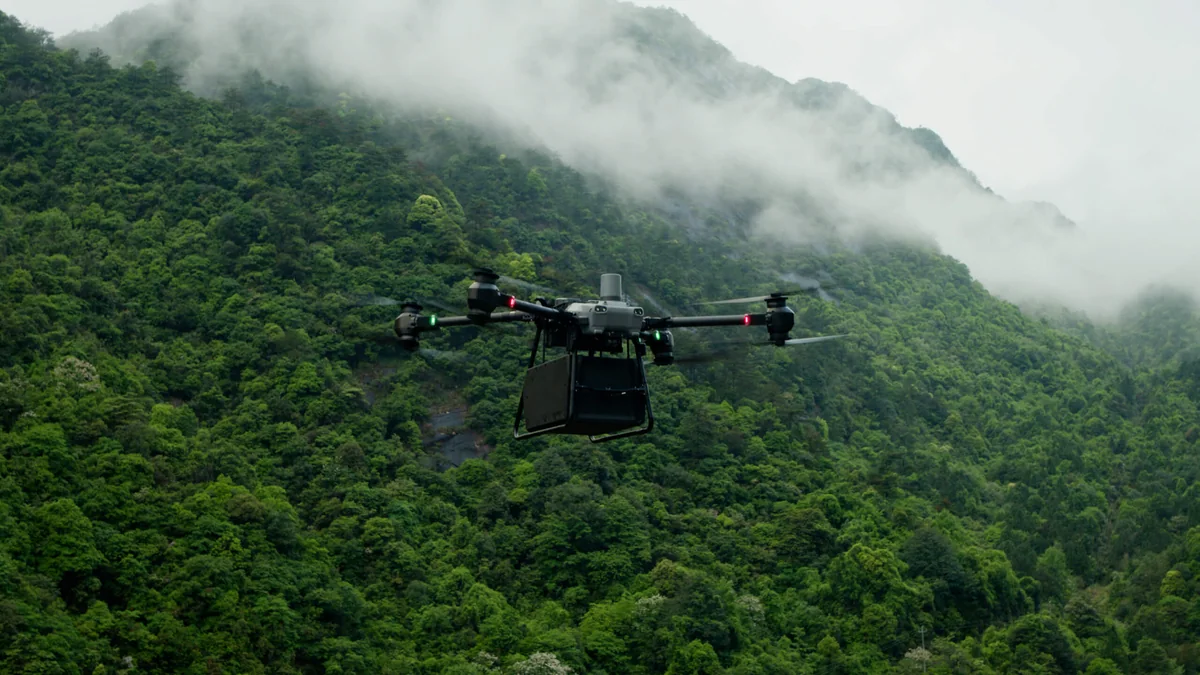
A delivery drone is an integrated unmanned aerial vehicle (UAV) hardware system engineered to transport lightweight parcels, prepared meals, medical supplies, and urgent small parts directly from dispatch nodes to end recipients over congested ground corridors. Unlike manually piloted multirotors flown one-to-one within visual line of sight, commercial last-mile delivery drones operate as coupled cyber-physical systems. They combine a dedicated airframe, an automated terminal release mechanism, ground turnaround hardware, and centralized remote supervision interfaces that allow a single operator to monitor multiple autonomous aircraft across pre-mapped routes simultaneously.
From a terminal-engineering perspective, what defines a delivery drone is deterministic physical interaction in unstructured human environments. Each flight must safely transition from cruise into populated airspace, confirm ground clearance without trained receiving staff, execute a repeatable handoff, and return for rapid energy replenishment. Achieving dependable door-to-door performance therefore places equal emphasis on propulsion acoustics, payload-bay mechanics, downward hazard sensing, and automated turnaround ergonomics.
Airframe Designs Optimized for Urban and Suburban Delivery
Delivery drone airframes are classified orthogonally by aerodynamic lift architecture and close-proximity human safety. Multi-rotor platforms utilizing hexacopter or octocopter motor layouts dominate tight urban sites and tree-lined residential yards. Their symmetric thrust vectors deliver precise hover hold in turbulent building wakes and maintain controlled descent authority after a single motor or speed-controller failure, though high induced-power losses restrict forward-flight range to dense metropolitan radii.
To reach suburban neighborhoods, inter-hospital routes, and cross-water corridors spanning tens of kilometers, manufacturers rely on hybrid vertical takeoff and landing (VTOL) airframes—including tilt-rotor, lift-plus-cruise, and blended-wing-body designs. Fixed wings unload the hover rotors during cruise to cut energy draw per kilometer while preserving vertical departure and arrival on compact retail pads. Catapult-launched fixed-wing airframes remain effective where non-stopping air-drop missions eliminate hover phases altogether.
Across every configuration, residential deployment hinges on proximity-safety hardware and psychoacoustic engineering. Shrouded or ducted rotors, perimeter prop guards, and frangible fuselage structures reduce injury risk during accidental foliage or bystander contact. Equally critical is acoustic shaping: communities react far more negatively to narrowband tonal whine than to broadband airflow sound at equivalent decibel levels. Engineers therefore combine lower rotor tip speeds, swept or serrated blade tips, higher blade counts, and unequal blade spacing to push acoustic energy downward in frequency and disperse harsh blade-pass harmonics into a softer, less intrusive signature.
Payload Bays and Last-Meter Delivery Mechanisms
The defining mechanical differentiator among delivery drones is how the aircraft bridges the final vertical meters to the recipient. Three commercial transfer architectures dominate the sector, trading off obstacle tolerance, wind sensitivity, ground infrastructure, and cargo protection.
| Transfer Architecture | Obstacle Tolerance | Wind Susceptibility | Ground Infrastructure | Speed & Fragile Handling | Recipient Experience |
|---|---|---|---|---|---|
| Hover-and-Winch Tether | High; aircraft stays above trees and utility lines | Moderate–high; requires pendulum damping in gusts | None; flat yard or driveway suffices | Moderate cycle; soft touchdown protects fragile goods | Direct doorstep or yard pickup |
| Touchdown Pad & Smart Locker | Low; needs clear vertical descent column | Minimal; aircraft lands before opening bay | High; dedicated pad or powered locker kiosk | Fast turnaround; best for heavy or liquid loads | Walk to shared kiosk; enclosed custody |
| Parachute & Soft-Drop | Moderate; needs open field for wind drift | High; relies on real-time wind compensation | Minimal; designated rural lawn or clearing | Fastest aircraft cadence; limited shock isolation | Outdoor retrieval; unsuited for fragile items |
Hover-and-Winch Tether Systems
Hover-and-winch mechanisms lead direct-to-yard residential delivery by keeping spinning rotors safely above pedestrians, fences, tree canopies, and utility wires. Holding a stabilized hover at standoff altitude, the aircraft lowers a slender aramid tether via a precision brushless winch carrying either a passive tension-sensing hook or an active, sensor-equipped delivery droid that uses small thrusters or inertial damping to counter gust-induced sway. Once the parcel rests on the ground, instantaneous line-tension drop triggers automatic decoupling and smooth retraction. Airworthy winch systems also integrate an emergency tether cut-away—actuated by load spikes or sustained snagging on tree limbs, clotheslines, or pets—that cleanly severs the line so a fouled tether can never pull the aircraft down onto bystanders.
Touchdown Release Bays and Smart Delivery Lockers
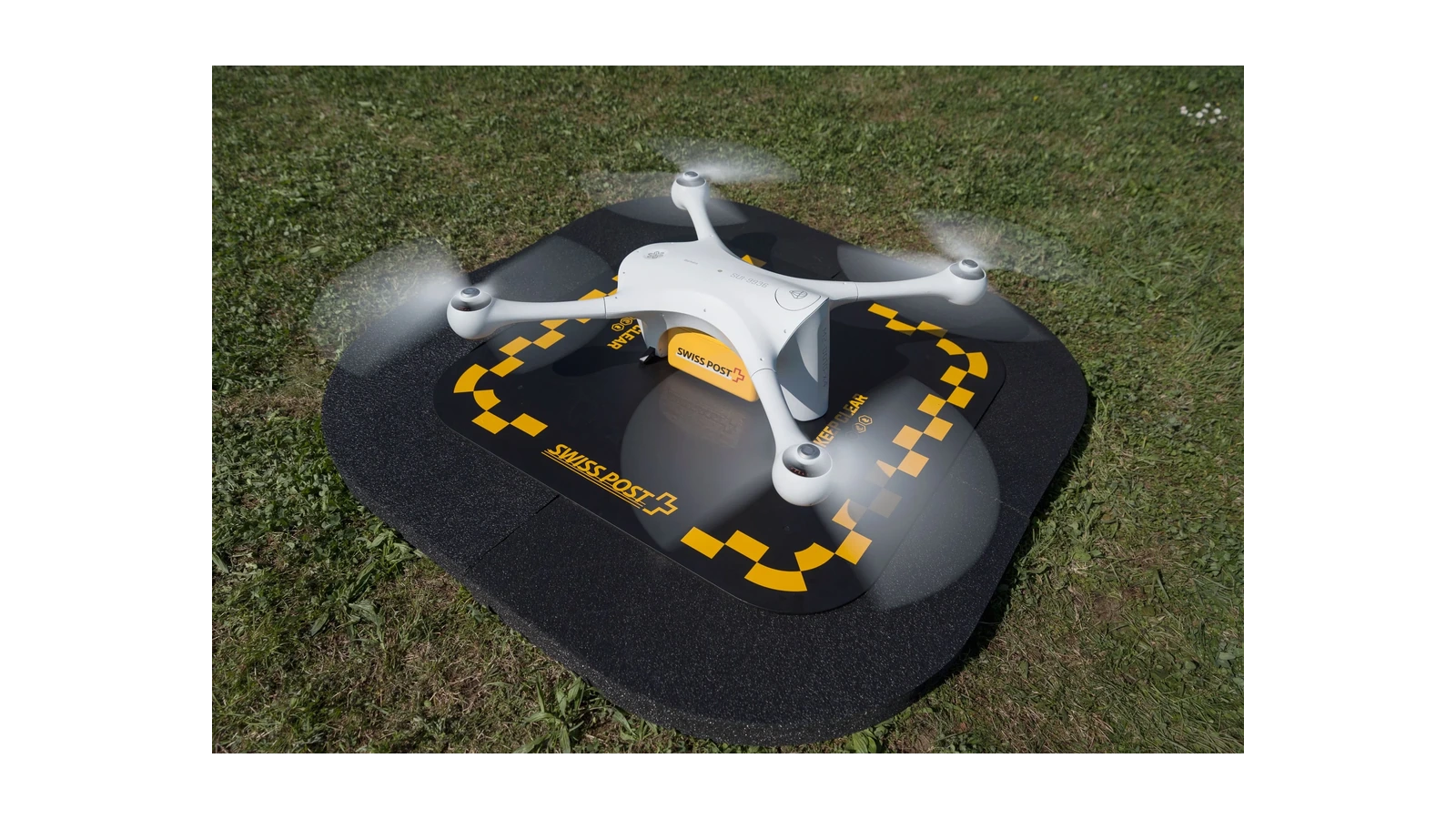
Touchdown designs eliminate tether dynamics by landing firmly before opening a belly bay or ventral latch. Across dense apartment districts, retail plazas, and hospital campuses, touchdown aircraft interface directly with automated drone delivery lockers and kiosks—integral terminal hardware designed to complete enclosed last-meter handoff. Guided by optical fiducials or ultra-wideband beacons, the aircraft lands atop the kiosk's elevated deck, cuts rotor power, and triggers an actuated roof hatch that drops the parcel into a climate-buffered internal compartment. Recipients then retrieve orders using an authentication code, eliminating wind sway, weather exposure, and curb theft where private yards do not exist.
Parachute and Soft-Drop Capsules for Unimproved Sites
Where fixed-wing range takes priority over hover flexibility—particularly across dispersed rural clinics and unimproved outposts—aircraft perform precision low-altitude air-drops without slowing to a hover. Approaching along a calculated glide path, flight computers fuse real-time wind-aloft estimates and groundspeed to release a crush-buffered parcel attached to a lightweight, biodegradable or recoverable deceleration parachute. Continuous forward flight minimizes energy consumption per drop and maximizes sortie cadence, though impact deceleration limits cargo to shock-tolerant medical packs and durable goods.
Insulated Cold-Chain Compartments and Pre-Flight Weight and Center-of-Gravity Checks
Internal payload bays must protect cargo integrity and aerodynamic trim across diverse goods. Medical delivery drones employ vacuum-insulated liners and phase-change materials to hold refrigerated or ambient bands for vaccines and blood products without draining flight batteries. Clinical compartments are engineered around regulatory triple-packaging standards—such as UN 3373 Biological Substance, Category B containment—combining leakproof primary vessels, absorbent liners, and impact-resistant secondary shells. Food-delivery bays add baffled dividers and damped cradles to prevent liquid spillage during pitch maneuvers. Before launch, automated load cells in landing-gear struts or ground loading jigs verify total payload mass and center-of-gravity alignment, locking out takeoff if store staff mispack or overload a cassette.
Navigation, Drop-Zone Safety Sensing, and Ground Dock Infrastructure
Safe urban fulfillment demands terminal perception far beyond Global Navigation Satellite System (GNSS) positioning. While multi-constellation GNSS fused with inertial measurement units guides en-route cruise, urban canyons and tree canopies create multipath distortion and transient hazards. Delivery drones therefore pair precision approach cues with downward stereo machine vision, infrared imagers, and solid-state LiDAR. Throughout descent or winch payout, onboard processors continuously verify an unobstructed drop cone; if a pedestrian, pet, or vehicle enters the zone, the aircraft automatically pauses payout, loiters aloft, shifts to an alternate cleared spot, or aborts and returns to base.
Layered airborne safety hardware protects surrounding airspace and overflown neighborhoods. Commercial platforms use dual-network redundant command-and-control links—pairing multi-carrier cellular telemetry with backup satellite or dedicated radio channels—so remote supervisors retain health telemetry and override authority despite localized congestion. Onboard detect-and-avoid architectures combine cooperative transponders with non-cooperative acoustic, optical, or radar sensors to maintain separation from low-flying crewed aircraft. As a final mitigation over populated corridors, independent flight-termination modules and ballistic parachute recovery systems cut rotor power and limit kinetic impact energy during unrecoverable faults.
At the dispatch hub, ground turnaround hardware sets practical sortie cadence. Storefront launch pads and containerized micro-depots support two main energy workflows: fully automated robotic docks that extract depleted batteries and insert charged packs via alignment rails, or ergonomic manual quick-swap bays where retail staff slide keyed battery cartridges and pre-loaded parcel cassettes into the airframe in under a minute. Integrated weather sensors, automated pre-flight self-diagnostics, and sealed charging cabinets enable compact rooftop or parking-lot stations to sustain continuous high-frequency dispatch.
Common Usage Examples
Last-Mile Retail, E-Commerce, and On-Demand Food
Retail and food delivery focuses on lightweight parcels—typically several hundred grams to a few kilograms—flown on high-frequency, short-radius hops from neighborhood hubs, grocers, and restaurants. Hardware design prioritizes minute-scale ground turnaround, hot-swappable battery cartridges, spill-resistant thermal caddies, and low-frequency acoustic shaping to prevent community complaints during peak mealtime surges. Because flight paths cross private rooftops and backyards, commercial platforms also enforce hardware-level transit privacy, running downward navigation optics through non-recording edge pipelines or applying shuttering and geographic masking outside approved drop zones.
Healthcare, Blood Products, Lab Specimens, and Defibrillators
Medical logistics imposes strict thermal traceability and schedule determinism across two main mission profiles. High-cadence inter-hospital shuttle loops move pathology slides, biopsies, and UN 3373 diagnostic blood specimens between clinics and central labs, requiring sealed, shock-buffered payload bays with continuous temperature logging. Conversely, emergency deployments dispatch blood components and automated external defibrillators (AEDs) directly to rural residences or cardiac-arrest scenes ahead of ground ambulances, favoring rapid-launch hybrid VTOL aircraft with high-visibility beacons, winch lowering onto uneven terrain, and ruggedized cold-chain canisters validated against summer thermal spikes.
Remote Communities, Shore-to-Ship, and Urgent Industrial Resupply
Specialized delivery drones also overcome severe geographic friction across maritime, island, and industrial environments. Shore-to-ship platforms deliver customs paperwork, fresh provisions, and critical mechanical spares from port pads to anchored merchant vessels, demanding salt-spray sealing, strong gust rejection, and dynamic deck-tracking sensors for pitching superstructures. Long-range hybrid aircraft similarly supply isolated islands and mountain settlements with prescription medicines when ferries or roads close, while large manufacturing complexes and refineries deploy intra-site delivery drones to rush calibrated tooling, sensors, and lab samples between distant workshops.
Synonyms, Related Terms, and Category Boundaries
Across aerospace procurement and technical literature, delivery drones are also termed autonomous delivery drones, parcel delivery UAVs, or UAV parcel delivery systems. While those phrases interchangeably describe the integrated aircraft, release mechanisms, and ground turnaround hardware, two adjacent terms designate separate operational and vehicle categories that require clear distinction.
First, "drone delivery" generally refers to commercial drone delivery services rather than aircraft hardware alone. Whereas delivery drone engineering covers airframe aerodynamics, winch cut-away safety, downward clearance sensing, battery-swap docks, and airworthiness hardware, commercial service operations address airline-style network management—including retail platform integration, fleet dispatching, hub siting, pricing, and per-parcel unit economics. Second, "cargo drone" designates medium-to-heavy middle-mile freighters engineered to haul palletized or consolidated bulk loads between regional warehouses, airfields, and distribution hubs. Unlike heavy cargo drones requiring airfield ground-support equipment and unloading crews, delivery drones are purpose-built for lightweight, high-cadence last-mile parcel transfer directly to end recipients, smart lockers, clinics, or ship decks.