
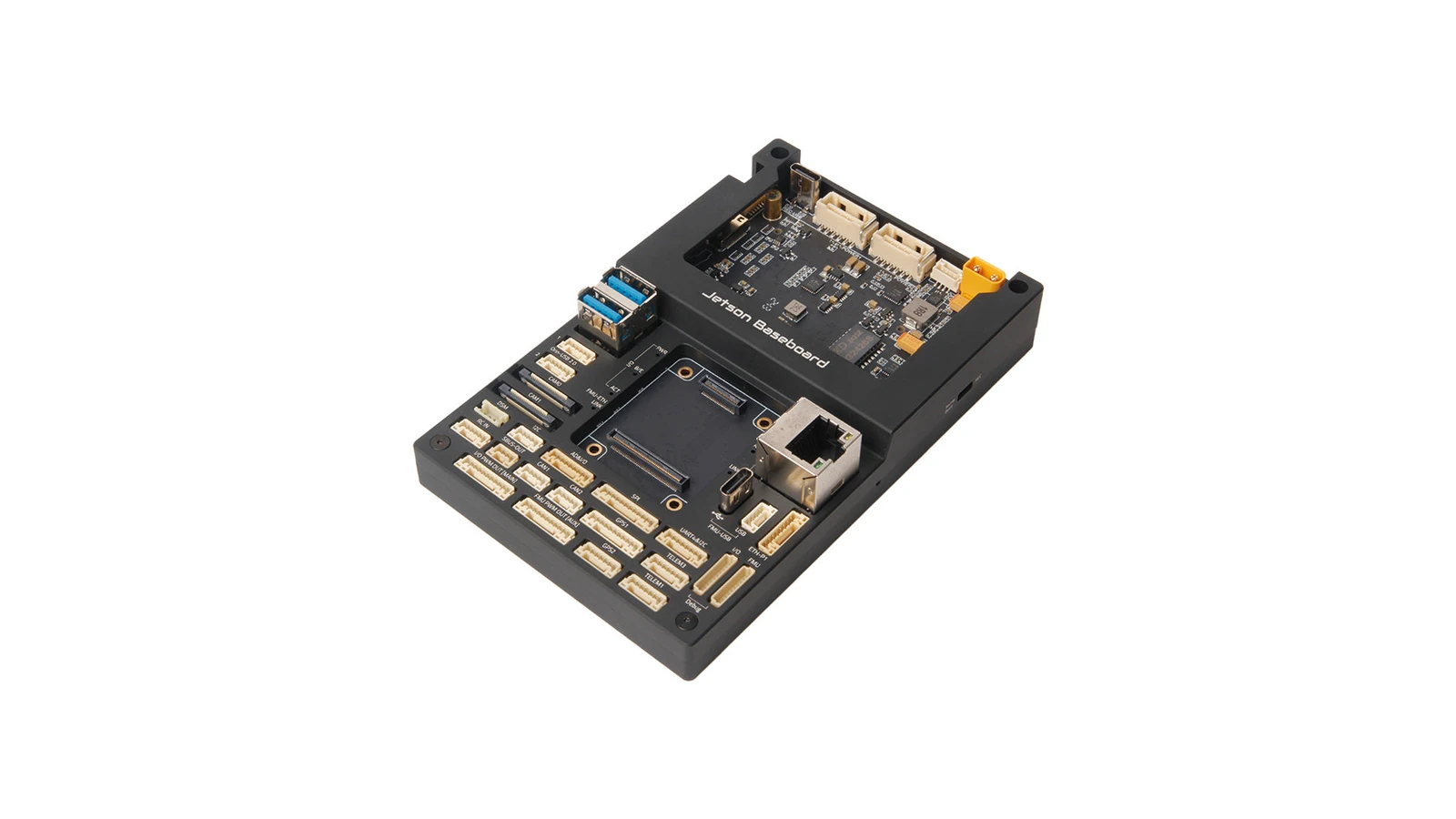
Sustaining that payload convergence under flight loads requires stripping Ethernet infrastructure down to its core electronics. Autonomous air, ground, and marine platforms demand gram-scale, vibration-hardened onboard switching that enforces VLAN traffic isolation, IEEE 1588 sub-microsecond timing, and MIL-STD EMI qualification inside sealed avionics bays.
What Is an Embedded Ethernet Switch?
An embedded Ethernet switch is a compact, board-level or module-level packet-switching subsystem designed for direct integration inside an unmanned vehicle, sensor pod, or rugged enclosure. Rather than occupying space as a standalone boxed unit with its own housing and power supply, an embedded switch mounts onto a host carrier board or avionics frame, forwarding Ethernet frames across internal subsystems via Media Access Control (MAC) address tables at Layer 2 or routing packets across subnets at Layer 3. By collapsing switching directly into the internal electronics stack, it forms the high-speed wired backbone uniting payloads, mission computers, and communications equipment.
Multi-sensor unmanned systems quickly outgrew point-to-point serial wiring as onboard data rates escalated. While flight controllers retain deterministic fieldbuses such as CAN and PWM for real-time actuator and motor control, and wireless datalinks handle air-to-ground radio transmission, internal traffic connecting high-definition electro-optical and infrared (EO/IR) gimbals, 3D LiDAR scanners, synthetic aperture radar (SAR), companion GPU computers, and wideband IP radios easily overwhelms UART, CAN, and USB harnesses. Point-to-point wiring also compounds harness mass, connector bulk, and integration complexity. An onboard embedded Ethernet backbone resolves these bottlenecks by unifying heterogeneous payload traffic onto a scalable, packet-switched architecture.
Switching Capabilities: Unmanaged vs. Managed, TSN, and PoE
Selecting an embedded switch for unmanned avionics requires matching switching intelligence, timing determinism, and power delivery to mission requirements.
Unmanaged Plug-and-Play Boards vs. Managed Layer 2 / Layer 3 Switches
Unmanaged embedded switch boards operate with zero configuration, automatically learning MAC addresses and forwarding frames across ports. They fit ultra-lightweight small UAVs or simple sensor hubs carrying modest traffic where deterministic traffic shaping is unnecessary. Once safety-critical command-and-control (C2) telemetry shares a physical fabric with bursty HD EO/IR video or dense LiDAR streams, however, unmanaged hardware creates unacceptable risk because microbursts can trigger buffer congestion, latency spikes, or dropped control packets.
Managed Layer 2 and Layer 3 embedded switches prevent these failure modes through hardware-enforced traffic engineering. Virtual Local Area Networks (VLANs) logically isolate mission-critical C2 and avionics telemetry from high-bitrate payload video over shared copper or fiber links. Quality of Service (QoS) hardware queues prioritize flight telemetry and radar alerts ahead of bulk video, while Internet Group Management Protocol (IGMP) snooping constrains multicast video feeds strictly to subscribed endpoints—such as onboard recorders or IP radios—eliminating unnecessary port flooding. Managed boards also enable ring redundancy protocols for millisecond failover, and Layer 3 models add wire-speed inter-VLAN routing for segmented multi-subnet avionics.
| Capability | Unmanaged Board | Managed Layer 2 | Managed Layer 3 |
|---|---|---|---|
| Traffic Isolation | None (flat domain) | IEEE 802.1Q VLANs | VLANs plus inter-VLAN routing |
| Priority Queuing | Fixed or none | Strict priority QoS | Advanced DSCP/CoS policies |
| Multicast Control | Floods all ports | IGMP snooping | IGMP snooping and multicast routing |
| Timing and Failover | Basic forwarding | IEEE 1588 PTP, TSN, rings | Full PTP/TSN, dynamic routing |
| Primary Role | Small UAVs, simple hubs | ISR UAVs, UGVs, docks | Large autonomous defense platforms |
Precision Time Protocol (IEEE 1588 PTP) and Time-Sensitive Networking (TSN)
Hardware-assisted timing separates aerospace-grade managed switch modules from commodity boards. Autonomous perception, aerial mapping, and target geolocation require data from LiDAR, multi-spectral cameras, SAR, and inertial navigation systems (INS) to share a single precise timebase; even millisecond clock drift distorts 3D point clouds and degrades sensor fusion at flight speeds. Switches supporting IEEE 1588 Precision Time Protocol (PTPv2) implement hardware timestamping directly in switch silicon, accounting for internal residence time to bypass operating-system jitter and deliver sub-microsecond synchronization across every sensor port.
Extending this clock discipline, Time-Sensitive Networking (TSN) turns Ethernet into a deterministic avionics fabric. Capabilities such as time-aware traffic shaping and frame preemption reserve bounded-latency windows for real-time autonomy and control loops, ensuring oversized sensor frames cannot stall critical telemetry under heavy link load.
Onboard Power over Ethernet (PoE / PoE+) Trade-Offs
Some embedded switch modules integrate Power Sourcing Equipment (PSE) stages compliant with IEEE 802.3af (PoE, up to 15.4 W per port) or IEEE 802.3at (PoE+, up to 30 W per port). Combining power and gigabit data over one twisted-pair cable streamlines integration for external IP cameras, mast-mounted sensors, and compact edge nodes by eliminating separate power harnesses and bulkhead feedthroughs.
On unmanned platforms, however, onboard PoE entails concrete engineering trade-offs. Because UAV and UGV avionics rails typically run at 12 V to 28 V DC while PoE mandates 48 V to 57 V DC, the switch requires isolated wide-input DC-DC boost converters. Voltage step-up introduces efficiency losses, adds inductor mass, and concentrates heat inside sealed, fanless enclosures—making PoE most attractive when cabling savings outweigh localized thermal penalties.
Form Factors and Rugged Mechanical and Electrical Design
Embedded Ethernet switches span an orthogonal range of form factors, link media, and ruggedization tiers. At the smallest footprint, stamp-hole System-on-Module (SOM) and mezzanine cards—including COM, Mini-PCIe, and M.2 formats—mount directly onto custom carrier PCBs, providing multi-port switching within a few square centimeters. Mid-sized platforms widely adopt rugged board standards such as PC/104, VPX, and OpenVPX, alongside custom ultra-lightweight UAV bare boards, whereas exposed airframe bays transition to rugged boxed enclosures using sealed circular bulkheads. Port speeds scale from 100 Mbps and 1GbE for telemetry and standard sensors to 2.5GbE and 10GbE copper or optical fiber trunks feeding uncompressed video, high-density LiDAR, and companion GPUs. An emerging aerospace and robotics trend borrows automotive Single-Pair Ethernet (SPE)—100BASE-T1 and 1000BASE-T1—reducing twisted-pair cabling from four pairs to a single copper pair to trim harness mass across wingspans and articulated booms.
Mechanical and electrical hardening distinguishes flight-grade switches from commercial boards. Plastic-latch commercial RJ45 connectors frequently suffer micro-intermittencies or unlatch under sustained rotorcraft and propulsion vibration. Rugged embedded switches therefore eliminate RJ45 jacks in favor of positive-locking micro-pitch wire-to-board headers—such as PicoBlade or Micro-Lock styles—or break out differential pairs to M12 circular interconnects and MIL-DTL-38999 bulkhead pigtails. Environmental survivability is equally decisive: unlike commercial boards rated for 0°C to +70°C, rugged embedded switches typically support -40°C to +85°C extended temperatures, fanless conduction cooling clamped directly to chassis frames, and conformal coating against moisture, dust, and salt fog. Defense and aerospace programs qualify these assemblies against MIL-STD-810 for shock, vibration, and thermal cycling, MIL-STD-461 for electromagnetic interference and compatibility (EMI/EMC), and RTCA DO-160 environmental standards.
Key System Engineering Benefits
Integrating a purpose-engineered embedded Ethernet switch delivers compounding advantages across airframe packaging, payload modularity, and program economics.
Extreme Space, Weight, and Power (SWaP) Savings
Stripping away machined aluminum housings, external adapters, and duplicate power-conditioning stages shrinks multi-port switching nodes to tens of grams—or single-digit grams for mezzanine modules—within single-digit watt budgets. Weight saved in internal networking translates directly into longer endurance, larger batteries, or heavier mission payloads.
Cleaner Harness Routing and Modular Payload Swap-Out
Replacing tangled point-to-point serial and USB bundles with a structured Ethernet backbone simplifies wire routing and improves electromagnetic cleanliness. Because standardized IP interfaces decouple payloads from low-level host bus wiring, teams can swap an EO/IR turret for a LiDAR or hyperspectral pod without redesigning the flight-control carrier board.
Faster Time to Market: Pre-Validated Module vs. Chip-Down Custom PCB
For unmanned OEMs building hundreds to several thousand vehicles annually, a pre-validated embedded switch module outperforms chip-down custom motherboard design on both schedule and total cost. Integrating raw switch silicon demands controlled-impedance differential routing, magnetics layout, PHY tuning, ongoing switch firmware support, and iterative EMI/EMC testing. Adopting a pre-qualified module transfers that design risk to specialized networking vendors and accelerates qualification.
Flexible Star, Daisy-Chain, and Fault-Tolerant Ring Topologies
Embedded switches adapt cleanly to varied airframe layouts and redundancy targets. Architects can build central fuselage star hubs, daisy-chain miniature nodes along thin wing booms to minimize long cable runs, or link dual-redundant mission computers in self-healing ring topologies that maintain connectivity despite single-link faults or battle damage.
Common Applications Across Unmanned Platforms and Edge Systems
Across air, land, maritime, and ground-support deployments, embedded Ethernet switches serve as the internal data fabric uniting high-bandwidth sensors and autonomous compute.
UAVs, UGVs, USVs, Subsea ROVs, and Defense Avionics
Medium- and large-class intelligence, surveillance, and reconnaissance (ISR) and inspection UAVs use embedded switches to aggregate EO/IR turrets, SAR processors, edge AI computers, and IP datalinks inside compact avionics bays. Unmanned ground vehicles (UGVs) rely on managed rugged boards to fuse multiple 3D LiDARs, stereo cameras, and radar with PTP-synchronized timestamps. Unmanned surface vessels (USVs) interconnect maritime radar, sonar, and navigation suites, while subsea remotely operated vehicles (ROVs) deploy compact modules inside pressure vessels to bridge optical-fiber tethers into internal Ethernet links for cameras, manipulators, and multibeam sonars.
Automated Drone Docks and Robotics Ground Stations
In industrial automation, autonomous drone-in-a-box docks integrate board-level or compact DIN-rail embedded switches to connect weather stations, security cameras, robotic positioning actuators, smart battery-charging programmable logic controllers (PLCs), and cellular or satellite backhaul routers inside weatherproof housings. Autonomous mobile robots (AMRs) and factory robotics cabinets likewise embed rugged managed switches to link navigation sensors and safety controllers under continuous vibration.
Portable Rugged GCS Units and Integrated Smart Sensor Pods
Within smart, connected field equipment, briefcase-style dual-screen rugged ground control stations (GCS) use embedded switch modules to unite hardened mission computers, display interfaces, hand controllers, directional antenna trackers, and external radio transceivers through a single rugged internal interconnect. Inside integrated smart sensor pods, miniature switch cards link multiple synchronized cameras directly to an embedded AI board inside the gimbal, transmitting processed video and metadata across the slip ring.
Synonyms and Related Hardware Terms
In unmanned systems procurement and avionics documentation, embedded Ethernet switches are commonly termed board-level Ethernet switches, OEM Ethernet switches, embedded switch modules, or integrated Ethernet switches. Separating these assemblies from adjacent hardware tiers prevents specification ambiguity. At the silicon tier, a bare switch ASIC or switch IC provides only the packet-forwarding core, while an Ethernet PHY transceiver handles physical-layer line signaling over copper or fiber; both require full custom board engineering. An embedded switch module integrates switch silicon, PHYs, magnetics or isolation, precision clocking, and management firmware onto a compact, ready-to-embed PCB. By contrast, a rugged boxed switch encloses comparable electronics inside a standalone, environmentally sealed chassis fitted with MIL-DTL-38999 or M12 connectors for external airframe or bulkhead mounting.