
By coupling sub-30-millisecond head-mounted video feeds directly to manual angular-rate stick authority and extreme thrust-to-weight airframes, those hobbyist racing roots evolved into a purpose-built class of operational hardware. Today, that unfiltered human-in-the-loop control architecture powers ducted indoor tactical room-clearing tools, dynamic single-take cinema rigs, rapid confined-space industrial screening units, and unjammable fiber-optic defense platforms operating across contested environments where satellite-assisted drones cannot survive.
What Is an FPV Drone?
A First-Person View (FPV) drone is an unmanned aircraft flown from an onboard forward-facing camera perspective streamed at ultra-low latency into head-mounted goggles or a dedicated ground display. Unlike stabilized camera multirotors governed by satellite positioning, barometric altitude hold, and automated obstacle braking, an FPV platform prioritizes direct manual angular-rate (Acro) control authority, crisp rotational acceleration, and high thrust-to-weight agility. The pilot continuously commands angular velocity across roll, pitch, and yaw while modulating throttle directly.
Every layer of the FPV stack is engineered to eliminate end-to-end latency. When traversing tight industrial clearances or chasing high-speed targets, even tens of milliseconds of extra video buffering erodes human reaction margin and triggers collisions. FPV systems therefore trade autonomous flight-assist safeguards for deterministic millisecond visual feedback and tight electromechanical responsiveness.
How FPV Drones Work and Core Equipment Ecosystem
An FPV aircraft operates as a high-speed human-in-the-loop control circuit in which the pilot provides continuous attitude stabilization and path guidance. Reliable handling depends on three tightly coupled pillars: the live video downlink, manual rate control firmware, and a modular hardware kit tailored to airframe class.
Ultra-Low-Latency Video Transmission: Analog VTX vs. Digital HD FPV Systems
Video architecture defines the primary engineering trade-off across the FPV ecosystem, splitting commercial, cinema, and tactical buyers between analog composite links and low-latency digital high-definition systems. Analog FPV transmits unbuffered Composite Video Broadcast Signal (CVBS) feeds via lightweight, low-cost video transmitters (VTX) across wide frequency allocations. Without frame encoding or packet buffering, analog maintains fixed, minimal glass-to-glass latency. As signal margins weaken near range limits or behind masonry, analog imagery degrades gradually into static snow rather than freezing abruptly, allowing pilots to retain orientation and recover. This graceful degradation and band agility keep analog entrenched in long-range and contested tactical operations.
Digital HD FPV systems apply specialized low-latency compression to stream sharp high-definition imagery into digital goggles. Though introducing slightly higher, variable latency, digital links suppress multipath ghosting inside steel structures and resolve fine hazards—thin cables, rebar, and branches—that vanish in analog noise. Digital HD consequently leads cinematography and precision indoor screening, despite its sharper signal-cliff behavior where weak reception can stutter or drop suddenly.
Direct Manual Control Modes: Acro Rate Authority vs. Stabilized Assist
Although FPV flight controllers offer self-leveling Angle and Horizon assist modes for takeoff or novice familiarization, professional operations rely predominantly on unstabilized Acro (rate) mode. Centering the control sticks in Acro mode neither levels the airframe nor holds altitude or brakes forward momentum; zero deflection simply commands zero angular rate, leaving the aircraft to glide inertially along its current attitude.
This direct angular-rate coupling unlocks maneuvers unattainable by GPS-stabilized camera drones. Pilots can invert across vertical drops, dive parallel to steep structures, slip cleanly through narrow openings, and reverse vectors instantaneously by pitching directly into thrust rather than fighting software tilt limits. The trade-off is intense cognitive workload and a steep training curve requiring dozens of hours in physics-accurate flight simulators before live industrial or proximity missions.
The Four-Part Hardware Kit and Airframe Architectures
A complete FPV deployment pairs four core assemblies: a crash-tolerant airframe, an integrated flight-controller and four-in-one electronic speed controller (FC/4-in-1 ESC) stack, head-mounted FPV goggles, and a high-packet-rate radio control link. Kilohertz flight controllers sample onboard gyroscopes rapidly to tighten rate-control loops, while sub-gigahertz and multi-band frequency-hopping C2 protocols—such as ExpressLRS and Crossfire-class links—preserve deterministic stick response across extended range and noisy RF environments.
Airframe selection scales directly with mission envelope. Exposed five-inch carbon-fiber X-frames form the workhorse standard for agile freestyle, chase filming, and testing. For indoor commercial and tactical clearance, sub-250-gram micro-frames and ducted Cinewhoop airframes enclose propellers inside protective shrouds that tolerate wall contact and mitigate injury risk around personnel. Heavy-lift Cine-lifters scale frame stiffness and motor torque for cinema payloads, while seven-to-ten-inch and larger long-range multirotors use larger propellers and high-capacity packs for extended reach.
While multirotors dominate most workflows, long-range fixed-wing FPV platforms—especially tailless flying wings carrying nose-mounted FPV cameras—constitute a vital specialized segment. By generating aerodynamic wing lift rather than sustaining hover purely on rotor thrust, fixed-wing FPV aircraft achieve far greater endurance and cruise distance for wide-area corridor scouting, ridge transit, and high-speed tactical training where vertical hover is unnecessary.
Key Differences Between FPV Drones and Standard Stabilized Camera Drones
Although both categories share brushless multirotor propulsion, FPV platforms and standard GPS-stabilized camera drones optimize for opposite goals: raw maneuverability and millisecond immersion versus automated stability, sensor redundancy, and low operator workload.
Flight Physics, Thrust-to-Weight Ratio, and Pilot Workload
Standard stabilized camera drones prioritize hover efficiency, multi-directional obstacle avoidance, and automated return-to-home safeguards that enable rapid onboarding for non-specialist crews. FPV multirotors, by contrast, carry high thrust-to-weight ratios—frequently exceeding five-to-one on agile builds—delivering explosive climbs, abrupt braking flares, and crisp wake recovery. Stripped of optical-flow arrays, omnidirectional collision sensors, and mechanical gimbals to maximize agility and crash resilience, FPV platforms offer virtually no automated safety net. Under heavy throttle loads, high-discharge batteries typically yield only three to fifteen minutes of endurance on performance multirotors, outside dedicated long-range designs.
| Operational Dimension | FPV Drones | Standard Stabilized Camera Drones |
|---|---|---|
| Control Mode | Manual Acro (angular-rate); no auto-hover | GPS hold, altitude hold, and auto-braking |
| Video Link | Ultra-low-latency analog CVBS or low-latency digital HD | Buffered HD downlink optimized for range and clarity |
| Camera Mount | Rigid fixed uptilt FPV camera; optional cinema payload | Stabilized three-axis mechanical gimbal |
| Thrust & Endurance | High thrust-to-weight; typically 3–15 minutes | Moderate thrust-to-weight; typically 25–45+ minutes |
| Pilot Training Curve | Steep; requires extensive simulator hours | Low; automated safeguards accelerate onboarding |
| Core Mission Roles | Chase cinema, confined fly-throughs, tactical interception | Mapping, steady photography, slow precision inspection |
Fixed Uptilt Flight Camera vs. Stabilized Three-Axis Gimbal Payload
Camera integration reflects the core divergence between both classes. Standard camera drones isolate lenses on motorized three-axis gimbals so the horizon remains level regardless of fuselage pitch. On an FPV airframe, however, the navigation camera is bolted rigidly to the nose at a fixed upward tilt angle—known as uptilt—relative to the motor plane. Because forward acceleration requires nose-down pitch, faster cruise speeds require steeper uptilt so the pilot sees a level forward path while retaining unfiltered visual cues of roll and pitch attitude.
To deliver smooth commercial imagery without the mass, drag, and fragility of mechanical gimbals, modern FPV cinema and inspection teams mount rigid action or cinema cameras alongside high-frequency onboard gyroscope blackbox logging. In post-production, offline stabilization tools such as Gyroflow read exact rotational telemetry frame by frame and apply inverse crop-and-rotation compensation, producing gimbal-grade smoothness from compact, impact-tolerant airframes.
Commercial, Industrial, Defense, and Sport Applications
Refined originally in competitive racing, low-latency FPV engineering now anchors three distinct commercial and institutional markets alongside its sport foundation.
Dynamic Cinema, Broadcast Sports, and One-Take Facility Fly-Throughs
In filmmaking and live sports broadcasting, FPV aircraft execute dynamic camera trajectories beyond the reach of cranes, cable cams, or stabilized drones. Heavy-lift Cine-lifter multirotors carry cinema bodies at highway speeds to chase race cars, motocross athletes, and downhill skiers at close proximity. Simultaneously, compact ducted Cinewhoop drones capture seamless one-take architectural and factory fly-throughs, transitioning smoothly from outdoor yards through doorways, between active assembly lines, and across multi-story showrooms to deliver immersive spatial narratives.
Confined-Space Tactical Reconnaissance and Rapid Visual Screening
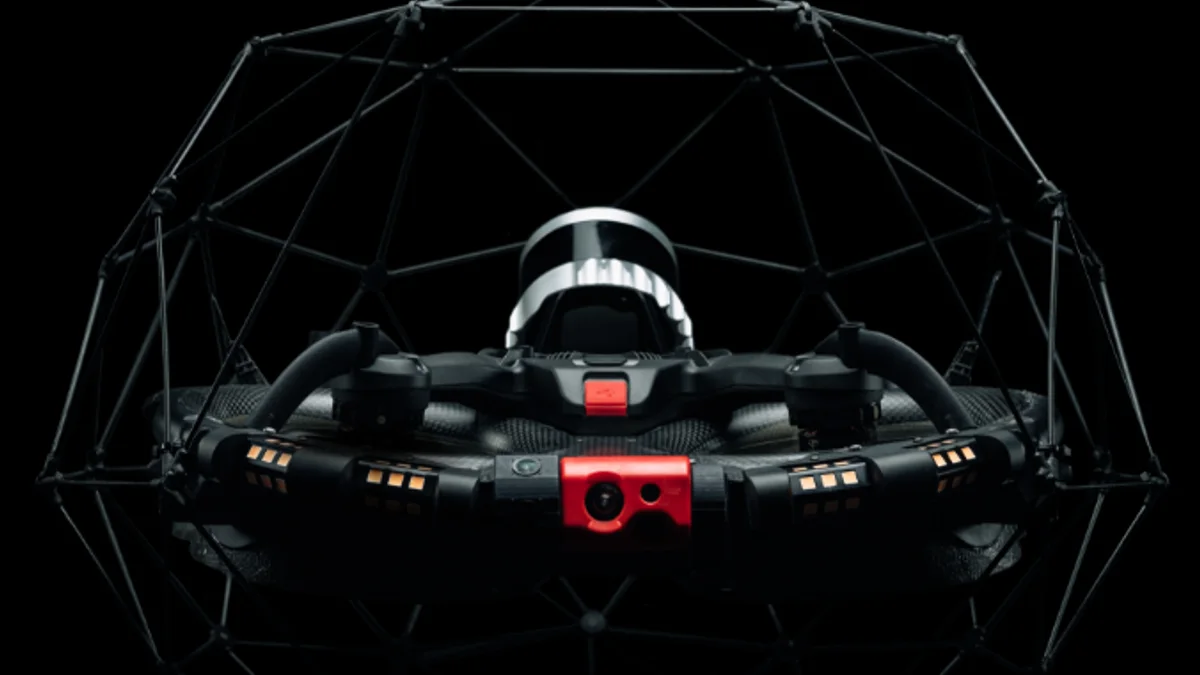
Ducted Cinewhoops and sub-250-gram indoor tactical micro-frames provide rapid visual penetration inside GPS-denied, cluttered spaces where standard drones lose lock or snag exposed blades. Law-enforcement tactical units and SWAT teams deploy ruggedized indoor micro-FPV units to clear corridors, stairwells, and blind rooms ahead of entry officers. In industrial and disaster-response workflows, skilled pilots fly shrouded FPV platforms beneath conveyors, inside pipe galleries, through ship compartments, and across collapsed structures for rapid preliminary screening. This role complements rather than replaces autonomous caged inspection drones equipped with LiDAR and optical-flow hover: high-cost stabilized caged units enable field engineers to hover slowly and document micro-cracks with minimal flight training, whereas low-cost ducted FPV airframes rely on expert manual pilots for rapid exploratory sweeps.
Defense Operations, Counter-UAS Interceptors, and Red-Team Threat Emulation
Across modern defense and security sectors, modular FPV platforms represent a pivotal class of attritable, high-agility unmanned systems. Operating without mandatory satellite navigation or automated return-to-home logic while leveraging diverse analog, sub-gigahertz, or multi-band C2 links, FPV aircraft complicate legacy RF detection and jamming playbooks. To defeat dense electronic-warfare environments, specialized defense variants replace wireless command and video links with unjammable tethered fiber-optic spools, while emerging onboard optical modules provide terminal visual target lock-on across final approach.
The same high climb rate, agility, and low unit cost have established fast FPV platforms as kinetic counter-UAS interceptors capable of pursuing and neutralizing hostile reconnaissance or loitering drones at a fraction of missile cost. On test ranges, FPV drones also serve as realistic red-team threat emulators, challenging radar, acoustic, electro-optical, and electronic-warfare defenses against small, low-altitude, erratically maneuvering targets.
Drone Racing, Freestyle, and the Skilled Pilot Pipeline
Competitive FPV racing and freestyle flying serve as vital industrial engines rather than purely recreational sports. Threading multi-gate courses at extreme velocity under split-second cognitive pressure stress-tests high-current ESCs, low-latency radio protocols, motor efficiency, and high-discharge battery chemistry. Equally important, racing circuits and simulator leagues cultivate a specialized talent pipeline of stress-tested manual pilots whose reflex calibration translates directly into broadcast production crews, confined-space industrial screening teams, and tactical defense units.
Regulatory Rules, Visual Observer Requirements, and Industry Terminology
Flying an FPV drone with enclosed goggles triggers a mandatory compliance rule that enterprise clients routinely overlook. Because goggles block direct unaided vision of surrounding airspace, major civil aviation authorities—including FAA Part 107 in the United States, EASA across Europe, and CAAS in Singapore—require outdoor visual-line-of-sight (VLOS) FPV flights to include a dedicated Visual Observer (VO), or spotter, beside the pilot. The observer maintains unaided sight of the aircraft, monitors manned traffic, birds, and bystanders, and relays hazards immediately. Ignoring this two-person crew mandate violates airspace law and can void commercial aviation liability insurance after an incident.
Across industry specifications, buyers encounter several overlapping terms. First-person view quad or FPV drone denotes the broad class; Acro or freestyle drone highlights unstabilized manual aerobatics; Cinewhoop designates a compact ducted-propeller FPV platform for indoor flight; Cine-lifter describes a heavy-payload FPV multirotor for cinema cameras; and FPV wing identifies a fixed-wing long-range FPV airframe.