
What Is an Industrial Multirotor Drone?
An industrial multirotor drone is an unmanned rotary-wing aircraft propelled by three or more fixed-pitch, variable-RPM rotors engineered for enterprise operations, harsh field environments, and repeatable commercial workflows. By varying the rotational speed and differential torque of independent brushless motors rather than articulating swashplates, collective-pitch blade grips, or tail-rotor transmissions, multirotor airframes pair mechanical simplicity with precise low-speed agility. This propulsion geometry delivers vertical takeoff and landing (VTOL) from confined sites, zero-turn-radius maneuvering, and stabilized station-keeping within tight structural clearances—making multirotors the primary workhorse for close-proximity inspection, localized mapping, and tactical overwatch.
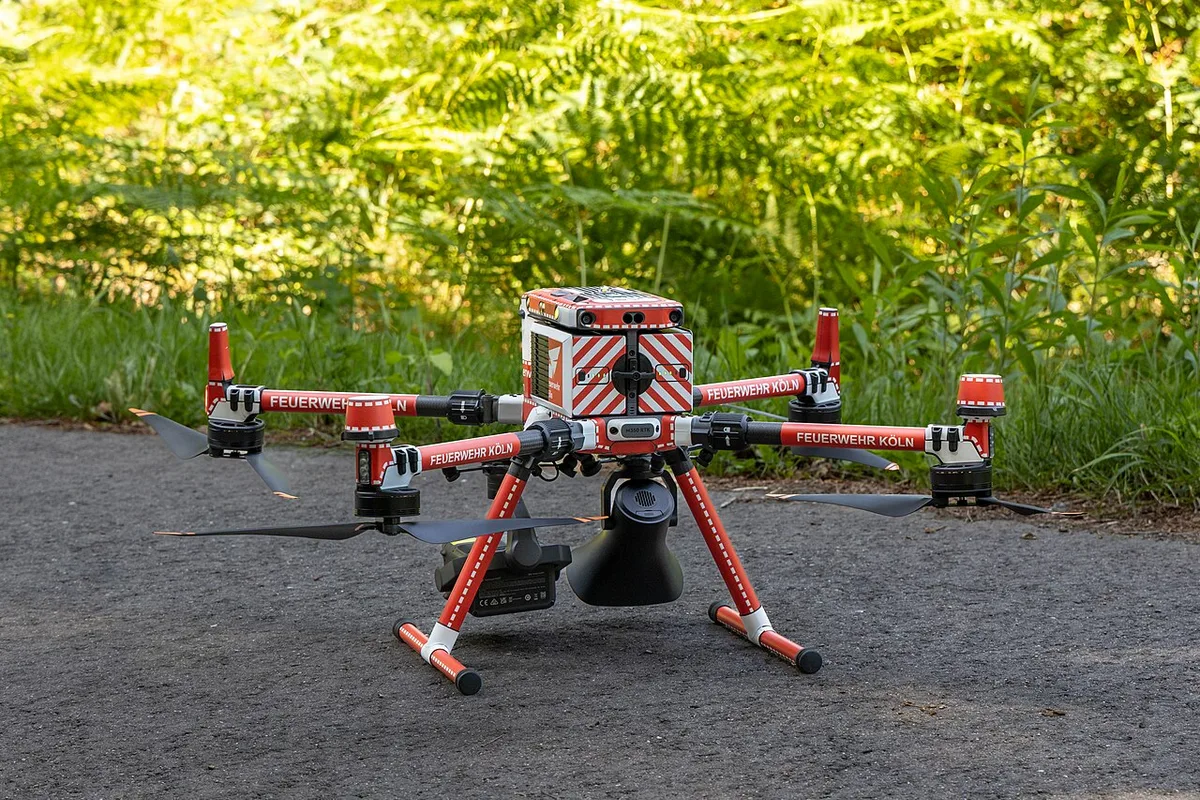
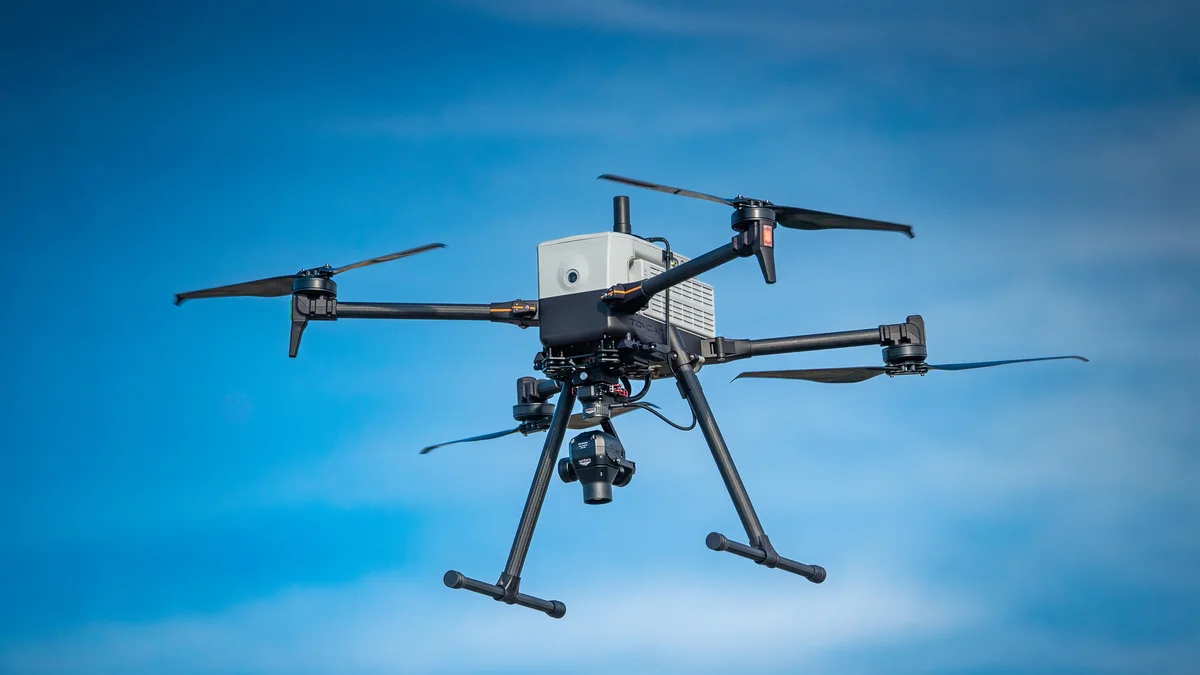
Four engineering thresholds separate industrial multirotors from consumer quadcopters. First, enterprise platforms replace molded plastics with rigid, folding carbon-fiber-reinforced polymer (CFRP) airframes built with positive-locking arm hinges that pack compactly for vehicle transport while suppressing high-frequency structural resonance that blurs long-range optical zoom or LiDAR returns, all sealed against dust, rain, and thermal extremes. Second, they carry higher useful payload margins to lift multi-kilogram LiDAR scanners, radiometric thermal imagers, or gas detectors without sacrificing stability. Third, they standardize modular quick-release payload interfaces and open developer buses rather than locking operators to a fixed camera. Fourth, they integrate redundant flight-critical avionics, dual-battery power architectures, and active obstacle-sensing suites that safeguard expensive payloads and surrounding infrastructure during routine operations.
Core Industrial Engineering Capabilities
Weatherproofing (IP Ratings), Wide Operating Temperatures, and EMI Shielding
Industrial sites rarely wait for calm weather. Enterprise multirotors use gasketed enclosures, conformal-coated electronics, and shielded motor bearings verified against Ingress Protection (IP) standards, where the first digit indicates solid particulate resistance and the second denotes water protection. Frames rated at IP54 or IP55 block conductive dust and withstand direct rain or spray during coastal fog and storm patrols. Thermal engineering extends operations across sub-zero winters and scorching substations via self-heating battery packs, sealed avionics bays, and high-temperature motor windings. Equally vital near energized high-voltage lines, substations, and broadcast towers is electromagnetic interference (EMI) resilience: because stray magnetic fields corrupt fluxgate magnetometers, enterprise airframes combine shielded harnesses with dual-antenna real-time kinematic (RTK) GNSS receivers, deriving true heading from satellite carrier-phase baselines instead of magnetic compasses.
Modular Payload Interfaces, Dual and Upward Gimbals, and Onboard SDKs
Industrial multirotors operate as airborne sensor buses built around universal smart payload gimbals. Quick-release bayonet or dovetail mounts route regulated power, video, and telemetry directly into interchangeable payloads, enabling one airframe to shift from optical-thermal inspection to LiDAR scanning in minutes. Many enterprise platforms support dual downward gimbals—pairing wide mapping cameras with zoom-thermal sensors—alongside a decisive industrial differentiator: the upward-facing gimbal mount. Mounted atop the central hub, an upward gimbal allows a multirotor to hover beneath bridge decks, viaduct girders, offshore rig undersides, and substation gantries to inspect overhead concrete spalling or bolt fatigue where fixed-wing aircraft and large rotorcraft cannot maneuver. Complementing these mounts, onboard software development kits (SDKs) and auxiliary ports expose power rails and serial or Ethernet links for methane detectors, acoustic imagers, spotlights, and edge processors.
Avionics, Dual-Battery Hot-Swapping, and Obstacle Safety Redundancy
Enterprise continuity depends on fault-tolerant avionics and minimal turnaround downtime. Industrial flight controllers integrate dual- or triple-redundant inertial measurement units (IMUs), barometers, and GNSS modules governed by real-time voting algorithms that isolate drifting sensors before attitude control degrades. Power delivery relies on dual-battery architectures supporting live hot-swapping: between sorties, crews replace depleted packs sequentially while the remaining pack keeps the flight controller, RTK link, and calibrated LiDAR sensor continuously powered, avoiding slow cold-boot cycles. During flight near steelwork or wooded corridors, omnidirectional obstacle-avoidance suites fuse stereo vision with millimeter-wave radar to detect thin conductor wires, guy-lines, and trusses in low light, smoke, or blowing dust.
Airframe Configurations by Rotor Count and Layout
Quadcopters (4 Rotors) and Rare Tricopter Variants
Four-rotor quadcopters dominate enterprise inspection and light-to-medium surveying. With only four arms, they minimize rotor-to-rotor aerodynamic interference, maximize hover efficiency per unit disk area, and fold into compact cases deployable by one technician in minutes. However, conventional quadcopters carry a critical fault-tolerance limit: because all four rotors balance roll, pitch, and yaw simultaneously, a motor, propeller, or speed-controller failure typically prevents controlled flight unless backed by a ballistic parachute. Rare tricopter variants—sitting at the three-rotor boundary of multirotors—add a servo-tilted rear arm for yaw control, introducing mechanical wear without solving single-motor vulnerability.
Hexacopters (6 Rotors)
Six-rotor hexacopters step up thrust capacity for mid-weight LiDAR systems, dual-gimbal optical suites, and missions over sensitive infrastructure requiring propulsion redundancy. Spreading thrust across six evenly spaced arms provides genuine motor-out redundancy: if one propulsion channel fails, the flight controller reallocates throttle across the remaining five rotors to maintain attitude authority and execute a controlled landing, provided takeoff mass remains within the degraded-mode thrust margin. The trade-off is a wider unfolded footprint, modestly higher empty weight, and slightly lower hover efficiency than an equivalent quadcopter—making hexacopters a balanced midpoint between portability and fault tolerance.
Octocopters (8+ Rotors): Flat-8 vs. Coaxial X8 Configurations
Heavy industrial sensors and high-wind offshore patrols push selection toward eight-rotor octocopters, divided between flat-8 and coaxial X8 geometries. A flat-8 places eight rotors on eight separate arms, keeping every propeller in unobstructed air for maximum lift efficiency and multi-motor redundancy, though its sprawling span complicates transport in tight vehicles or vessel decks. A coaxial X8 stacks counter-rotating upper and lower motor pairs onto four folding arms, shrinking packing volume dramatically while preserving eight-channel fault tolerance. Because lower propellers spin inside the accelerated downwash of upper rotors, coaxial X8 airframes incur a measurable thrust-efficiency penalty—an aerodynamic trade-off explored further within dedicated coaxial rotorcraft engineering.
| Configuration | Rotor / Arm Layout | Aerodynamic Efficiency | Transport Footprint | Motor-Out Redundancy | Primary Enterprise Role |
|---|---|---|---|---|---|
| Quadcopter | 4 rotors / 4 arms | Highest | Most compact | None (needs parachute) | Inspection, light surveying |
| Hexacopter | 6 rotors / 6 arms | High | Moderate | Single-motor safe landing | Mid-weight LiDAR, dual gimbals |
| Flat-8 Octocopter | 8 rotors / 8 arms | Moderate–High | Largest | High multi-motor margin | Heavy sensors, high-wind sites |
| Coaxial X8 | 8 rotors / 4 arms | Moderate (downwash loss) | Compact for payload | High multi-motor margin | Heavy payloads, tight launches |
Endurance Physics and Deployment Modes
Enterprise selection must confront the inherent aerodynamic endurance ceiling of multirotor flight. Generating lift purely through downward rotor thrust rather than wings imposes high disk loading and continuous power draw, limiting battery-electric multirotors to tens of minutes per sortie—far shorter than fixed-wing or hybrid VTOL fixed-wing aircraft cruising on wings over long corridors. Procurement teams also face a widespread specification pitfall: brochures typically quote unloaded, zero-wind hover endurance down to near-empty batteries. Once operators mount real payloads, incur additional aerodynamic drag, fight steady headwinds, climb steep terrain, and enforce mandatory reserve battery thresholds for safe return-to-home contingencies, effective mission time frequently drops by a third to half of nominal ratings—meaning a platform advertised for nearly an hour of unloaded hover often yields closer to twenty-five or thirty minutes of productive surveying under full sensor load. Fleet sizing should therefore rely on published payload-versus-endurance curves under realistic wind loads.
To manage or bypass this battery ceiling, industrial operators rely on three deployment architectures. Free-flight mobile operations offer maximum agility, combining folding carbon frames with dual-battery hot-swapping and multi-bay field chargers for near-continuous daytime coverage across dispersed sites. When missions require uninterrupted aerial persistence over one location for hours, tethered multirotor systems connect the aircraft to ground power through a lightweight, high-voltage cable supplying continuous electricity and secure fiber-optic telemetry; these tethered platforms excel at emergency communications relay, persistent security overwatch, and long-duration disaster monitoring without landing. Finally, automated drone-in-a-box docks shelter industrial multirotors inside weatherproof ground enclosures that automate recharging or battery swapping, climate control, and remote dispatch for unattended scheduled patrols across remote solar plants, mines, and substations.
Common Industrial Applications
Infrastructure and Utility Asset Inspection
Power utilities, wind operators, refineries, and bridge authorities deploy industrial multirotors for close-range zoom and radiometric thermal diagnostics. Precision hovering documents blade delaminations, overheated insulators, flare-stack corrosion, and bridge-underside cracks without scaffolding or line de-energization, complementing purpose-built inspection aircraft.
Small-to-Medium Site Surveying and High-Overlap 3D Facade Mapping
Across construction sites, quarries, mine benches, and industrial plants, multirotors capture high-overlap nadir and oblique photogrammetry plus dense LiDAR point clouds. Unlike fixed-wing aircraft bound to forward airspeed, multirotors fly slow vertical grids along sheer walls and facades to generate accurate volumetric models and digital twins.
Precision Agriculture: Crop Scouting and Spraying Platforms
Agronomists use compact multirotors with multispectral cameras to map crop vigor, drainage issues, and pest stress across fragmented fields. Larger ruggedized frames also execute variable-rate liquid and granular spraying on terraced slopes, orchards, and small plots, bridging general enterprise airframes and dedicated agricultural drones.
Short-Haul Industrial Lifting and Material Transport
In steep terrain and offshore zones, high-thrust multirotors perform short-haul point-to-point transport—hoisting solar panels, tower hardware, and tools to elevated crews, or ferrying urgent spares between supply vessels and offshore rigs—while extreme tonnage-class platforms belong to a broader cross-configuration heavy-lift category.
Search, Rescue, Firefighting, and Emergency Response
Public safety teams value industrial multirotors for rapid trunk-to-air launch during emergencies. Carrying thermal imagers, spotlights, loudspeakers, and drop payloads, these platforms locate missing persons at night, track wildfire hotspots through smoke, and deliver immediate situational awareness before manned aircraft mobilize.
Common Synonyms, Related Terms, and Category Boundaries
Across procurement tenders, aviation regulations, and technical literature, industrial multirotor drones are commonly called industrial multi-rotor UAVs, enterprise multirotor drones, and commercial multirotor drones—interchangeable terms describing ruggedized multi-propeller platforms built for professional workflows. By contrast, multicopters serves as a broader architectural umbrella covering any aircraft with three or more rotors, spanning consumer camera drones, hobbyist racing frames, and industrial platforms alike.
Clear category boundaries prevent procurement confusion. Heavy-lift drones should not be conflated as a synonym for industrial multirotors; heavy-lift designates a cross-configuration payload class spanning large multirotors, unmanned helicopters, and hybrid-lift aircraft rather than one rotor geometry. Likewise, general-purpose industrial multirotors remain distinct from collective-pitch single-rotor unmanned helicopters, dedicated coaxial rotorcraft engineering, and specialized single-mission airframes built exclusively for heavy agricultural spraying, pressurized facade washing, or specialized tactical operations.