
Yet when the analog front-end and programmable digital logic are engineered for real electromagnetic coexistence and tight SWaP-C budgets, software-upgradable waveforms transform a single transceiver module into a future-proof mission asset. Rather than swapping avionics harnesses or fixed-function silicon every time spectrum rules shift or adversarial drone protocols mutate, operators push updated air interfaces in firmware, keeping unmanned fleets and airspace-defense sensors ahead of congested, contested RF environments.
What Is a Software-Defined Radio (SDR)?
A software-defined radio (SDR) is a reconfigurable communications and sensing architecture in which signal-processing stages traditionally hardwired into discrete analog circuits—such as frequency mixing, channel filtering, modulation, demodulation, and forward error correction—are executed in software or programmable digital logic. In a fixed-function hardware transceiver, center frequencies, channel bandwidths, and waveform protocols are physically bound to dedicated analog filters, oscillators, and application-specific silicon; changing the air interface requires replacing hardware. An SDR preserves only the physical boundary layers in analog form: the antenna, a wideband RF front-end for amplification and conditioning, and high-speed analog-to-digital and digital-to-analog converters (ADCs and DACs). Once the signal is digitized into complex in-phase and quadrature (I/Q) streams, programmable processors—field-programmable gate arrays (FPGAs), digital signal processors (DSPs), RF systems-on-chip (RFSoCs), and general-purpose processors (GPPs)—define the radio's operational identity. For unmanned systems, this decoupling turns a single transceiver into a field-upgradable platform that adapts frequencies, waveforms, and mission modes through firmware updates rather than hardware swaps.
Inside an SDR Hardware-Software Stack: Why SWaP-C Matters on a Drone
Integrating an SDR onto an unmanned aerial vehicle (UAV) shifts radio engineering from benign benchtop conditions into strict Size, Weight, Power, and Cost (SWaP-C) constraints. Every gram of avionics mass and every watt of thermal dissipation directly reduces endurance, while dense onboard electronics create severe electromagnetic coexistence hazards for unhardened front-ends.
Wideband RF Transceiver Front-Ends, Tuning Range, and Instantaneous Bandwidth
An SDR's analog front-end governs what the digital baseband can actually observe, yet two parameters are routinely conflated during avionics selection: tuning range and instantaneous bandwidth (IBW). Tuning range—commonly spanning tens of megahertz to beyond 6 GHz on wideband transceiver chips—defines where the local oscillator can center the receiver or transmitter. Instantaneous bandwidth, constrained by ADC/DAC sample rates, Nyquist limits, and baseband filtering, dictates how wide a continuous slice of spectrum the radio digitizes simultaneously. A receiver spanning 6 GHz with narrow IBW must sweep sequentially across sub-bands and risks missing brief, wide-band frequency-hopping drone control or video bursts, whereas wide IBW captures fast-hopping emitters in a single snapshot.
Dynamic range and RF selectivity are equally decisive aloft. High-resolution ADCs with strong spurious-free dynamic range (SFDR) and low-phase-noise oscillators allow the receiver to resolve weak distant telemetry beside nearby high-power signals. Without switched RF preselector filter banks—combining surface acoustic wave, bulk acoustic wave, or micro-cavity filters ahead of the low-noise amplifier—a wideband receiver co-located with an aircraft's own telemetry transmitter or flying near urban cellular towers suffers out-of-band blocking, intermodulation distortion, and immediate ADC saturation.
Compute Engines: Embedded FPGAs and RFSoCs vs. Host CPU and GPU Processing
Streaming wideband I/Q samples into software creates throughput and latency bottlenecks that dictate baseband compute partitioning. General-purpose ARM or x86 CPUs and companion GPUs excel at high-level networking stacks, encrypted routing, machine-learning signal classification, and post-flight analytics, but operating-system jitter prevents them from sustaining deterministic, microsecond-scale radio loops. Flight-grade SDR architectures therefore offload time-critical physical-layer operations—digital downconversion and upconversion, polyphase channelization, synchronization, real-time spectral triggers, and agile frequency hopping—into embedded FPGA fabric directly behind the data converters.
Direct-RF systems-on-chip compress this architecture further by integrating multi-gigasample ADCs, DACs, programmable FPGA fabric, and multicore embedded ARM processors onto a single die. Eliminating board-level high-speed serial links cuts power draw, printed-circuit-board area, and stray emissions—critical gains when fitting wideband communications or sensing hardware into a compact UAV airframe or gimbaled payload bay.
Low-SWaP Airborne OEM Modules vs. Rack and Benchtop Ground SDRs
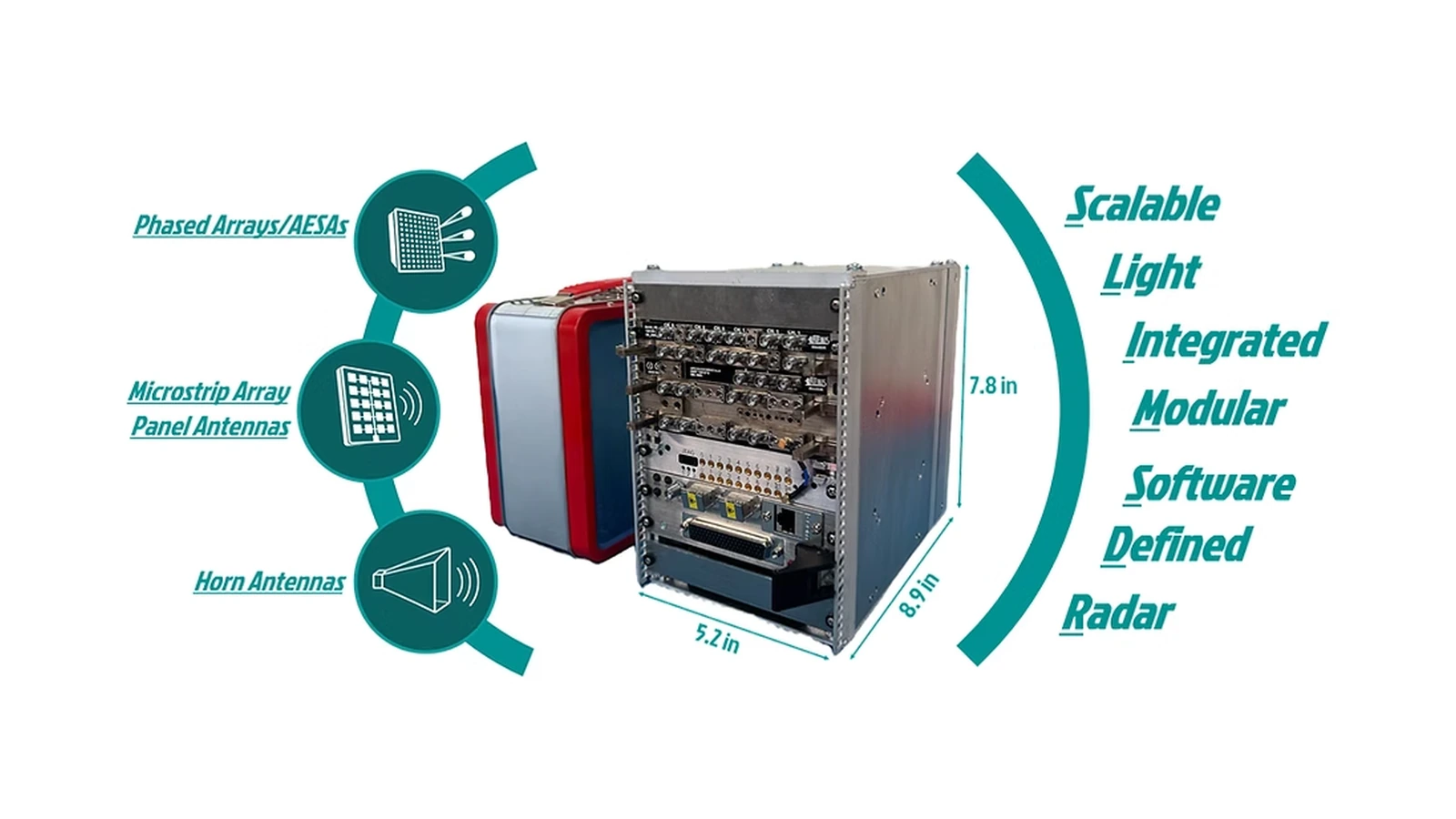
Engineering teams often validate waveforms on desktop USB laboratory SDRs only to encounter rapid failures during flight trials. Entry-level lab units typically lack temperature-compensated oscillators able to survive altitude-driven thermal drift, omit RF preselector banks, and use fragile consumer connectors vulnerable to rotorcraft vibration. Production airborne OEM modules resolve these issues through conduction-cooled shielding, locking coaxial interconnects, ruggedized power conditioning, and compact SWaP envelopes weighing tens of grams in a credit-card footprint.
Fixed and mobile ground SDR installations trade size for RF fidelity and array geometry. Rack-mounted ground units employ high-linearity front-ends, multi-channel phase-coherent receivers sharing a common local oscillator and disciplined timing reference, and high-throughput Ethernet or optical backhaul to power multi-element angle-of-arrival (AoA) phase interferometry and distributed time-difference-of-arrival (TDOA) geolocation.
| Engineering Dimension | Airborne OEM Embedded SDR | Ground / Rack-Mount SDR |
|---|---|---|
| SWaP and Packaging | Tens of grams; conduction-cooled, vibration-hardened module | Kilogram-class rack chassis; forced-air cooling |
| RF Front-End | Switched preselectors for onboard transmitter coexistence | High-SFDR, multi-stage filtering for crowded spectrum |
| Channel Architecture | 1 to 2 RF channels for C2, mesh, or compact sensing | 4+ phase-coherent channels with shared LO and PPS sync |
| Compute Partitioning | Embedded FPGA/RFSoC with onboard ARM for edge DSP | FPGA front-end streaming wideband I/Q to server CPUs/GPUs |
| Primary Unmanned Role | Agile UAV datalinks, MANET relays, airborne survey payloads | Fixed C-UAS arrays, AoA/TDOA direction finding |
High-Value Roles in the Drone and Counter-UAS Ecosystem
Across commercial, industrial, and defense aviation, SDR hardware underpins three core mission domains where fixed-function radios cannot keep pace with shifting spectrum rules, contested RF environments, or evolving threat protocols.
Agile UAV Datalinks, Multi-Band Mesh, and Anti-Jamming Communications
Unlike fixed-function commercial drone datalinks locked to one modulation format and license-exempt band, an SDR-based airborne radio lets an airframe manufacturer standardize on a single hardware module worldwide. Loading region-specific software waveforms adapts center frequencies, channel masks, and transmit power limits to national spectrum regulations without modifying avionics harnesses. Across multi-aircraft missions, programmable waveforms sustain self-healing mobile ad hoc network (MANET) mesh links that dynamically route command-and-control (C2) telemetry and video over airborne relays to extend beyond-visual-line-of-sight range.
Under electronic attack or heavy industrial interference, SDR agility becomes essential for link survivability. Combining FPGA-based spectrum sensing with rapid frequency hopping, adaptive modulation and coding, and narrowband interference excision allows an airborne radio to detect jammed channels and relocate traffic onto clean sub-bands before control drops—preserving deterministic link margins across contested electromagnetic terrain.
Counter-UAS RF Detection, Protocol Decoding, and Direction Finding
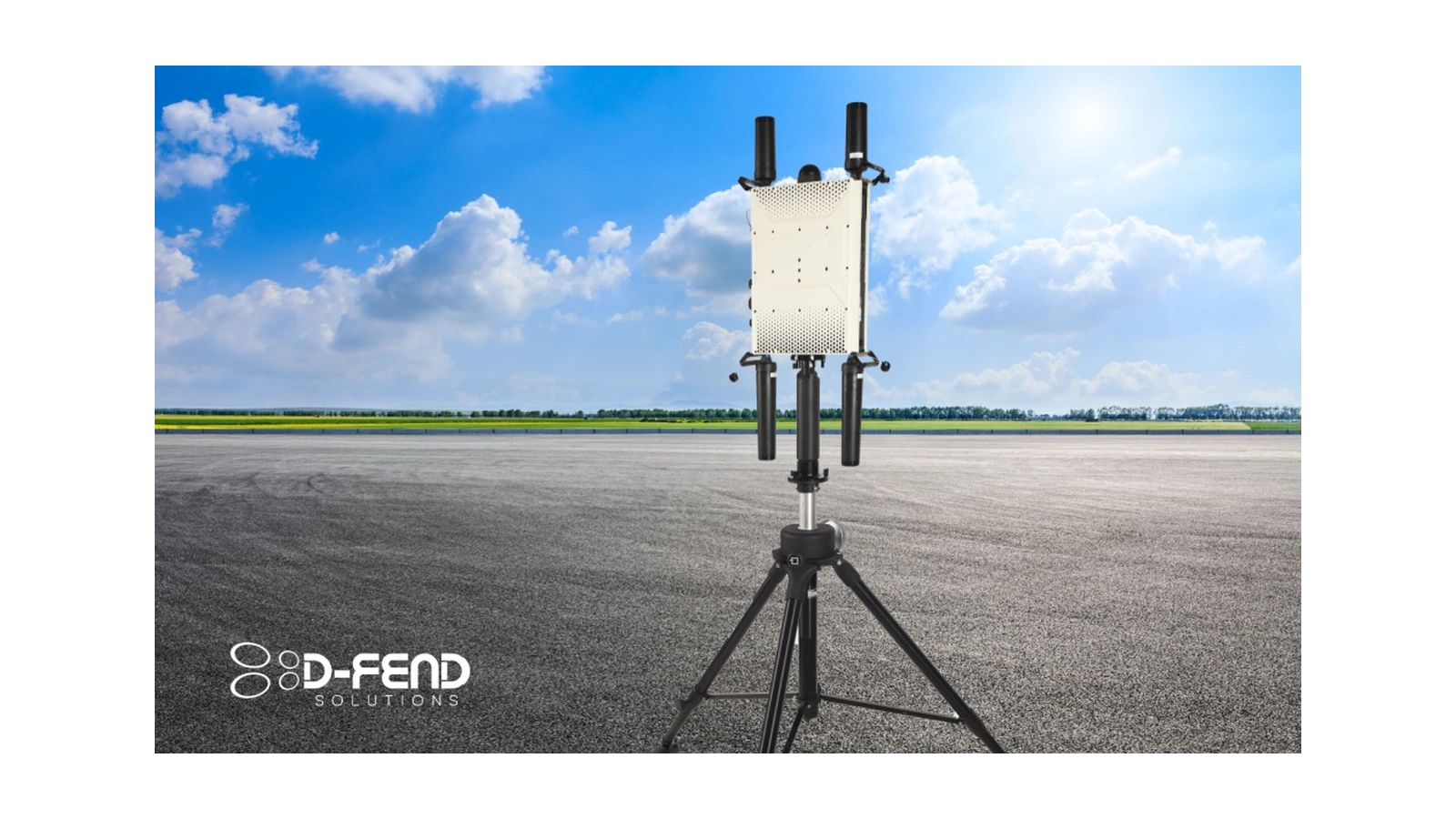
Within Counter-UAS (C-UAS) airspace security architectures, wideband SDR receivers act as the passive RF sensing engine that detects, classifies, and geolocates unauthorized drones without emitting radar energy. Commercial multirotors, long-range fixed-wing aircraft, and custom first-person-view (FPV) builds continually change telemetry framing, proprietary video links, and frequency-hopping tables. An SDR-based passive sensor absorbs that threat churn in software: operators push updated waveform signature and protocol-decoding libraries remotely, enabling deployed hardware to identify new drone families and extract telemetry metadata without physical replacement.
Wide instantaneous bandwidth intercepts brief control bursts across congested industrial, scientific, and medical bands alongside sub-gigahertz links. Paired with phase-coherent multi-channel front-ends and calibrated antenna arrays, the same receiver resolves bearings via AoA phase interferometry or cross-correlates networked timestamps via TDOA to pinpoint both aircraft and operator. Where legally authorized, software-defined transmit chains also generate surgical, protocol-aware RF mitigation waveforms that disrupt hostile control links while minimizing collateral impact on adjacent aviation and cellular services.
Drone-Mounted Spectrum Mapping, Cellular Base-Station Testing, and SAR/SIGINT Payloads
Carrying a low-SWaP SDR as a dedicated payload transforms a UAV into an agile three-dimensional RF measurement platform. Telecom operators fly multirotors equipped with calibrated wideband SDRs around cellular towers to map three-dimensional antenna radiation patterns and verify elevated 5G coverage corridors inaccessible to ground drive-testing. Civil aviation authorities and port security teams similarly deploy airborne SDR interference-hunting payloads to locate covert vehicle-mounted GNSS jammers and unlicensed transmitters disrupting airport approaches; whereas buildings and terrain blind ground-level direction-finding vans through multipath reflection, an elevated drone clears local clutter and triangulates emitters within minutes.
In defense and emergency response, airborne SDR payloads support tactical signals intelligence (SIGINT) and electronic intelligence (ELINT) alongside search-and-rescue (SAR) operations. When earthquakes, wildfires, or maritime disasters disable terrestrial cellular networks, a UAV carrying a compact SDR can operate as an airborne cellular transceiver or International Mobile Subscriber Identity (IMSI) locator payload, capturing mobile handset registration beacons to geolocate stranded survivors across inaccessible terrain.
Broader Industry and Research Usage Examples
Beyond operational drone links, airborne payloads, and C-UAS sensors, SDR platforms support adjacent aviation research, regulatory monitoring, and tactical interoperability workflows.
Wireless R&D, Avionics Link Prototyping, and 5G/NTN Testing
Aerospace laboratories use wideband SDR testbeds to validate air-to-ground propagation models, prototype uncrewed traffic management links, and emulate satellite-to-UAV handovers for 5G non-terrestrial networks (NTN). Evaluating candidate waveforms on reconfigurable hardware exposes real-world Doppler shift, multipath fading, and adjacent-channel leakage before committing designs to custom avionics silicon.
Airborne and Ground Spectrum Monitoring and Interference Hunting
Spectrum regulators and critical-infrastructure operators pair fixed ground SDR monitoring stations with UAV-borne receivers to conduct continuous electromagnetic noise-floor surveys around airports, vertiports, and industrial corridors. Correlating ground baselines with elevated airborne bearings speeds up cross-geolocation of intermittent or mobile interference threatening navigation and telemetry bands.
Defense, Tactical Communications, and Public Safety Interoperability
Defense forces and emergency responders deploy airborne SDR relays to bridge incompatible legacy and modern radio waveforms across joint military units, police, fire services, and maritime agencies during major incidents. On tactical reconnaissance airframes, software-defined receivers also serve as compact electronic support measures (ESM) payloads cataloging emitter activity across wide operational theaters.
Broadcast, Satellite Ground Stations, and Amateur Radio Roots
Outside unmanned aviation, SDRs support broadcast signal verification and allow multi-mission satellite ground stations to demodulate shifting orbital downlinks through software updates alone. Much of this modern waveform-engineering ecosystem traces its educational and rapid-prototyping heritage to amateur radio experimentation and open-source signal-processing frameworks, which trained generations of engineers in digital baseband design.
Related Terms, Synonyms, and Evolution Toward Cognitive Radio
Systems engineering literature frames SDR technology alongside three closely related concepts. An ideal software radio represents the theoretical limit in which digitization occurs directly at the antenna terminals with zero analog front-end circuitry—a boundary approached by direct-RF sampling yet still constrained by physical thermal noise, impedance matching, and high-power blocking. A software-defined system (SDS) generalizes reconfigurability beyond radio transceivers to multi-function RF apertures sharing wideband hardware across communications, radar sensing, and electronic monitoring.
The most consequential trajectory for unmanned aviation is cognitive radio, which pairs SDR hardware with autonomous situational awareness and real-time decision engines. By analyzing wideband spectral occupancy and jamming behavior through embedded algorithms and machine-learning classifiers, a cognitive radio autonomously selects interference-free frequencies, adapts modulation order, and shapes transmit power without human intervention—delivering the resilient autonomy drones need in congested and contested airspace.