

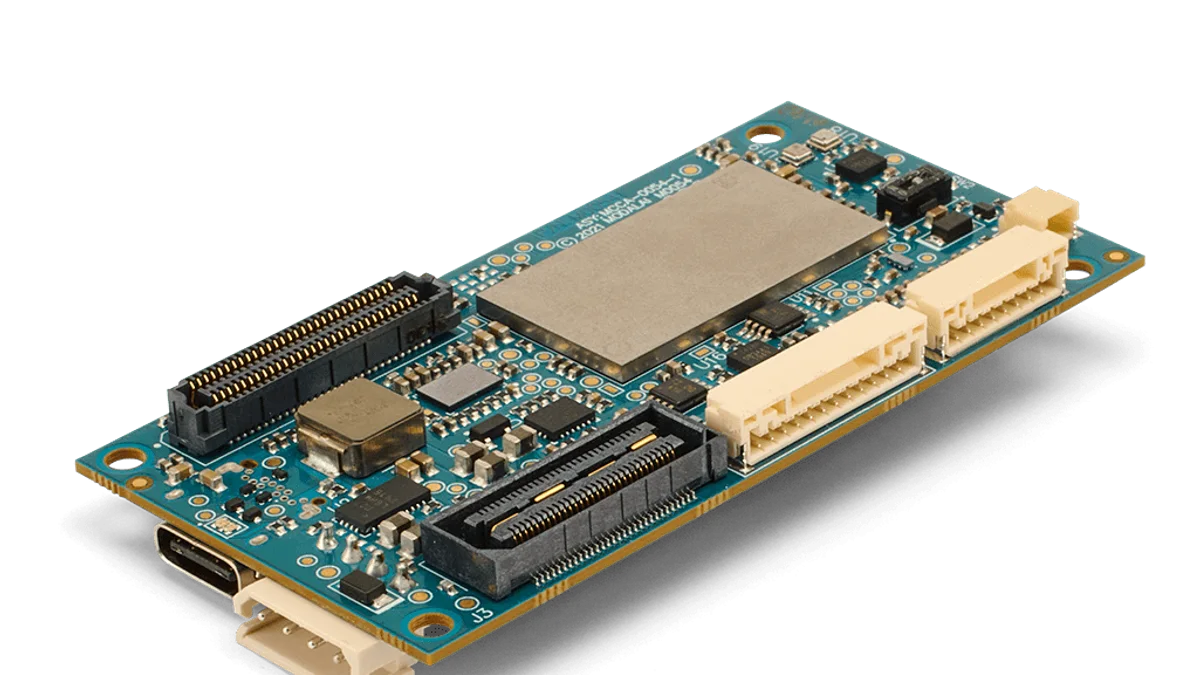
Nominal waypoint holding means little without redundant voting architectures, calibrated air-data synthesis, and deterministic fault containment capable of isolating a drifting inertial channel before control divergence occurs. Specifying, evaluating, and qualifying mission-critical UAV autopilots across commercial and defense airframes therefore requires scrutinizing closed-loop guidance, navigation, and control architecture, redundancy tiers, envelope-protection laws, and avionics integration standards as a unified flight-critical system.
What Is a UAV Autopilot System?
A UAV autopilot system is an integrated hardware-and-software Guidance, Navigation, and Control (GNC) avionics assembly that stabilizes an unmanned aircraft, estimates its flight state, and executes autonomous missions without continuous manual inputs. Unlike a bare flight controller circuit board or standalone firmware, a commercial autopilot is procured as a turnkey suite for medium-to-large fixed-wing aircraft, hybrid vertical takeoff and landing (VTOL) platforms, unmanned helicopters, and high-reliability industrial multirotors. From an airworthiness standpoint, it serves as the flight-critical authority maintaining structural, aerodynamic, and airspace boundaries across nominal and degraded states.
Delivered to an aircraft manufacturer, a complete autopilot suite extends well beyond the central processor. Standard aviation-grade packages combine a ruggedized, vibration-isolated flight computer with embedded inertial sensors, an external air-data computer (ADC) and pitot-static probe, remote GNSS and magnetic heading modules, isolated power-distribution electronics, and dedicated ground control station (GCS) configuration software. Unified calibration, electromagnetic qualification, and interface controls enable integrators to govern fault containment holistically rather than assembling unverified hobbyist components.
The Closed-Loop Guidance, Navigation, and Control (GNC) Cycle
Flight-critical autopilots run a deterministic real-time feedback loop spanning three layers: sensing physical states, computing navigation and guidance solutions, and driving actuators within hard envelope limits.
Sense: Multi-Sensor Suite Input (Inertial, Air Data, and GNSS)
Autonomous flight across complex airframes demands more than three-axis rates and accelerations from an inertial measurement unit (IMU). Fixed-wing aircraft and large rotorcraft rely on pitot-static probes measuring dynamic and static pressure to derive indicated and true airspeed alongside barometric altitude. High-performance platforms add angle-of-attack and sideslip vanes to monitor aerodynamic margins, radar or laser altimeters for height-above-ground precision during flare and terrain following, and propulsion feedback including engine speed, cylinder-head temperature, or motor-controller telemetry. Multi-constellation GNSS receivers and remote magnetometers anchor absolute position and heading, while validity monitors flag icing, dropouts, or bias drift before corrupting estimation.
Calculate & Decide: State Estimation and Flight Guidance Laws
The avionics core separates navigation—determining current state—from guidance—computing desired trajectories. Recursive sensor-fusion estimators blend high-rate inertial propagation with lower-rate GNSS, air-data, and heading updates to output continuous three-dimensional position, velocity, attitude, airspeed, and wind-vector estimates. Outer-loop guidance laws compare this state against the flight plan to compute cross-track corrections, crosswind crab angles, turn-anticipation arcs, loiter orbits, and approach glideslopes. Decoupling estimation from guidance enables graceful degradation: if satellite reception fails, guidance continues running on inertial and air-data estimates while executing contingency routes.
Control & Feedback: Inner-Loop Actuation and Envelope Protection
Inner-loop control laws convert outer-loop guidance targets—roll, pitch, yaw rate, or climb rate—into actuator commands. Depending on the airframe, the autopilot drives surface servos for ailerons, elevators, rudders, and flaps, collective and cyclic swashplate actuators, brushless motor controllers, or engine throttle governors. Every control cycle, flight-envelope protection clamps commands using live airspeed, attitude, and load-factor estimates to prevent stalls, overspeed flutter, over-banking spirals, and structural overloads. Continuous inertial and air-data feedback closes the loop, rejecting turbulence and compensating for asymmetric drag or fuel burn.
Core Operational Capabilities
Attitude Stabilization, Altitude/Airspeed Hold, and VTOL Transition Control
At its foundation, the autopilot maintains rock-steady attitude stabilization alongside simultaneous altitude and airspeed hold. Fixed-wing autopilots employ a Total Energy Control System (TECS) rather than isolated pitch-for-altitude and throttle-for-airspeed loops. Because thrust regulates total mechanical energy (kinetic plus potential) while pitch redistributes energy between speed and height, coordinated throttle and elevator control eliminates phugoid oscillations and preserves stall margins during climbs or power cuts. Hybrid VTOL aircraft add the transition corridor between hover and cruise, requiring smooth authority blending across lift rotors and aerodynamic surfaces as airspeed builds without rotor-wash upsets or premature rotor shutdown.
Autonomous Waypoint Navigation, Loiter Patterns, and Precision Auto-Landing
Operational autopilots execute three-dimensional waypoint routes, circular or racetrack loiters, and terrain-following profiles informed by elevation databases and radar or laser altimeters. Launch and recovery impose the strictest guidance demands. Fixed-wing systems manage catapult launches, bungee climb-outs, and autonomous runway takeoffs with nosewheel steering and rudder crosswind compensation. During recovery, precision auto-landing aligns the airframe with final approach corridors, manages sink rate along energy-regulated glideslopes, executes runway flare, or guides capture into arrestment nets. Maritime configurations extend this logic to moving ship decks, combining relative positioning with vessel-motion prediction to synchronize touchdown with deck heave and pitch.
Safety Envelopes, Geofencing, and Contingency Automation
Airworthiness approvals depend on deterministic failsafe governance rather than ad-hoc pilot intervention. Industrial autopilots enforce three-dimensional polygonal geofences—combining lateral keep-in or keep-out zones with altitude ceilings—that initiate turn-backs before boundary breaches occur. Upon faults such as low energy reserves, datalink loss, GNSS denial, single-engine failure, or a jammed control surface, the contingency engine evaluates remaining energy and wind vectors to execute pre-validated mitigations. Depending on operational risk, the system may climb to restore radio line-of-sight, divert to a pre-surveyed alternate landing site, enter an emergency loiter, or trigger independent ballistic parachutes or a segregated Flight Termination System (FTS).
Ground Control Station (GCS) and Companion Computer Integration
The autopilot anchors flight-critical authority inside a broader onboard and ground architecture. Upward inside the airframe, serial, Controller Area Network (CAN), or Ethernet buses link the autopilot to mission companion computers and stabilized payloads. While companion processors execute non-deterministic perception or tactical autonomy, the autopilot screens incoming velocity or waypoint requests against hard envelope limits before moving actuators. Downward over redundant RF or satellite datalinks, the autopilot exchanges telemetry, diagnostics, and mission revisions with a Ground Control Station. Fielded GCS setups span sunlight-readable handheld controllers, ruggedized portable case terminals, and multi-aircraft software consoles supporting real-time retasking, health monitoring, and live airspace integration.
Redundancy Architectures and Airworthiness Assurance Tiers
Single-String vs. Dual/Triple-Redundant Voting Architectures
Eliminating single points of failure is essential for heavy or long-range aircraft flying over populated areas or shared airspace. Single-string autopilots rely on one processor lane and one sensor core; though lightweight, any unrecovered compute lockup, power brownout, or latent IMU failure causes loss of control. Dual-redundant architectures add a hot-standby lane with cross-channel health monitors for automatic failover upon hardware crashes or out-of-range faults. Yet when two lanes diverge silently—such as subtle gyro bias drift—dual monitors cannot unambiguously identify the healthy channel without auxiliary analytical checks.
Triple-Modular Redundancy (TMR) resolves ambiguity through continuous two-out-of-three voting across three isolated compute lanes, power rails, and inertial suites. When one lane disagrees, the voter isolates it instantaneously while the healthy pair sustains control. High-integrity designs further apply dissimilar redundancy—pairing distinct microcontrollers, sensor technologies, or independent software paths—to prevent common-mode defects from disabling all lanes simultaneously.
| Architecture | Arbitration & Fault Logic | Containment Limitation | Typical Mission Tier |
|---|---|---|---|
| Single-String | One compute/sensor lane; watchdog resets | Unrecovered core fault causes loss of control | Light multirotors, VLOS operations |
| Dual Hot-Standby | Two isolated lanes; cross-channel switchover | Silent disagreements hinder unambiguous voting | Medium industrial fixed-wing and VTOL |
| Triple-Modular (TMR) | Three lanes; 2-of-3 majority voting | Higher SWaP-C; needs dissimilar design for common-mode faults | Heavy cargo, urban BVLOS, certifiable UAS |
Open-Ecosystem vs. Certifiable Proprietary Autopilots
Integrators must balance open-ecosystem autopilot derivatives against certifiable proprietary aviation suites. Open-ecosystem platforms offer rapid iteration, broad peripheral compatibility, and low acquisition cost, suiting prototypes, research, and low-risk commercial missions. However, community-maintained codebases seldom provide the formal requirements traceability, deterministic memory partitioning, and configuration control regulators expect for high-risk airspace operations.
Certifiable proprietary autopilots are engineered around aerospace assurance standards from inception. System safety processes align with SAE ARP4754A, flight software follows RTCA DO-178C verification objectives, and complex airborne electronic hardware complies with RTCA DO-254 guidelines, scaled to the Design Assurance Level (DAL) matched to aircraft kinetic energy and hazard severity. Commercial aviation-grade vendors supply formal verification artifacts, environmental qualification evidence covering thermal extremes, vibration, shock, and electromagnetic interference, and structured certification support. For manufacturers pursuing Specific-category approvals or type certification, this pre-built evidentiary chain compresses regulatory timelines and explains multi-fold price differentials.
Deployment Across Mission Profiles
Corridor & Wide-Area Aerial Mapping and Surveying
Photogrammetry, LiDAR corridor mapping, and precision agriculture prioritize geometric repeatability over agility. Survey-configured autopilots suppress cross-track error along parallel flight lines despite crosswinds to maintain uniform image overlap. Equally critical are gust-attenuated attitude stability and microsecond-level hardware synchronization between navigation timestamps and camera shutters or laser scanners, supporting centimeter-grade georeferencing with minimal post-processing.
Long-Range Infrastructure Inspection and Persistent Monitoring
Utility inspection, pipeline patrol, and maritime surveillance demand sustained stability in turbulent weather alongside tight payload coordination. Beyond static waypoints, professional autopilots support payload-guided flight—known as target slaving or geo-pointing—where real-time line-of-sight vectors from an electro-optical or infrared gimbal feed directly into the guidance loop. Once locked onto a stationary facility or moving vessel, the autopilot dynamically calculates optimal orbit centers, loiter radii, and bank angles to keep the target continuously framed without airframe masking.
Defense ISR, Target Drones, and Heavy Cargo Delivery
Defense and heavy logistics push autopilot robustness to physical and electromagnetic extremes. Intelligence, surveillance, and reconnaissance (ISR) aircraft in contested environments rely on tightly coupled inertial dead-reckoning, air-data wind modeling, and barometric or optical aiding to sustain missions and return home safely under prolonged GNSS denial. Aerial target drones demand high-G maneuvering laws and sea-skimming altitude control to replicate threat kinematics. Heavy cargo platforms face abrupt center-of-gravity shifts during sling-load release or air-drops, requiring adaptive gain scheduling to re-trim instantaneously while preserving civil-airway redundancy compliance.
Related Terms, Synonyms, and Avionics Hierarchy
Drone Autopilot / UAS Autopilot vs. Standalone Flight Controller
In consumer multirotor markets, "drone autopilot," "UAS autopilot," and "flight controller" are often used interchangeably. Across medium-to-large industrial and aerospace engineering, the distinction defines procurement scope. A standalone flight controller denotes the bare circuit board hosting microcontrollers, onboard inertial chips, and physical pin headers. A UAV autopilot system denotes the complete, enclosed closed-loop avionics suite integrating calibrated air-data sensing, multi-sensor navigation fusion, full-envelope control laws, redundancy management, and ground-station interfaces prepared for aircraft qualification.
Flight Management System (FMS) and Autonomous Flight Control System (AFCS)
As unmanned aircraft scale into medium-altitude long-endurance and regional freight classes, avionics architectures mirror crewed aviation hierarchies. Strategic mission management—covering flight-plan routing, airspace conformance, fuel or energy optimization, and dynamic diversion planning—resides in the Flight Management System (FMS). High-integrity inner-loop stabilization, flight-envelope protection, redundancy voting, and actuator command generation reside in the Autonomous Flight Control System (AFCS). Separating FMS and AFCS functions logically or across partitioned hardware isolates mission software updates from flight-critical stabilization code, streamlining safety certification.