
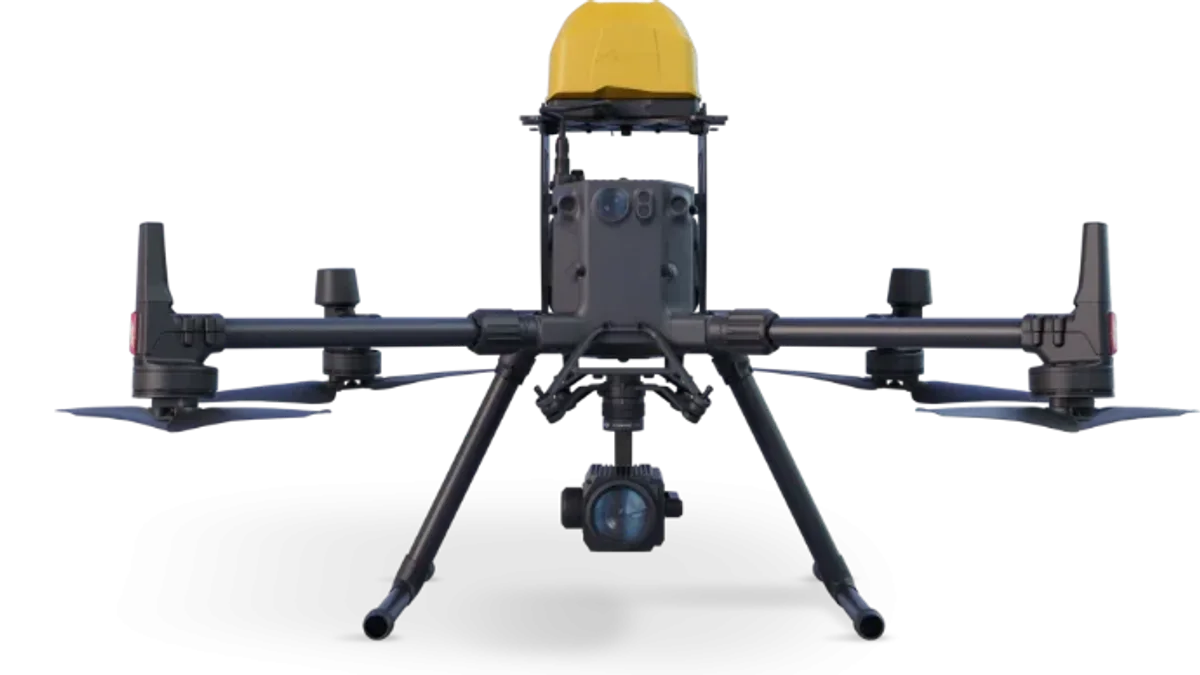
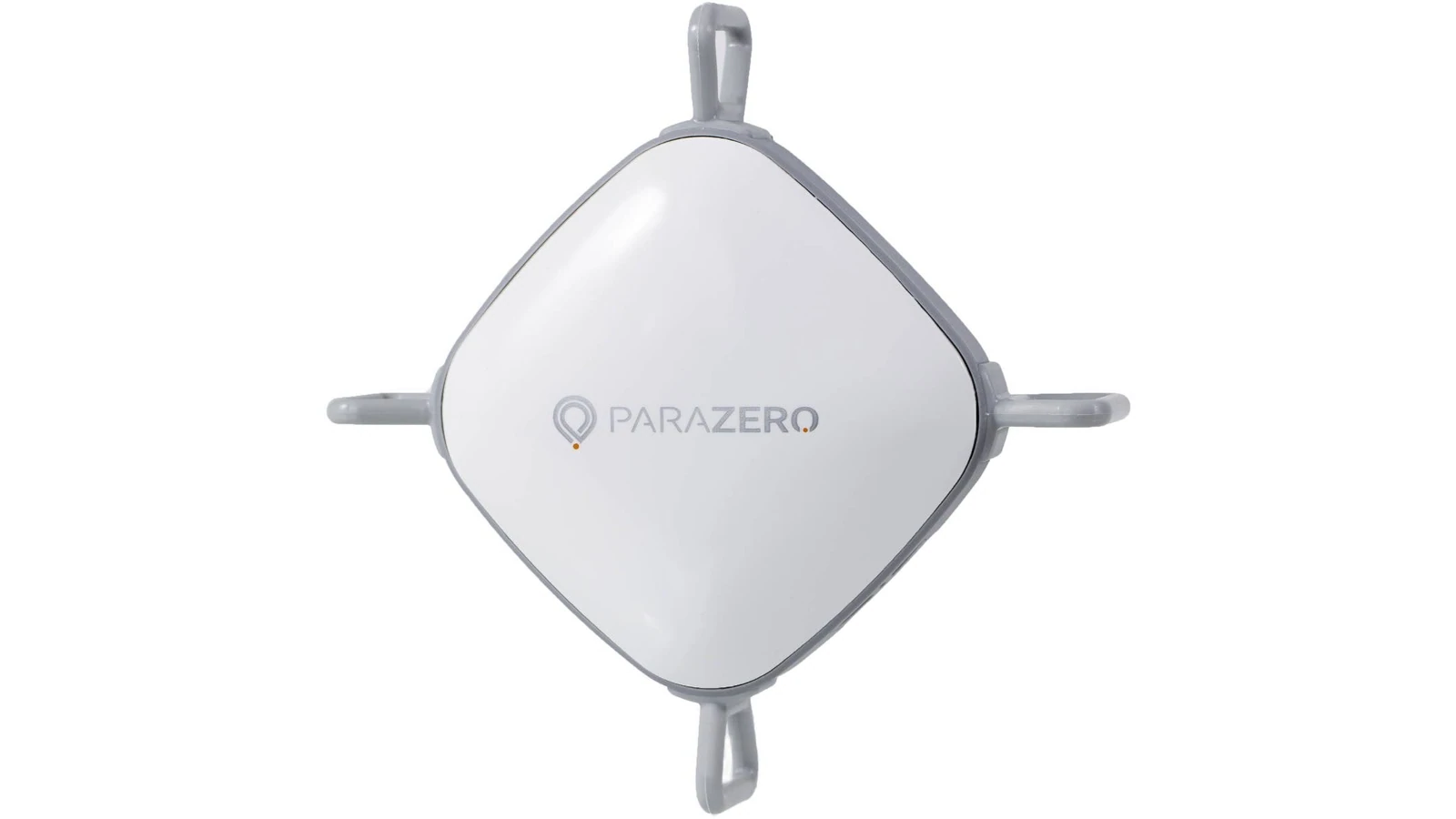
Bridging commercial aviation safety standards and enterprise drone deployments therefore requires an electrically, computationally, and RF-independent containment kill chain. By segregating power, navigation monitoring, command reception, and physical actuation from the primary avionics bus, operators establish a deterministic last line of defense when primary flight systems fail.
What Is a UAV Flight Termination System?
A UAV Flight Termination System (FTS) is an independent, safety-critical onboard and ground-segment subsystem engineered to immediately end an unmanned aircraft's flight when primary avionics fail or the airframe threatens to exit its authorized airspace. Across civil airworthiness and defense range-safety disciplines, this domain encompasses the complete segregated architecture, the onboard Flight Termination Device (FTD) that physically executes shutdown, and Autonomous Flight Termination Systems (AFTS) that trigger without human intervention. Regardless of configuration, an FTS fulfills one overriding mandate: horizontal containment. It operates as the last-resort physical gate preventing an uncontrollable aircraft from breaching its operational volume and entering commercial flight paths, populated zones, or restricted facilities.
Standard autopilot failsafes—such as return-to-home (RTH), loiter-on-link-loss, or software geofencing—cannot replace a compliant FTS. Those routines run inside the primary flight controller and depend on the same processor, inertial sensors, GNSS receiver, power distribution bus, and command-and-control (C2) datalink that sustain normal flight. If firmware deadlocks, attitude estimation diverges, or GNSS spoofing induces a flyaway, the autopilot can neither detect the containment breach nor recover control. Likewise, mapping a transmitter toggle to send a software motor-disarm command over the primary telemetry link—commonly called a soft kill switch—fails regulatory audits whenever primary C2 drops or the flight computer freezes. True flight termination requires complete electrical, computational, and radio-frequency independence from the primary unmanned aircraft system.
How an Independent FTS Works
An airworthy FTS achieves high-integrity containment by segregating sensing, decision logic, command reception, and physical actuation onto an isolated hardware path that runs parallel to—and retains override authority over—the primary avionics stack.
Architectural Independence: Dedicated Power, RF, and Position Monitoring
Eliminating common-mode failures is the foundation of containment engineering. On a conventional drone, one continuous avionics chain links the main propulsion battery, flight controller, primary datalink, and electronic speed controllers (ESCs) or servos. A main-bus short circuit, regulator failure, or wideband RF interference on the primary C2 channel can disable that entire chain simultaneously.
A compliant FTS severs every shared dependency through a segregated parallel branch. Electrically, the airborne module carries a dedicated reserve battery sized to power continuous monitoring and high-current actuation even after total main-bus collapse, protected by diode or load-switch isolation so primary faults cannot drain the reserve. For communications, command-triggered systems employ a dedicated narrowband termination receiver on an independent frequency band, modulation scheme, and antenna path separate from primary C2 and payload links. Low-data-rate narrowband RF delivers substantially stronger link margins and terrain penetration, remaining reachable well after broadband telemetry links drop. For autonomous containment, an independent microcontroller and separate GNSS receiver continuously validate position and velocity vectors against pre-loaded three-dimensional geofence polygons, unaffected by corrupted state estimates inside the primary autopilot.
Command-Triggered vs. Autonomous Flight Termination
Containment architectures rely on command-triggered termination, autonomous onboard termination, or a hybrid pairing of both triggers.
In a command-triggered FTS, a remote pilot in command (RPIC) or range safety officer monitors aircraft position against approved corridor boundaries and triggers shutdown from a hardened ground termination transmitter. Human-in-the-loop oversight allows operators to briefly steer a degraded aircraft clear of roads or structures when partial authority remains, yet command-only architectures remain exposed to radio line-of-sight loss and human reaction delay during high-speed excursions.
Autonomous Flight Termination Systems (AFTS) pair independent sensing with hardware-enforced hard geofencing to eliminate link dependency and reaction latency. Before launch, engineers load the operational volume and containment buffer into tamper-resistant memory inside the FTD. In flight, the isolated processor tracks real-time three-dimensional boundary proximity alongside link-heartbeat timers. If the aircraft crosses the hard containment perimeter—or exceeds altitude ceilings, attitude-divergence limits, or link-loss thresholds inside restricted corridors—the AFTS fires autonomously within milliseconds. Mature beyond-visual-line-of-sight (BVLOS) platforms typically combine command override with autonomous geofence enforcement so operators can intervene early while hard boundaries remain guaranteed if communications fail.
Termination Actions Across Electric, Fuel, and Fixed-Wing Platforms
Once triggered, the FTD must arrest forward progress and place the airframe on a predictable descent inside the containment buffer. Because propulsion physics and glide performance differ sharply across airframe classes, hardware interruption must match platform dynamics.
| Platform Class | Hardware Interruption Mechanism | Containment Physics & Recovery |
|---|---|---|
| Electric Multirotor | Solid-state main-bus disconnect or hardware PWM/CAN multiplexer injecting zero-throttle ESC disarm | Immediate thrust loss yields steep ballistic drop; sequenced trigger deploys parachute after props arrest |
| Fuel-Powered Platforms | Normally closed fuel-supply solenoid cutoff paired with ignition-magneto or ECU grounding circuit | Halts combustion immediately while isolating onboard generators to stop powered flyaways |
| Fixed-Wing UAV | Thrust cut combined with hardware servo multiplexers seizing elevator, rudder, and aileron channels | Commands preset high-drag deep stall, spin, or spoiler deflection to collapse glide ratio |
On electric multirotors, termination hardware sits physically downstream of the flight controller: an inline solid-state relay severs main traction power, or a hardware PWM/CAN multiplexer isolates autopilot outputs and injects fixed disarm signals directly into the ESCs. Because multirotors rely wholly on active thrust for lift, propulsion cutoff stops lateral travel almost instantly. On fuel-powered rotorcraft and hybrids, electrical disconnection alone cannot halt a magneto-fired engine; the FTD must close a fuel solenoid valve while grounding the ignition circuit to guarantee rapid shutdown.
Fixed-wing airframes pose a far greater horizontal containment challenge. High lift-to-drag ratios allow an unpowered fixed-wing UAV to glide many kilometers downwind past its operational boundary and toward adjacent runways. Compliant fixed-wing FTS modules therefore route critical servo lines through hardware multiplexers. Upon termination, the FTD hijacks control surfaces from the autopilot and drives preset hard-over deflections—such as full-up elevator with opposing rudder and aileron inputs or spoiler deployment—forcing a tight aerodynamic spin or deep stall that collapses glide ratio and drops the aircraft inside the buffer.
Across both multirotor and fixed-wing platforms, flight termination pairs closely with drone parachute recovery systems. Their roles are strictly orthogonal: the FTS enforces horizontal containment by ending forward flight, whereas the parachute system reduces vertical ground-impact kinetic energy during descent. Precise sequencing ensures the FTD cuts propulsion first—eliminating rotor-strike and canopy-entanglement hazards—before firing a delayed pulse to deploy the ballistic canopy.
Regulatory Standards and Qualification Frameworks
Demand for segregated FTS hardware is anchored in modern risk-based aviation rules and defense range mandates. Under the Joint Authorities for Rulemaking on Unmanned Systems (JARUS) Specific Operations Risk Assessment (SORA), Step 9 establishes containment requirements preventing unmanned aircraft from exiting their operational volume into adjacent populated zones or controlled airspace. Where adjacent-area risk is elevated, operators must satisfy Enhanced Containment criteria—demonstrating stringent probability limits against containment breaches and proving that no single primary-UAS failure can simultaneously cause a flyaway and disable containment.
In Europe, the European Union Aviation Safety Agency (EASA) codified these expectations through Means of Compliance (MOC) Light-UAS.2511. MOC Light-UAS.2511 mandates architectural and design independence for containment systems in higher-risk Specific category approvals, auditing power isolation, software segregation, independent navigation sensing, and dedicated RF links. Qualification requires formal safety analysis, environmental and electromagnetic compatibility testing, and end-to-end verification under worst-case primary-avionics failure modes.
These civil airworthiness rules trace directly to defense flight-test range safety standards, notably the Range Commanders Council RCC 319 lineage. Originally developed to standardize redundant receivers, dedicated batteries, environmental qualification, and fault-isolated decoding for uncrewed range vehicles, RCC 319 established the zero-common-mode discipline now adapted to commercial BVLOS aviation. Modern unmanned aircraft FTS qualification preserves that rigorous mechanical and electronic termination lineage—cutting propulsion, spoiling aerodynamic lift, and confining descent within verified boundaries.
Key Operational Use Cases
Independent containment transitions from an optional safeguard to a mandatory operational prerequisite whenever standoff distance, third-party exposure, or control uncertainty amplifies breach risk.
Beyond Visual Line of Sight Commercial Operations
Long-range BVLOS missions—such as pipeline and powerline inspection, maritime patrol, and regional cargo logistics—frequently parallel civil aviation corridors, highways, and rail lines. Beyond visual range, operators cannot observe subtle track drift, and cellular or satellite C2 links experience intermittent handoffs. Dual-mode command and autonomous FTS modules guarantee deterministic containment before an impaired aircraft enters controlled airspace.
Operations Near Populated Areas, Airports, and Critical Facilities
Low-altitude operations near urban edges, industrial plants, ports, public venues, or active aerodromes face strict authorization conditions. Regulators routinely require a combined FTS and ballistic parachute architecture: the independent FTS prevents lateral excursion over uninvolved crowds, hazardous infrastructure, or runway approaches, while the sequenced parachute limits impact energy during descent.
Experimental Flight Testing, High-Speed Target Drones, and Defense Range Operations
Prototype airframes undergoing maiden flights, envelope expansion, or control-law tuning carry substantially higher divergence risk than mature production systems. Unvalidated gains, structural flutter, or experimental autonomy stacks can provoke sudden flyaways within seconds. Flight-test teams and defense range operators rely on hardened, high-reliability FTS hardware to enforce hard perimeter redlines on prototypes and high-speed aerial targets before they breach range boundaries.
Selection Criteria, Pre-Flight Arming Safety, and Related Terms
Selecting an FTS demands balancing airborne size, weight, and power (SWaP) against uncompromising RF and integrity margins. Foremost is independent link range: the command termination link must deliver verified coverage well beyond maximum mission radius, accounting for adverse antenna orientation and low-altitude terrain shadowing. Engineers must also verify solid-state relay current capacity, servo multiplexer latency, environmental sealing, and independent battery endurance across full mission duration plus reserve margins.
Preventing accidental or unauthorized activation is equally critical, as an unintended trigger guarantees hull loss and ground-impact risk. Compliant ground termination units integrate physical dual-command arm-and-fire interlocks—combining keyed master arm switches, guarded toggle covers, and simultaneous two-button confirmation—supported by pre-flight built-in test (BIT) checks. Over the air, rolling cryptographic authentication and unique vehicle-binding keys prevent replay attacks, RF spoofing, and accidental cross-triggering across multi-aircraft fleets.
Finally, engineering and compliance teams must keep terminology exact. A Flight Termination System (FTS) describes the complete independent architecture; the Flight Termination Device (FTD) denotes the airborne actuation hardware; and an Autonomous Flight Termination System (AFTS) adds onboard boundary sensing and autonomous triggering. By contrast, software geofencing runs inside the primary autopilot without fault isolation, while the informal term "kill switch" obscures the vital regulatory boundary between non-compliant autopilot disarm switches and true hardware-segregated flight termination systems.