
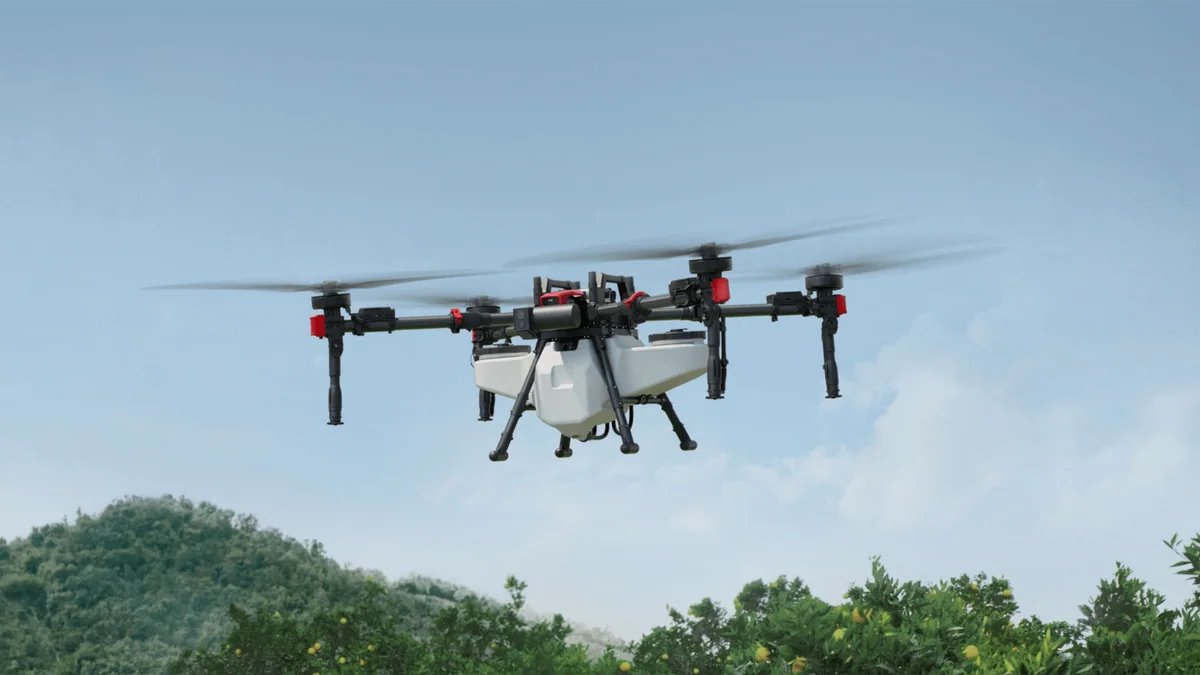
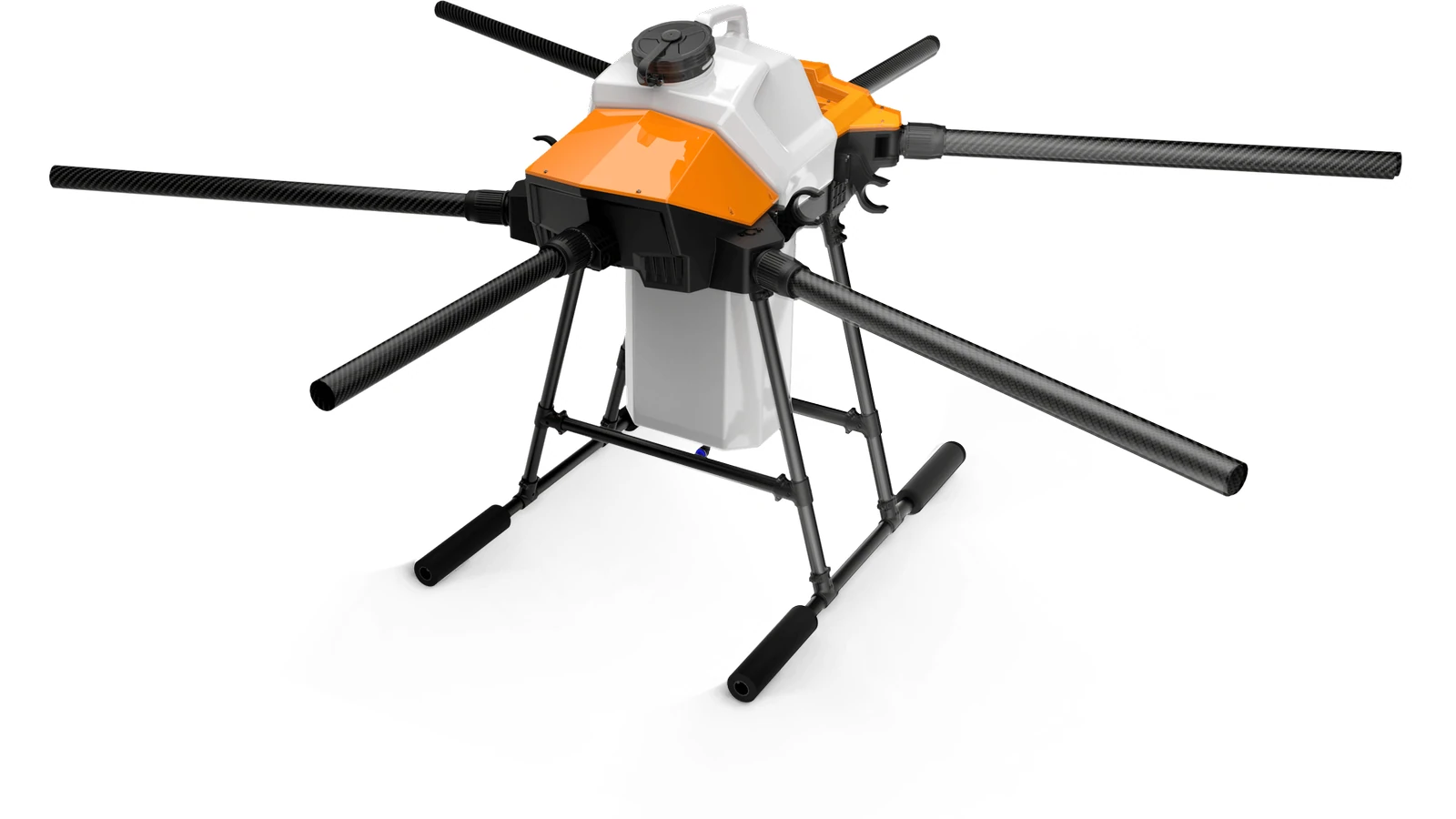
Actual daily acreage and biological efficacy are governed by how tightly core subsystems work together in the field: rotary-atomizer droplet spectrum control that prevents nozzle clogging, rotor-downwash canopy penetration balanced against off-target drift, active terrain-following radar holding constant clearance over steep orchards or wet paddies, and trailer-mounted rapid generator charging paired with closed-loop mixing tenders.
What Is an Agricultural Spraying Drone?
An agricultural spraying drone—widely termed a crop spraying drone or agricultural spray UAV—is a dedicated unmanned aircraft engineered to dispense liquid agrochemicals, foliar nutrients, and biologicals from just a few meters above the crop canopy. Unlike general-purpose imaging multicopters, these field machines combine chemical tanks, metered pumps, precision atomizers, centimeter-level satellite positioning, and active terrain-following radar inside a ruggedized industrial airframe. Because daily spraying exposes electronics to corrosive pesticides, abrasive field dust, and end-of-shift high-pressure washdowns, manufacturers seal avionics and power controllers inside high-ingress-protection enclosures with corrosion-resistant hardware. Folding carbon-fiber and aluminum arms allow heavy airframes to collapse into pickup beds or trailers for rapid transport between fragmented fields.
Electric multirotor architectures—chiefly heavy-duty quadrotors and coaxial octorotors—dominate global fleet adoption due to mechanical simplicity, modular battery swaps, and minimal routine maintenance. Fuel-powered single-rotor unmanned agricultural helicopters remain a specialized secondary configuration, retaining operational niches in hilly Japanese rice farming, steep forestry corridors, and long-endurance missions where extended single-sortie range justifies higher engine and drivetrain servicing overhead.
How Spraying Drones Work and Core Subsystems
Uniform ultra-low-volume deposition across uneven crops requires tight coupling among fluid mechanics, rotor aerodynamics, centimeter-grade navigation, and closed-loop flow control under continuous vibration and shifting liquid loads.
Liquid Tanks, Pumps, Flow Meters, and Atomization Nozzles (Pressure vs. Rotary Centrifugal)
Fluid delivery begins with a baffled, quick-release tank feeding high-flow diaphragm or brushless impeller pumps regulated by dual-channel electromagnetic flow meters. Real-time flow feedback locks pump output to ground speed, holding a uniform per-hectare application rate as the aircraft slows into turns or climbs embankments.
Operators choose between hydraulic flat-fan pressure nozzles and dual-disc rotary centrifugal atomizers. Hydraulic nozzles force solution through calibrated orifices, imparting strong downward momentum that resists light crosswinds; however, orifice wear gradually skews calibration, and wettable powders or thick suspension concentrates frequently clog narrow tips. Dual-disc rotary centrifugal atomizers instead meter liquid onto high-speed brushless spinning discs, shearing droplets mechanically without pressurized narrow orifices. By modulating disc rotational speed electronically, pilots vary the Volume Median Diameter (VMD) continuously in micrometers—producing finer droplets for dense contact fungicide and insecticide leaf coverage, or coarser droplets to suppress off-target drift during systemic herbicide passes. Standardized quick-latch mounts also let crews swap the liquid tank for a centrifugal dry granular spreading hopper within minutes to distribute granular fertilizers, cover-crop seeds, or pelleted baits.
Rotor Downwash Aerodynamics and Canopy Penetration
Multirotor sprayers harness heavy rotor downwash to drive droplets actively into dense crop canopies rather than relying solely on gravitational settling. High-disc-loading rotors project a turbulent downward air column that parts upper leaves and flips foliage, coating shaded stems and leaf undersides where fungal spores and piercing-sucking pests shelter.
This coupling operates within strict aerodynamic limits set by altitude, airspeed, and ambient wind. Flying too high weakens downwash before mist reaches the canopy, exposing fine droplets to crosswind shear. Conversely, excessive forward speed tilts the wake rearward and strengthens rotor tip vortices, lifting fine droplets above the swath and triggering spray drift. Effective agronomic flight planning balances droplet VMD, swath width, airspeed, and above-canopy clearance to keep spray anchored inside the downwash core.
RTK Positioning, Phased-Array Terrain Radar, and Obstacle Avoidance
Stewardship against overlap waste and missed pest strips relies on dual-antenna Real-Time Kinematic (RTK) GNSS receivers linked to local base stations or cellular correction networks for centimeter-level parallel track fidelity. Dual-antenna heading estimation also prevents magnetic interference from buried irrigation pipes, metal greenhouses, and high-current power cables.
Because moving foliage defeats optical height sensors, sprayers employ multi-directional millimeter-wave and phased-array terrain-following radar to detect slopes and tree crown contours in real time. The flight controller modulates vertical thrust continuously to maintain constant relative height above the canopy across terraces and rolling terrain. Forward phased-array radar and binocular vision systems simultaneously detect thin rural hazards—overhead distribution lines, guy wires, and utility poles—executing automated braking or vertical bypass maneuvers.
Autonomous Route Generation, Breakpoint Resume, and Variable-Rate Application (VRA)
Field execution starts with boundary mapping and obstacle geotagging via handheld RTK rovers or imported survey maps. Mission software generates optimized parallel routes, carves safety buffers around wells and neighboring sensitive crops, and synchronizes valve actuation strictly to active swaths.
Because tanks empty every few minutes, automated breakpoint resumption drives industrial continuity. Liquid-level radar or load-cell sensors detect chemical exhaustion or low battery voltage, shut valves cleanly, record the exact centimeter coordinate, and return the aircraft to the landing zone. After replenishment, one command resumes spraying at the exact breakpoint without missed strips or double-dosed patches. Advanced controllers also ingest gridded prescription maps from upstream multispectral scouting, dynamically modulating pump output across management zones for Variable-Rate Application (VRA) matched to localized crop vigor or pest pressure.
Field Turnaround Infrastructure: Rapid Charging, Generators, and Mixing Tenders
Commercial aerial spraying functions not as isolated flights, but as a high-cadence industrial workflow built around roughly ten-minute sortie cycles repeated dozens of times daily. Ground turnaround logistics—not airframe speed alone—govern daily acreage output and return on investment.
Continuous operations demand matching battery thermodynamics to mobile power generation. High-capacity agricultural batteries discharge at punishing C-rates and return hot from every flight. Crews deploy truck-mounted inverter fuel generators feeding intelligent multi-channel fast chargers and active air-cooled or liquid-cooled cradles. Running a three-battery, one-charger rotation keeps one pack flying while a second cools and fast-charges and a third stands ready on the pad, eliminating idle downtime.
Chemical mixing speed and crew safety are equally decisive. Rather than hand-pouring concentrated pesticides into the aircraft between sorties, commercial teams outfit pickup beds or field tender trailers with agitated pre-mix mother tanks and high-flow transfer pumps fitted with drip-free quick-connect couplers. While one operator swaps the battery in seconds, another pumps pre-mixed solution to exact target weight, cutting turnaround below one minute and minimizing chemical exposure. Because commercial buyers acquire airframes alongside spare battery banks, fast-charging generators, and mixing tenders as an integrated capital package, fleet financing and payback calculations hinge on total system cost.
Agronomic Applications and Field Scenarios
Spraying drones deliver their strongest field economics where wet soils, crop height, steep topography, or sudden pest outbreaks restrict wheeled equipment.
Broadcast Foliar Feeding, Fungicide/Insecticide Application, and Defoliation
Across staple grains and high-value row crops, autonomous fleets execute rapid broadcast applications of systemic and contact fungicides, insecticides, plant growth regulators, and chelated foliar nutrients. Ultra-low-volume deployment lets growers act decisively during narrow phenological windows—such as heading-stage cereal disease control or pre-harvest cotton defoliation—before pathogens or weather erode yield.
Precision Spot Spraying and Targeted Weed Management
Paired with weed-classification maps from prior aerial imaging surveys, spraying drones replace blanket coverage with surgical spot spraying. The aircraft traverses fields autonomously while opening valves exclusively over mapped weed patches or pest hotspots, reducing herbicide expenditure, limiting soil chemical load, and shielding healthy crop stands from unnecessary phytotoxicity.
Wet Paddies, Steep Terraces, Tall-Stalk Crops, and 3D Orchards
Field access defines the sharpest advantage of aerial spraying. After heavy rainfall or irrigation, waterlogged rice paddies and muddy wheat fields immobilize heavy tractors for days while fungal outbreaks spread; drones launch from dry field edges immediately. On hillside terraces, narrow valleys, and steep vineyards where rollover hazards bar ground booms, terrain-following radar keeps aircraft contoured to the slope. During late-season growth in tall-stalk corn, sorghum, and sugarcane, aerial application eliminates stalk breakage and rutting entirely. In three-dimensional orchards, crown-following flight modes trace irregular canopies to push sprays into dense vertical foliage.
Year-Round Multi-Use: Cover-Crop Seeding, Fertilizer Spreading, and Greenhouse Shading
To smooth seasonal cash flow, custom applicators leverage modular payload swaps across the agricultural calendar. Exchanging the liquid tank for a centrifugal granular spreader enables top-dressing urea onto flooded paddies, reseeding waterlogged rice patches, interseeding winter cover crops into standing corn, and broadcasting aquaculture pond feed. Between open-field seasons, crews also use spray payloads to coat commercial greenhouse glass with removable summer whitewash shading.
Key Benefits, Limitations, and Comparison with Ground Booms and Crewed Crop Dusters
Choosing among spraying drones, self-propelled ground boom sprayers, and crewed agricultural aircraft depends on parcel geometry, soil trafficability, turnaround agility, and contiguous acreage.
| Operational Factor | Agricultural Spraying Drones | Self-Propelled Ground Booms | Crewed Crop Dusters |
|---|---|---|---|
| Soil & Crop Impact | Zero wheel rutting or compaction; operates over mud and tall stalks | High ground pressure; restricted in wet soils; wheel-track crop loss | Zero soil impact; requires nearby airstrip and clear approaches |
| Terrain & Parcel Agility | Excels on small, irregular, terraced, and obstacle-lined plots | Suited to flat or gently rolling fields with wide headlands | Optimized for large, unobstructed contiguous blocks |
| Vast-Plain Throughput | Moderate per aircraft; scales via multi-drone tender crews | High sustained daily output on dry broadacre farms | Highest single-platform coverage across massive tracts |
| Water & Target Precision | Ultra-low-volume water savings; centimeter spot and VRA execution | High carrier water volume; boom section control | Low-to-moderate volume; coarser precision near buffers |
Operational and Agronomic Benefits
Eliminating heavy wheels from planted rows preserves crop stands and prevents soil compaction, lifting net harvestable yield. Ultra-low-volume atomization slashes carrier water hauling in arid regions. Remote autonomous flight separates workers from concentrated chemical mist—replacing hazardous manual backpack spraying—while integrated work lights and RTK guidance allow nighttime operations during calmer, cooler conditions that avoid daytime bee foraging.
Practical Limitations, Drift Management, and Chemical and Aviation Regulations
Finite tank capacities and constant battery cycling still limit single-drone efficiency across vast, contiguous flat plains where wide ground booms and crewed aircraft achieve lower per-hectare turnaround times on dry soils. Atmospheric discipline remains mandatory: fine droplets evaporate quickly in high heat and low humidity, while strong winds or thermal inversions carry aerosols onto sensitive neighboring crops. Operators must enforce strict meteorological wind and humidity limits, tune droplet VMD for drift suppression, hold required aviation and pesticide applicator licenses, and apply only formulations carrying official aerial application label approval.
Synonyms and Agricultural Tech Ecosystem Boundaries
Across agronomy literature, procurement tenders, and regulatory standards, agricultural spraying drones are frequently termed crop spraying drones, agricultural spray UAVs, or ag sprayer drones. Within precision agriculture workflows, their boundary sits firmly in low-altitude physical actuation rather than upstream remote sensing. Multispectral imaging drones and photogrammetric mapping software execute crop scouting, vegetation indexing, and weed delineation; agricultural spraying drones occupy the downstream application layer, translating those digital prescription maps into metered, centimeter-accurate liquid or granular field delivery.