
In the field, trading hover convenience for wing-borne efficiency reshapes the entire operational workflow. An aircraft that cannot pause in midair must hold safely above its stall-speed margin and respect wide turn-radius geometry across terrain. Deploying at scale therefore means engineering around horizontal momentum, replacing point takeoffs with bungee rails or pneumatic catapults and committing to belly-skid clearings, parachute zones, or skyhook recovery logistics.
What Is a Fixed-Wing Drone?
A fixed-wing drone is an unmanned aircraft that generates aerodynamic lift through rigid, stationary wings moving forward through the air rather than powered rotary blades. Because forward airflow over an airfoil sustains lift at a fraction of the power required to accelerate a vertical rotor downwash, fixed-wing platforms achieve markedly higher lift-to-drag ratios (L/D) than multirotor or helicopter aircraft. In steady cruise, propulsion systems only overcome aerodynamic drag—combining airframe profile drag and lift-induced wing drag—instead of continuously supporting gross weight against gravity. This flight-physics efficiency delivers higher cruise velocities, lower energy burn per kilometer, and extended operational range.
Endurance scales sharply across propulsion classes. Lightweight electric hand-launched fixed-wing drones commonly fly for 1 to 2 hours or more, with efficient mapping frames reaching two to three hours per lithium pack. Medium-to-large commercial and tactical airframes powered by aviation piston or heavy-fuel internal combustion engines routinely exceed ten hours, extending into multi-day persistence at the upper boundary of runway-dependent medium- and high-altitude long-endurance (MALE and HALE) strategic aircraft. While strategic systems set the category's ceiling, commercial, industrial, and tactical operations center predominantly on portable hand-launched frames up to roughly 100-kilogram corridor and maritime platforms.
Wing-borne lift enforces a strict flight-envelope boundary: stall speed. A fixed-wing drone must sustain forward airspeed above its critical stall threshold to keep airflow attached, meaning it cannot hover. Flight attitude is governed by aerodynamic control surfaces—ailerons for roll, an elevator for pitch, and a rudder for yaw, or combined elevons on tailless airframes.
Main Fixed-Wing Airframe Planforms
Fixed-wing airframes divide into three primary planforms, trading structural simplicity, payload bay volume, sensor clearance, and gust tolerance across distinct mission profiles.
Flying-Wing (Tailless) Airframes
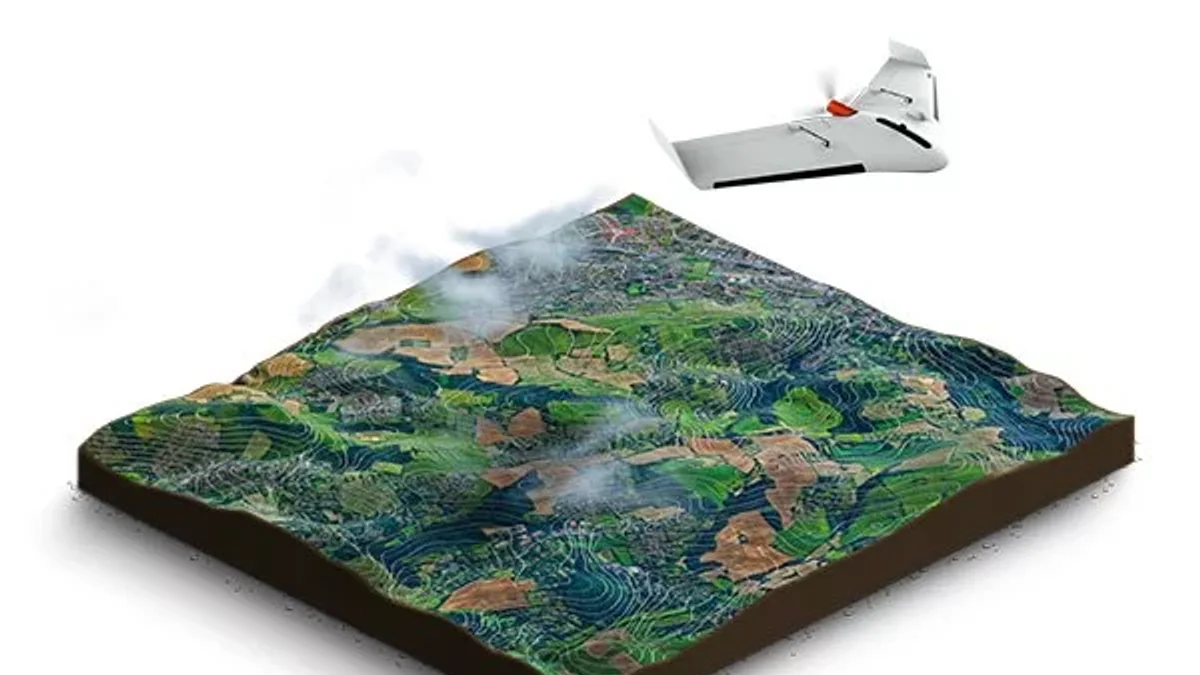
Flying-wing drones eliminate the conventional fuselage and tail, merging structure, avionics, propulsion, and payload into a swept lifting body steered by trailing-edge elevons. Lightweight variants made from expanded polypropylene (EPP) or expanded polyolefin (EPO) foam—or reinforced with carbon-fiber composites—survive rough field landings and assemble rapidly without tools, making them mainstays of agricultural scouting and photogrammetry. Without a tail moment arm, however, internal payload capacity stays tight, center-of-gravity placement requires precision, and lower pitch damping heightens sensitivity to low-altitude turbulence and crosswind gusts.
Conventional Fuselage-and-Tail (Tractor vs. Pusher Layouts)
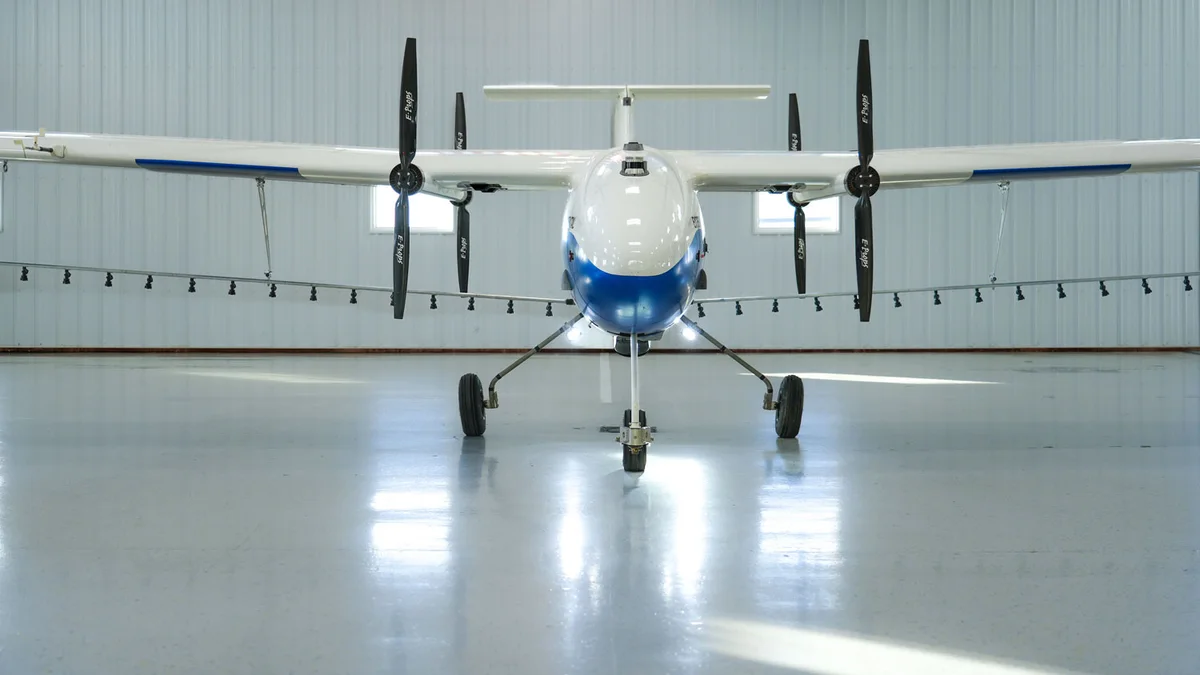
Conventional fuselage-and-tail designs pair a central body with dedicated horizontal and vertical stabilizers, providing predictable pitch damping, directional stability, and modular payload bays. Propeller placement splits this layout into tractor and pusher variants. Tractor configurations mount the propeller at the nose, simplifying motor cooling and balance, yet blades, vibration, and propwash obstruct forward optical views. Pusher configurations move propulsion behind the wing or tail cone, leaving the nose and forward belly completely clear for stabilized electro-optical/infrared (EO/IR) gimbals, laser scanners, and nadir mapping cameras.
Twin-Boom and High-Aspect-Ratio Long-Endurance Airframes
Medium-to-large reconnaissance, maritime patrol, and heavy multi-sensor missions favor twin-boom pusher airframes. Parallel booms extend aft from the wings to support an elevated empennage while framing a rear-mounted pusher engine behind a central pod. This geometry yields high torsional stiffness and an unobstructed nose and ventral bay for heavy turrets and centered fuel tanks that maintain balance during fuel burn. Pairing twin-boom or long-fuselage frames with high-aspect-ratio wings—slender spans that curb wingtip vortices and induced drag—maximizes cruise L/D across extended patrols and runway-based long-endurance operations.
Launch and Recovery Systems (Runway vs. Runway-Independent)
Outside paved airfields, deploying a pure fixed-wing drone depends on launch and recovery engineering—accelerating past stall speed at takeoff and shedding kinetic energy at landing without damaging optical payloads.
Launch Methods: Runway Takeoff, Hand-Launch, Bungee, and Pneumatic or Rail Catapults
Launch equipment scales with maximum takeoff weight (MTOW) and wing loading. Lightweight mapping drones under roughly 3 to 5 kilograms rely on manual hand-launching by a single operator in a minimal clearing, provided launch angle and throttle timing clear stall speed immediately. Midweight airframes between 4 and 12 kilograms frequently use elastic bungee cords or compact ramps for consistent launch velocity without powered ground gear.
In the 15-to-100-kilogram tactical and industrial tier carrying heavy gimbals or extended fuel loads, teams deploy vehicle-mounted or field-assembled pneumatic, hydraulic, or rail catapults. Catapults accelerate airframes to climb speed within meters, preserving runway independence while adding transport volume, setup time, and crew demands. Heavy middle-mile cargo frames and strategic long-endurance aircraft use wheeled landing gear for conventional takeoff and landing (CTOL) on hardened airstrips or roads.
Recovery Methods: Belly Skid Landing, Parachute and Airbag, Deep-Stall, and Net or Skyhook Arrestment
Non-wheeled fixed-wing drones must shed forward momentum cleanly before touchdown. Lightweight foam and composite platforms typically perform belly skid landings onto grass, soil, or snow, often executing a high-angle-of-attack deep-stall flare near the surface to drop airspeed while controlling sink rate. Belly recovery adds zero onboard weight, yet demands an open approach path and exposes ventral optics to abrasion unless protected by sliding shutters or recessed bays.
For tighter sites or fragile payloads, operators integrate ballistic parachutes with ventral airbags or crushable skids, shrinking horizontal rollout and touchdown shock at the cost of wind-drift vulnerability during descent. On ship decks, offshore rigs, and narrow forest clearings lacking rollout or drift space, point-arrestment systems take over: vertical arrestment nets absorb fuselage momentum across tensioned mesh, while wingtip Skyhook rigs intercept a suspended vertical tether that slides along the swept leading edge until a wingtip cleat locks and halts the aircraft safely above the deck.
| Category | Method | Typical MTOW | Site & Crew | Core Trade-Off |
|---|---|---|---|---|
| Launch | Hand / bungee | Under 12 kg | Small clearing; 1–2 crew | No heavy gear; capped payload |
| Launch | Pneumatic / rail catapult | 15–100+ kg | Compact pad; vehicle crew | Runway-free heavy lift; setup time |
| Both | Wheeled runway (CTOL) | 50 kg+ / strategic | Hardened strip or road | Smooth landing; airstrip bound |
| Recovery | Belly skid / deep-stall | Under 15 kg | Open grass or soil | Zero added weight; hard-ground wear |
| Recovery | Parachute + airbag | 5–50+ kg | Medium zone; open downwind | Soft touchdown; wind drift |
| Recovery | Net / Skyhook arrestment | 15–100+ kg | Ship deck or gantry | Pinpoint capture; reinforced frame |
Strengths, Limitations, and Comparison with Hybrid VTOL
Choosing a pure fixed-wing drone over rotorcraft or hybrid variants requires weighing cruise economics against low-speed agility and site readiness.
Core Strengths: Energy Efficiency, Area Coverage, Wind Penetration, and Glide Margin
High aerodynamic L/D allows one fixed-wing sortie to map or patrol several times the area covered by a comparable multirotor battery cycle. Higher cruise speed also improves wind penetration: flying into headwinds demands far less incremental power on an efficient wing than tilting high-drag rotors, maintaining steady ground speed over exposed ridges and coastlines. Equally vital for safety is passive glide margin—following propulsion failure, the aircraft enters a controlled unpowered glide governed by its L/D ratio rather than dropping ballistically, giving autopilots or pilots crucial range to reach an emergency landing zone.
Operational Limitations: No Hovering, Turn-Radius Constraints, and Landing Zone Risk
Those aerodynamic advantages impose concrete operational limits. Unable to hover or station-keep at zero airspeed, fixed-wing drones cannot perform close-range inspections of vertical structures such as telecom towers, bridge piers, or wind turbine blades. Stall speed and bank-angle limits also enforce a physical minimum turn radius, complicating tight reversals inside narrow valleys, urban canyons, or obstructed sites. Moreover, touchdowns on rocky, paved, or uneven surfaces risk ventral wear and impact shock to costly optical lenses or LiDAR units.
Pure Fixed-Wing vs. Hybrid VTOL Variants: The Dead-Weight Trade-Off
Buyers often ask whether hybrid vertical takeoff and landing (VTOL) fixed-wing designs render pure fixed-wing drones obsolete. Aircraft sizing physics show otherwise. Every hybrid VTOL platform carries dedicated vertical-lift hardware—hover motors, lift propellers, booms, speed controllers, and high-discharge hover battery overhead—that rides as idle dead weight throughout horizontal wing-borne cruise. Paired with the parasitic drag of stowed rotors and booms in the freestream, that overhead directly penalizes range and endurance.
At equal maximum takeoff weight, a pure fixed-wing aircraft carries zero vertical-lift dead weight or drag, converting that margin into longer endurance, higher payload mass fraction, and lower cruise power draw. Pure fixed-wing platforms therefore remain unmatched in wide-area surveying, maritime surveillance, and tactical patrol wherever hand-launch, catapult, parachute, or arrestment recovery is feasible, while operators adopt hybrid VTOL fixed-wing architectures specifically when confined sites rule out even runway-independent horizontal recovery.
Common Industrial, Geospatial, and Defense Applications
Fixed-wing drones dominate missions where operational value scales with linear distance traversed or total square kilometers covered per flight.
Wide-Area Topographic Mapping, Forestry, and Agricultural Scouting
Geospatial survey teams and agribusinesses deploy fixed-wing airframes to capture high-resolution orthomosaics, digital elevation models, and multispectral crop health maps across hundreds to thousands of hectares in a single sortie, minimizing battery-swap downtime over expansive forests, mines, and farmland.
Linear Infrastructure Inspection
Long corridors—including oil and gas pipelines, railways, coastlines, and high-voltage power transmission lines—align naturally with fast wing-borne cruise. Beyond-visual-line-of-sight (BVLOS) flights cover dozens to hundreds of kilometers per launch to detect third-party excavation, right-of-way encroachment, coastal erosion, and vegetation hazards.
Maritime and Border Surveillance and Wide-Area Search and Rescue
Across open ocean, remote borders, and wilderness terrain, long-endurance fixed-wing drones sustain hours of high-altitude loiter using EO/IR and thermal sensors to scan wide grids. Public-safety and defense teams frequently pair fixed-wing and rotary platforms in high-low workflows, using fixed-wing aircraft for broad thermal detection while cueing multirotors to hover for close-range confirmation.
Long-Range Middle-Mile Cargo and Emergency Medical Delivery
Across archipelagos, mountain ranges, and remote rural networks, fixed-wing cargo drones bridge middle-mile logistics gaps between regional hubs and isolated clinics. Using prepared strips, catapults, or precision parachute drops, they deliver blood supplies, vaccines, lab samples, and urgent spare parts faster than ground transport over difficult terrain.
Related Terms and Synonyms
Across aviation regulations and industry procurement, fixed-wing drones appear under several standard terms. Fixed-Wing UAV (Unmanned Aerial Vehicle) denotes the aircraft itself, while Fixed-Wing UAS (Unmanned Aircraft System) encompasses the complete operational stack, including airframe, ground control station, data links, and launch or recovery equipment. Fixed-Wing RPA (Remotely Piloted Aircraft) is favored in civil aviation regulatory frameworks emphasizing pilot accountability. To distinguish pure winged aircraft from vertical-lift classes, engineers specify HTOL (Horizontal Takeoff and Landing) or CTOL (Conventional Takeoff and Landing) configurations. Hybrid VTOL Fixed-Wing refers to an adjacent derivative architecture that trades peak pure fixed-wing aerodynamic efficiency and payload fraction for point vertical takeoff and landing in confined operating sites.