
Moving beyond these improvised workarounds drove the engineering of purpose-built hybrid VTOL architectures. Achieving both vertical deployment and long-range cruise efficiency, however, requires airframes and flight controllers that can reliably survive turbulent hover-to-cruise aerodynamic transition while minimizing parasitic drag and dead weight aloft.
What Is a VTOL Fixed-Wing Drone?
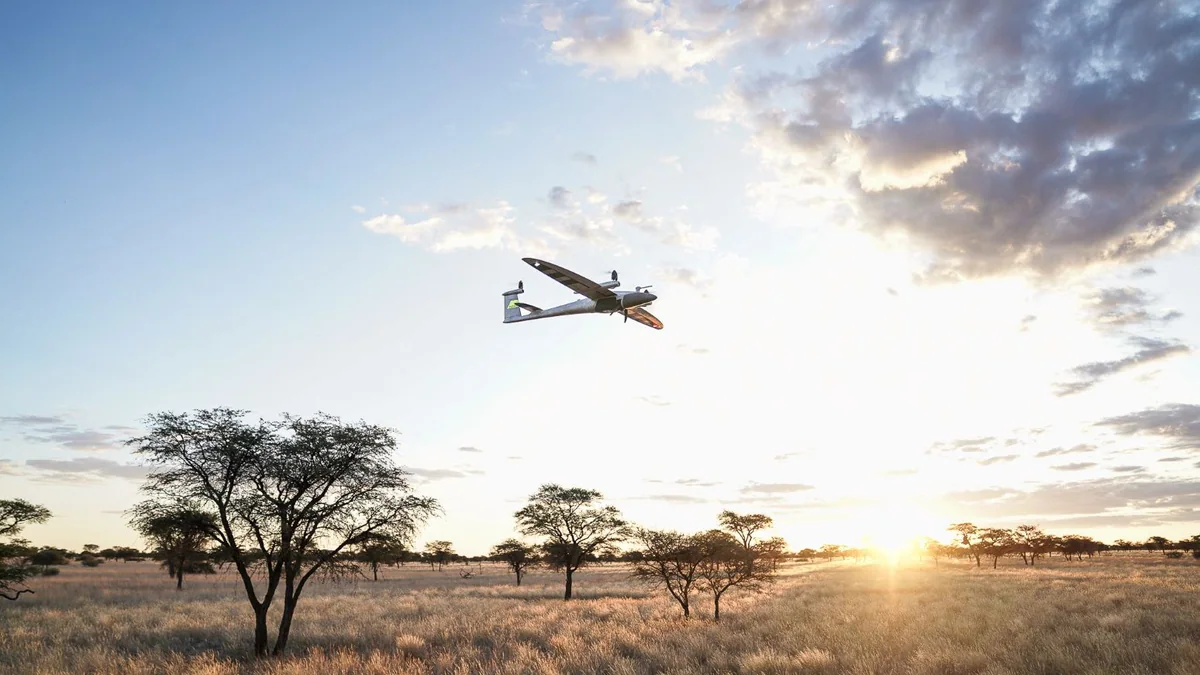
A vertical takeoff and landing (VTOL) fixed-wing drone is a hybrid unmanned aircraft combining rotor-driven vertical launch and recovery with wing-borne aerodynamic cruise. During departure and landing, downward rotor thrust supports the airframe's full weight, enabling operations from confined, unprepared ground without runways, catapults, or recovery nets. Once clear of obstacles, the aircraft accelerates horizontally until airflow across its fixed wings generates lift, sustaining forward flight at far lower power draw than rotorcraft achieve.
This dual-envelope architecture bridges an enduring operational divide across industrial, public safety, and defense aviation. Multirotors launch from tight spaces yet deplete energy quickly over distance, while pure fixed-wing aircraft deliver long endurance yet demand open landing strips or launch gear. Where confined launch sites intersect with wide-area or beyond-visual-line-of-sight (BVLOS) missions—such as vessel decks, forested mountain clearings, and urban rooftops spanning tens to hundreds of kilometers—VTOL fixed-wing platforms have emerged as the standard choice.
How Flight Phases Work: Hover, Transition, and Wing-Borne Cruise
Every VTOL fixed-wing mission follows a five-phase energy and control profile: vertical climb, forward transition, wing-borne cruise, back transition, and vertical descent. Across these phases, the flight controller continuously blends control authority as power demand and aerodynamic stability shift sharply.
Vertical Takeoff, Hovering, and Precision Landing
During takeoff and recovery, vertical rotors carry the entire gravitational load, producing the mission's peak instantaneous power draw. Moving large air masses downward demands intense current, meaning two minutes of climb, hover positioning, and descent can consume a disproportionately large share of usable battery capacity while imposing heavy thermal and C-rate stress on power packs and electronic speed controllers.
Aerodynamic exposure compounds this penalty. At near-zero forward airspeed, a fixed wing provides no stabilizing lift and instead behaves as a large sail. Under gusty crosswinds, wind pressure against the wing and tail creates strong weathercocking and rolling moments, forcing vertical rotors to expend extra control margin just to hold attitude. Consequently, a VTOL fixed-wing drone's vertical takeoff and landing crosswind envelope is consistently lower than its cruise wind rating, making ground wind evaluation vital to avoiding tip-overs or wingtip strikes.
The Transition Corridor: Accelerating to Wing-Borne Cruise and Back Transition
The transition corridor is the most critical flight regime because weight support shifts dynamically from powered lift to wing lift. In forward transition, horizontal thrust accelerates the aircraft until pitot-static airspeed sensors verify speed safely above the wing's stall margin. Once wing lift stabilizes, the flight controller progressively unloads vertical rotors, holding altitude while transferring attitude control from rotor thrust differential to aerodynamic control surfaces.
Back transition reverses this sequence on approach, spooling up vertical rotors before decelerating below stall speed while carefully coordinating pitch attitude and deceleration rate to avoid altitude ballooning. Both transitions remain acutely vulnerable to wind shear and tailwind gusts, which can trigger sudden airspeed loss or uncommanded roll excursions. Capable autopilots therefore enforce into-the-wind heading alignment during transition, cross-check pitot readings against inertial and GNSS-derived ground-speed estimates to protect against pitot blockage, and trigger automated hover-recovery failsafes if airspeed degrades unexpectedly.
Major VTOL Airframe and Propulsion Architectures Compared
Although all VTOL fixed-wing drones traverse the same five-phase envelope, designers balance vertical thrust hardware against clean cruise aerodynamics through three core mechanical architectures, each trading mechanical simplicity against parasitic drag, ground wind stability, and payload flexibility.
| Architecture | Mechanical Complexity | Parasitic Drag & Dead Weight | Crosswind Launch Stability | Payload Integration |
|---|---|---|---|---|
| Separate Lift-and-Cruise ("QuadPlane") | Low; fixed lift motors and separate cruise propulsor | High; idle lift motors and booms add drag and mass | High; wide rotor stance resists ground tipping | High; unobstructed fuselage belly and nose |
| Tilt-Rotor / Tilt-Wing | High; tilt servos, linkages, and pivot bearings | Low; shared rotors pivot cleanly into forward thrust | Moderate to high; varies with nacelle layout | High; level horizontal fuselage attitude |
| Tail-Sitter | Low; no tilt actuators and few moving parts | Minimal; no idle lift rotors or tail booms | Low; upright wing acts as large ground wind sail | Moderate; requires wider gimbal pitch range |
Separate Lift-and-Cruise ("QuadPlane" / 4+1) Configurations
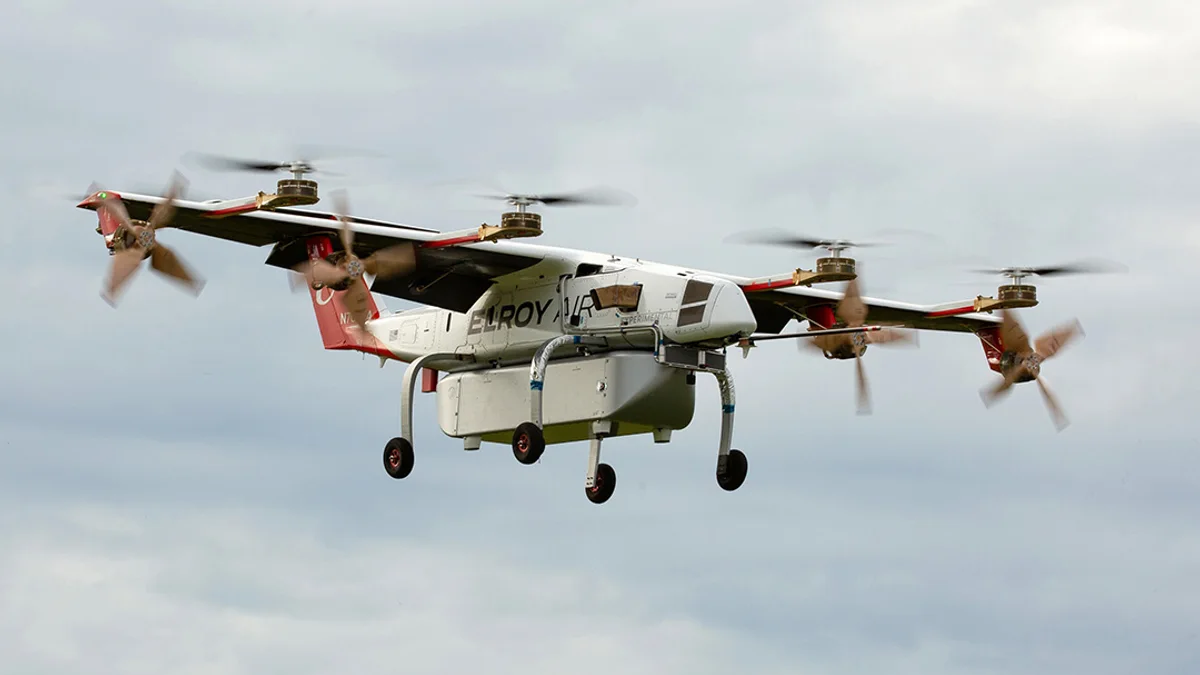
Separate lift-and-cruise designs—typically built as 4+1 or 8+1 QuadPlanes—mount fixed vertical lift motors on twin tail booms alongside a dedicated rear pusher or nose tractor cruise motor. Avoiding tilting linkages or rotating nacelles minimizes single-point mechanical failure modes, simplifies transition control laws, and lowers field maintenance burden. Dedicated vertical rotors also stay immediately ready to supply emergency lift assistance during gusty approaches or low-speed recovery maneuvers. That operational dependability explains why Lift+Cruise holds the largest installed base in commercial mapping and industrial inspection.
Its drawback is cruise aerodynamic inefficiency. Once wing-borne, vertical motors, structural booms, and stopped propellers become dead weight that adds parasitic drag and trims range. Engineers reduce drag by aligning stopped blades parallel to airflow or fitting folding propellers, yet the structural mass penalty of separate propulsion groups remains inherent.
Tilt-Rotor and Tilt-Wing Configurations
Tilt-rotor and tilt-wing designs eliminate dedicated lift-only hardware by repurposing the same propulsion units for hover and cruise. After vertical climb, high-torque servo actuators pivot either the motor nacelles or entire wing-rotor assemblies ninety degrees forward into cruise propellers. Removing idle booms and stationary rotors yields cleaner aerodynamics, higher cruise speeds, and superior range-to-weight efficiency.
The trade-off is heightened mechanical and control complexity. Transition requires tight coordination among tilt angle, rotor thrust, and control-surface deflections as airflow shifts across the wing, making flight-control tuning less forgiving than on a QuadPlane. Tilt actuators, bearings, and structural pivots also absorb cyclic loads and vibration, requiring tighter tolerances, stricter scheduled inspections, and higher lifecycle maintenance discipline.
Tail-Sitter Configurations
Tail-sitters maximize structural simplicity by resting upright on tail fins or wingtip supports, launching vertically, and pitching the entire airframe ninety degrees nose-down into horizontal wing-borne flight. Carrying neither idle lift motors nor tilt actuators, tail-sitters achieve minimal parasitic drag and an exceptionally compact transport footprint suited to portable reconnaissance and confined ship decks.
Pitching the entire airframe introduces distinct operational vulnerabilities. Standing upright on the ground exposes the wing's full planform to lateral gusts, elevating tip-over risk before liftoff and during touchdown. Back transition demands precise pitch-up deceleration to prevent ballooning or tail-stall in turbulence, while electro-optical gimbals require wider pitch travel to accommodate the ninety-degree fuselage attitude shift.
Powertrain Options: All-Electric vs. Hybrid Gas-Electric and Hydrogen VTOL
Powertrain sizing in VTOL fixed-wing aircraft must reconcile brief, high-power vertical phases with extended, low-power cruise. All-electric platforms address this gap using high-discharge lithium battery packs—frequently paired in dual-battery layouts for redundancy or modular logistics—engineered to sustain intense C-rate hover surges while retaining strong gravimetric energy density for cruise. Low acoustic output, minimal optical vibration, and rapid battery swaps make all-electric powertrains dominant across small-to-medium endurance tiers.
In medium-to-heavy long-endurance aircraft spanning roughly 25 to 150 kilograms, liquid fuel's energy density favors hybrid gas-electric architectures. A proven engineering layout pairs a compact high-discharge lithium buffer battery for vertical takeoff, transition, and landing peaks with a four-stroke electronic fuel-injection gasoline or heavy-fuel engine that drives multi-hour wing-borne cruise while recharging the buffer battery aloft via an onboard generator. Designers must position fuel tanks near the aircraft's neutral point so fuel burn does not destabilize center-of-gravity balance before vertical landing. Emerging hydrogen fuel-cell hybrids follow comparable power-buffering principles, combining quiet zero-emission cruise endurance with battery-backed vertical thrust. Operators should recognize that "hybrid" in industry usage refers both to aerodynamic rotor-plus-wing airframes and to battery-plus-fuel powertrains—two distinct engineering dimensions often combined in one platform.
Common Industrial, Public Safety, and Defense Applications
VTOL fixed-wing drones excel where confined launch points intersect with expansive geographic coverage, filling operational gaps between short-range hovering rotorcraft and runway-dependent airplanes.
Large-Area Surveying, Corridor Mapping, and LiDAR or Oblique Missions
Topographic mapping over steep mountains, dense forests, and congested work zones seldom offers smooth ground for belly landings. VTOL fixed-wing aircraft cover wide survey blocks and long corridors per sortie while landing vertically into tight clearings, protecting expensive LiDAR scanners and full-frame oblique photogrammetry cameras from impact shock and abrasion.
Long-Range Linear Infrastructure and Offshore Inspection
Inspecting pipelines, cross-regional high-voltage transmission corridors, railways, and offshore wind farms demands sustained BVLOS cruise speed along narrow routes. Launching from roadside pads, substation yards, or service vessels, VTOL fixed-wing drones patrol tens to hundreds of kilometers per flight without dispersed recovery strips along the corridor.
Border and Maritime Surveillance, ISR, and Search and Rescue
Patrol vessels and coast guard ships offer tight deck space amid shifting sea states, while remote border stations sit in rugged terrain. VTOL fixed-wing platforms deliver vertical deck recovery and austere deployment alongside multi-hour loiter endurance and wide-area electro-optical or infrared coverage for intelligence, surveillance, reconnaissance, and search and rescue.
Regional Agriculture, Forestry Patrol, and Environmental Monitoring
Large agricultural estates, forestry agencies, and conservation teams use VTOL fixed-wing drones to capture multispectral imagery across thousands of hectares, spot early wildfires over mountainous timberlands, and patrol remote wildlife reserves against poaching. Vertical recovery onto narrow fire roads avoids clearing airstrips inside sensitive ecosystems.
Procurement Trade-Offs, Synonyms, and Related Terms
Selecting a VTOL fixed-wing platform requires looking beyond headline endurance to assess field logistics and true operating envelopes. Procurement teams should examine tool-free quick-release wing assembly times and transport flight-case dimensions to confirm rapid deployment by a small crew from standard field vehicles. Equally important is separating cruise wind ratings from vertical takeoff, hover, and transition crosswind limits, since ground-phase weathercocking typically governs real-world dispatch availability. Buyers should also match powertrain architecture to field operations, weighing swappable dual-battery simplicity against the refueling, maintenance, and multi-hour endurance profile of hybrid gas-electric systems.
Precise terminology prevents specification misunderstandings across procurement documents and regulatory filings. Industry literature commonly refers to these platforms as hybrid VTOL drones or hybrid VTOL UAVs, fixed-wing hybrid VTOL drones, transition drones, and dual-mode or multi-mode flight drones. Because "hybrid" can signify either an aerodynamic pairing of vertical rotors with fixed wings or a propulsion pairing of lithium batteries with an internal combustion engine, buyers should explicitly distinguish airframe configuration from powertrain architecture whenever drafting requests for proposals or evaluating vendor datasheets.