
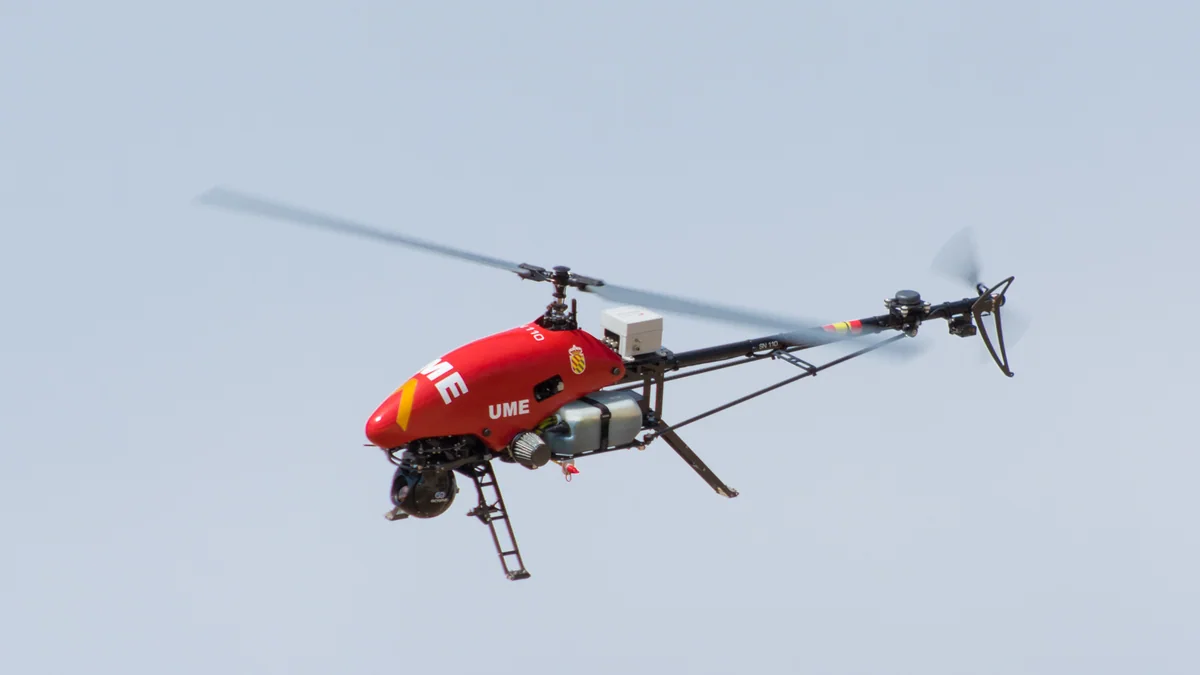
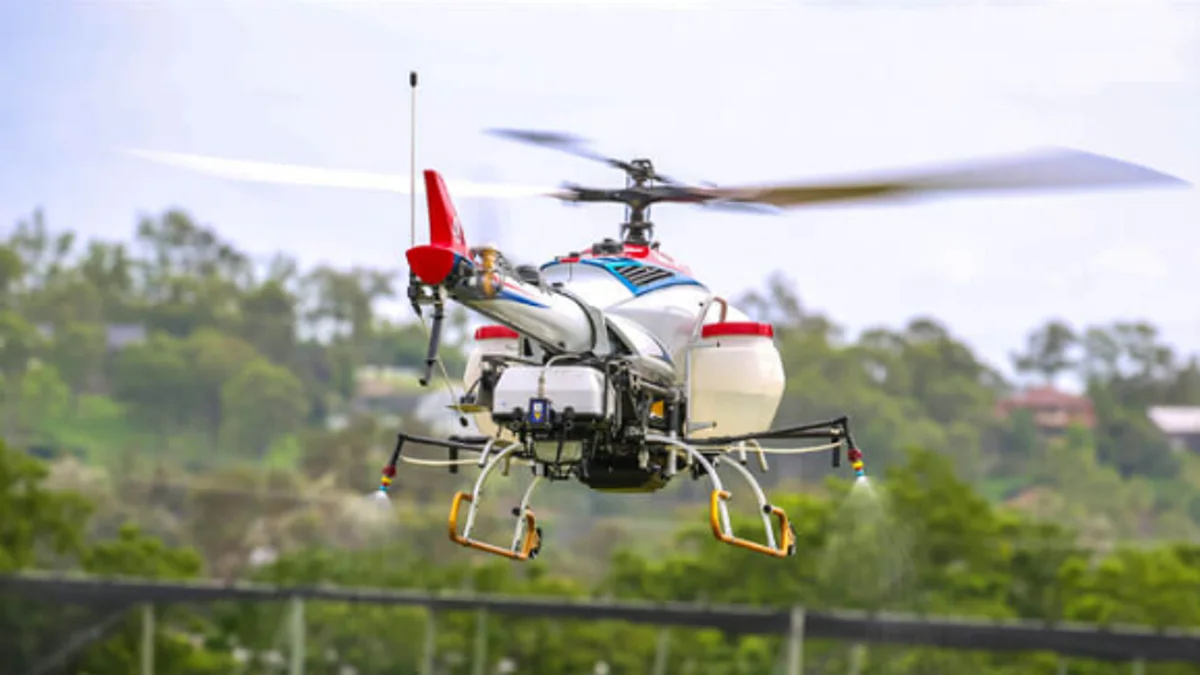
Crossing into heavy-payload, long-endurance rotary-wing missions demands a fundamentally different rotorcraft architecture. By driving a large, low-RPM variable-pitch main rotor at constant speed, an unmanned helicopter commands instantaneous cyclic and collective blade-pitch authority, low hover power consumption, and unpowered autorotation survivability during propulsion failure—capabilities earned at the price of precision swashplate linkages, high-torque transmissions, and disciplined mechanical engineering.
What Is an Unmanned Helicopter?
An unmanned helicopter is a remotely piloted or autonomous rotary-wing aircraft that generates vertical lift and directional thrust using one or two large, variable-pitch main rotors rather than arrays of small fixed-pitch propellers. At the mechanical core sits the swashplate assembly, a dual-ring linkage translating flight-controller servo inputs into continuous blade-angle adjustments while the main rotor maintains a nearly constant rotational speed. Raising or lowering the swashplate changes collective pitch across all blades simultaneously to climb, descend, or hold altitude. Tilting the swashplate applies cyclic pitch, varying each blade's angle of attack dynamically through its 360-degree sweep so the rotor disc tilts forward, aft, or laterally for crisp horizontal thrust and attitude control.
This constant-RPM, variable-pitch architecture defines the aerodynamic scaling divide between unmanned helicopters and fixed-pitch multirotors. Multirotors maneuver by rapidly accelerating and decelerating electric motors, an approach that breaks down as propeller diameters grow because rotational inertia increases sharply with blade radius and mass. Above medium takeoff weights, large fixed-pitch blades cannot change speed fast enough to reject turbulent gusts or maintain precise attitude authority. By decoupling thrust modulation from rotor inertia, unmanned helicopters utilize larger rotor diameters and lower disc loading—the ratio of aircraft weight to swept rotor area—achieving higher hover efficiency, longer endurance, heavier payload lift, and stronger wind resistance. Equally vital for heavy-class safety, a freewheeling clutch decouples the main rotor during engine or motor failure, allowing the aircraft to enter autorotation and convert upward descent airflow into rotor energy for a flared emergency landing.
Main Rotor Configurations and Torque-Countering Designs
Driving a main rotor shaft imposes an equal and opposite reaction torque on the fuselage. Unmanned helicopter designers counter this anti-torque force through four distinct rotorcraft layouts, trading mechanical complexity, footprint, lift efficiency, and center-of-gravity tolerance against mission demands.
Single Main Rotor with Tail Rotor
The single main rotor with tail rotor remains the standard unmanned helicopter layout because one unobstructed rotor disc maximizes hover efficiency and autorotation predictability. A smaller tail rotor mounted on an extended boom counters main-rotor torque and delivers responsive yaw control. Medium and heavy airframes typically drive the tail via a mechanical driveshaft and tail gearbox tapped from the main transmission, whereas select electric and hybrid platforms adopt an independent electric tail motor to eliminate shaft-alignment wear.
Coaxial Counter-Rotating Helicopters
Coaxial unmanned helicopters stack two counter-rotating variable-pitch main rotors on concentric shafts linked to upper and lower swashplates. Opposing torques cancel symmetrically across the mast, eliminating the vulnerable tail boom and tail rotor—an invaluable edge on crowded ship decks, forest clearings, and confined pads. Unlike fixed-pitch coaxial multirotors that rely on motor-speed differentials, coaxial unmanned helicopters retain full cyclic and collective blade pitch control, delivering compact stowage, strong crosswind stability, and high lift density despite greater mast and swashplate complexity.
Tandem Rotor and Intermeshing ("Synchropter") Configurations
Tandem rotor unmanned helicopters mount two large counter-rotating variable-pitch discs fore and aft along an elongated fuselage. All available power drives vertical lift rather than an anti-torque rotor, while differential collective pitch provides an exceptionally wide center-of-gravity envelope suited to voluminous cargo bays and shifting external loads. Intermeshing "synchropter" layouts deliver similar tail-free lift in a shorter footprint by placing two slightly canted, gear-synchronized shafts close together so opposing blades pass safely through each other's swept paths, yielding high heavy-lift stability and low disc loading.
| Configuration | Anti-Torque Method | Footprint | Lift & Efficiency Profile | Key Mechanical Trade-Off |
|---|---|---|---|---|
| Single Main + Tail Rotor | Tail rotor (shaft or electric) | Long tail boom | Highest unobstructed disc efficiency | Tail-strike risk; tail-drivetrain wear |
| Coaxial Counter-Rotating | Concentric opposing rotors | Compact; no tail rotor | High lift per footprint; strong wind stability | Complex concentric mast and dual swashplates |
| Tandem Rotor | Fore and aft opposing rotors | Long fuselage; high volume | Full power to lift; widest CG tolerance | Dual transmissions with synchronizing shaft |
| Intermeshing Synchropter | Synchronized angled twin rotors | Compact length; no tail rotor | Strong heavy-lift stability; low disc loading | Tight intermeshing gearbox tolerances |
Propulsion Options Across Weight Classes
Rotor layout and propulsion are orthogonal engineering choices, yet takeoff weight and endurance strongly dictate which powertrain fits each class across three primary propulsion tiers.
High-Voltage Electric Unmanned Helicopters
High-voltage brushless electric drives power lightweight to lower-medium unmanned helicopters where low acoustic signatures, clean power, and rapid turnaround matter most. Compared with combustion engines, electric drivetrains generate lower mechanical vibration, require no altitude fuel tuning, and cut routine engine maintenance. Although battery energy density restricts endurance relative to hydrocarbon fuels, electric unmanned helicopters excel in short-to-medium-range missions—including precision airborne geophysical surveying and localized heavy hoisting—where minimal vibration and zero exhaust contamination protect delicate instruments.
Piston and Rotary Internal Combustion Engines (Gasoline and Heavy-Fuel)
Two-stroke and four-stroke piston engines, alongside compact Wankel rotary units, anchor medium-class, long-endurance unmanned helicopters. Liquid fuels offer far higher usable energy density than current lithium batteries, enabling multi-hour loiter times for wide-area agricultural spraying, corridor patrol, and maritime surveillance. Across defense and offshore commercial fleets, gasoline engines increasingly yield to compression-ignition or spark-assisted heavy-fuel engines burning kerosene aviation fuels, simplifying logistics alongside shipboard fuel stores while lowering onboard fire hazards.
Turboshaft Gas Turbine Engines
For heavy unmanned helicopters spanning hundreds of kilograms to multi-ton takeoff classes, turboshaft gas turbines deliver unmatched power-to-weight ratios and high-altitude power retention. Driving the main reduction gearbox through a high-speed shaft, turboshafts burn standard naval and aviation kerosenes—JP-5, JP-8, and Jet-A1—making them the default powertrain for frigate-based maritime intelligence, tactical cargo resupply, and optionally piloted rotorcraft conversions. Despite higher acquisition costs and steeper idle fuel burn than diesel-cycle piston units, smooth turbine power and compact core volume unlock heavy-lift and high-altitude envelopes unreachable by reciprocating engines.
Engineering Trade-Offs: Mechanical Complexity, Vibration Control, and Maintenance
Understanding why fixed-pitch multirotors dominate sub-25-kilogram commercial inspection while unmanned helicopters lead heavy, long-endurance, and maritime missions requires evaluating the full mechanical ownership ledger. An unmanned helicopter concentrates propulsion, torque transfer, and attitude control inside precision rotating assemblies: main reduction gearboxes requiring scheduled lubrication and metal-chip inspection, high-speed bearings, swashplate linkages, pitch links, and life-limited blades and hub elastomers. Whereas a hexacopter or octocopter can often survive an isolated motor failure via thrust reallocation, a jammed swashplate actuator or fractured pitch link on a rotorcraft immediately threatens flight control. Professional unmanned helicopters therefore require high-reliability, often dual- or triple-redundant swashplate servo channels, disciplined pre-flight linkage checks, and strict adherence to time-between-overhaul schedules across engines, gearboxes, and rotor heads.
Vibration isolation poses an equally critical engineering challenge. Large two- or three-blade main rotors generate pronounced low-frequency harmonics at one-per-revolution and blade-pass frequencies. Without rigorous dynamic rotor track-and-balance tuning and engineered elastomeric mounts, low-frequency vibration degrades long-range electro-optical gimbal stabilization, blurs radar imagery, and fatigues avionics harnesses. Buyers evaluating unmanned helicopters must therefore budget beyond bare-airframe acquisition for spare drivetrain modules, scheduled gearbox and hub overhauls, blade-balancing equipment, and trained rotorcraft technicians capable of sustaining readiness in austere environments.
Common Defense, Maritime, and Industrial Applications
Unmanned helicopters justify their mechanical and maintenance demands wherever missions require sustained hover or slow-speed flight, heavy payloads, extended endurance, and high-wind resilience that ground lighter multirotors.
Maritime Deck Operations, ISR, and Defense Reconnaissance
Naval vessels, coast guard cutters, and ocean-research ships form the primary buyer base for heavy-fuel and turbine unmanned helicopters. Operating far beyond visual line of sight over open water, these platforms carry maritime search radars, stabilized electro-optical and infrared turrets, and automatic identification receivers for hours. High-sea-state shipboard deployment relies on relative-navigation guidance paired with mechanical deck-lock or harpoon-grid recovery systems that track a vessel's rolling, pitching, and heaving deck in real time, timing touchdown onto a perforated grid and locking the rotorcraft down against gale-force crosswinds.
Heavy Cargo Resupply, Mountain Rigging, and Ship-to-Shore Logistics
Across contested logistics corridors and remote mountain infrastructure zones, heavy unmanned helicopters deliver munitions, medical supplies, generator fuel, and structural hardware directly to austere sites or via external hooks. Underslung sling-load capability lets crews rig bulky power-line insulators, communications masts, or offshore drilling parts beneath the center of gravity without requiring a flat landing pad. At high-altitude outposts where thin air erodes fixed-pitch multirotor hover margins, variable-pitch turbine and turbocharged rotorcraft preserve dependable vertical lift for ship-to-shore and mountain-ridge resupply.
Geophysical Exploration, Long-Corridor Inspection, and Large-Scale Forestry and Agriculture
In commercial operations, airborne geophysical exploration stands out as a high-value niche uniquely suited to unmanned helicopters. Exploration teams tow heavy airborne magnetometers and electromagnetic sensor arrays on long lanyards beneath electric or combustion rotorcraft to fly low-altitude mineral survey grids over rugged terrain. Multirotors struggle here because closely clustered high-current motors create strong electromagnetic interference while offering short endurance under towed drag. Unmanned helicopters also carry heavy multi-return LiDAR and hyperspectral payloads across long utility and pipeline corridors, and execute high-volume aerial spraying over contiguous timberlands and broad-acre farms where wide rotor downwash drives droplets deep into dense canopies.
All-Weather Search, Rescue, and Wildfire Support
Emergency agencies deploy unmanned helicopters when high winds, heavy rain, smoke plumes, or mountain downdrafts exceed small-drone operating limits. Over stormy coastal waters, long-endurance rotorcraft search broad drift grids with thermal sensors and drop inflatable life rafts or beacons to stranded mariners. During nocturnal wildfire suppression—when manned aircraft face acute visibility and terrain hazards—unmanned helicopters sustain continuous overhead infrared hotspot mapping, perimeter tracking, and targeted resupply for isolated ground crews.
Synonyms, Related Terms, and Rotorcraft Distinctions
Across aviation regulations, defense procurement, and commercial specifications, unmanned helicopters appear under overlapping terms including helicopter drone, autonomous helicopter, rotorcraft UAV, remotely piloted helicopter, and the broader category rotary-wing UAV or UAS. Precision matters during fleet evaluation. In civil aviation taxonomy, rotary-wing UAV serves as an umbrella term spanning both fixed-pitch multirotors and variable-pitch helicopters. Within industrial engineering and defense tenders, however, "unmanned helicopter" specifically denotes a variable-pitch, swashplate-controlled rotorcraft—whether single-rotor, coaxial, tandem, or intermeshing—characterized by constant-RPM rotor dynamics, autorotation capability, and heavy-class scaling. Meanwhile, "remotely piloted helicopter" emphasizes supervised human-in-the-loop control, whereas "autonomous helicopter" highlights automated flight management across waypoint navigation, terrain following, and shipboard deck recovery.