
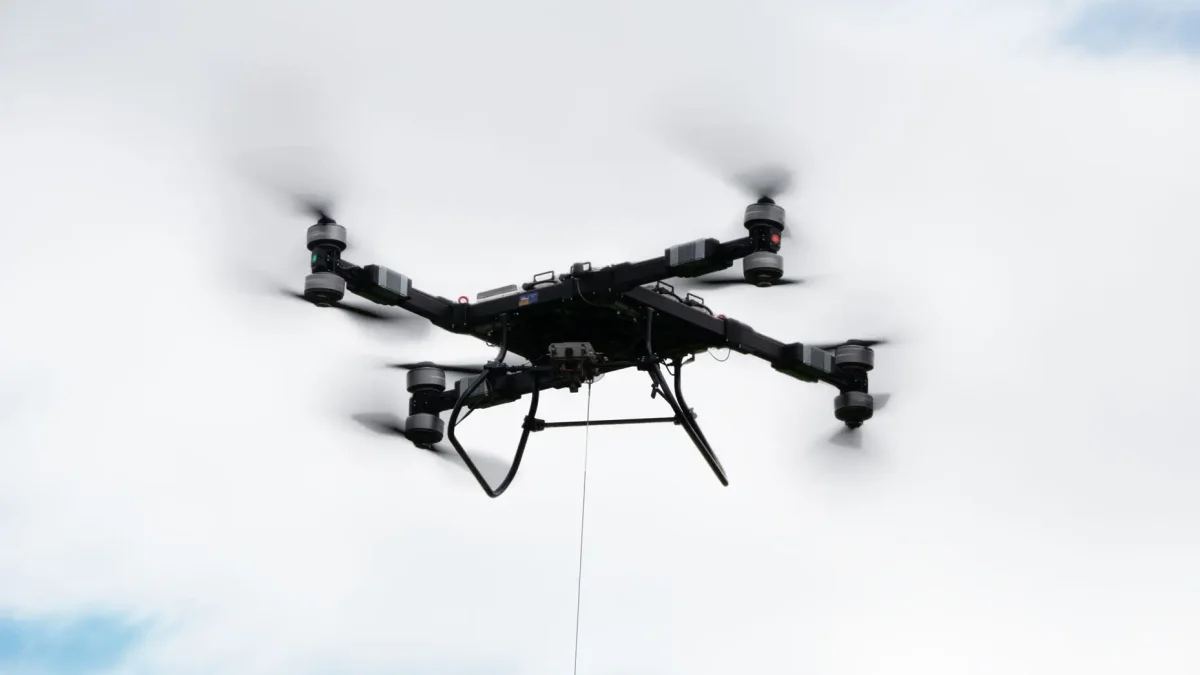
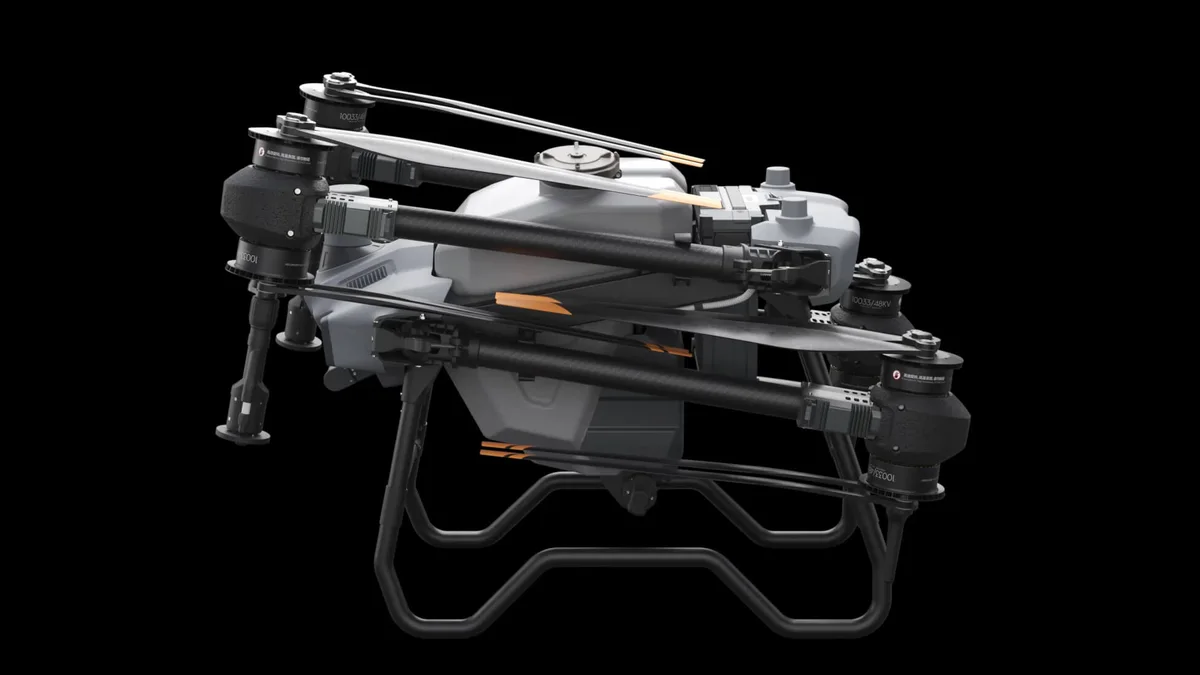
To overcome these footprint limits without sacrificing lift, propulsion engineers trade radial span for vertical density. Stacking counter-rotating rotors on shared axes places the lower disc inside the upper wake, yet designers deliberately accept modest slipstream efficiency loss in exchange for compact thrust density, intrinsic torque cancellation, and arm-level fault survival.
What Is a Coaxial Drone?
A coaxial drone is a rotary-wing unmanned aircraft that stacks two rotors or propellers vertically along a shared central axis, driving the upper and lower discs in opposite directions. Because the counter-rotating surfaces generate equal and opposing aerodynamic reaction torques, the airframe self-balances without an anti-torque tail rotor while compressing its horizontal footprint without forfeiting lift capacity.
In practice, the term covers two distinct engineering species that share only stacked counter-rotation. The first is the true single-axis coaxial rotorcraft—a tailless helicopter using nested concentric drive shafts and variable-pitch swashplates inside a slender cylindrical fuselage. The second is the coaxial multirotor, such as six-rotor Y6 and eight-rotor X8 (octo-quad) configurations, which pairs fixed-pitch electric motors vertically at each arm tip. Separating these two architectures is essential when evaluating packaging envelopes, hover aerodynamics, redundancy, and propulsion integration.
Two Distinct Engineering Architectures Under the "Coaxial" Label
Buyers and airframe engineers often miscommunicate around the coaxial label: tactical reconnaissance teams usually seek a tube-packed single-mast helicopter, whereas heavy-lift logistics and mapping integrators mean a compact four-arm X8 multirotor. Their drivetrains, control mechanics, and failure profiles diverge fundamentally.
Single-Mast Coaxial Rotorcraft (Variable-Pitch and Swashplate Designs)
A single-mast coaxial rotorcraft mounts two counter-rotating main rotors onto one central vertical column, eliminating both outstretched multirotor booms and the fragile tail boom and tail rotor of a conventional unmanned helicopter. Altitude and yaw rely on collective pitch changes, while upper and lower swashplates apply cyclic pitch to tilt the thrust vector in pitch and roll.
For packaging engineering, this layout achieves minimal radial width. Folding blades stow flush against a thermos-like cylindrical body that fits inside a soldier's tactical rucksack, an armored launch tube, or a cramped shipboard locker. Because variable-pitch blades alter angle of attack almost instantaneously without overcoming motor rotational inertia, single-mast designs also deliver superior gust rejection in turbulent air. The trade-off sits inside the rotor head: nested hollow concentric shafts, precision bearings, dual swashplates, and dense pitch linkages raise manufacturing tolerances and scheduled maintenance demands.
Coaxial Multirotors (Fixed-Pitch Y6, X8, and Coaxial Dodecacopters)
Coaxial multirotors retain the mechanical simplicity of direct-drive brushless motors while compressing the span of planar multirotors. Rather than arranging six, eight, or twelve rotors around a wide perimeter, engineers stack two fixed-pitch motor-and-propeller sets vertically at the tip of three, four, or six arms—yielding Y6, X8, and X12 airframes.
Halving the arm count for a given rotor complement shortens booms, lowers carbon-fiber deadweight, and shrinks transport cases. Crucially, coaxial arms provide propulsion redundancy inside a compact diameter: if one motor or speed controller fails on an X8 arm, the opposing motor stays active while the flight controller rebalances the remaining seven rotors to maintain level attitude and execute a controlled landing.
| Engineering Dimension | Single-Mast Coaxial Rotorcraft | Planar Octocopter (Flat Octo) | Coaxial Multirotor (X8) |
|---|---|---|---|
| Projected Footprint | Minimal; no booms or tail rotor | Wide; eight non-overlapping discs | Compact; four arms carry eight rotors |
| Boom Structural Weight | None; central mast fuselage | High; eight long booms and hubs | Moderate; four shorter, stiffened arms |
| Hover Efficiency | Moderate; high aspect ratio offset by wake overlap | High; clean undisturbed inflow on all discs | Lower; lower rotors work inside upper downwash |
| Mechanical Complexity | High; concentric shafts, dual swashplates | Low; direct-drive fixed-pitch motors | Low to moderate; simple motors, tighter cooling |
| Single-Failure Safety | Relies on autorotation or dual-engine coupling | High; seven isolated rotors sustain flight | High; paired arm motor preserves symmetric lift |
Aerodynamics and Engineering Trade-Offs
Coaxial propulsion trades peak hover efficiency for volumetric compactness, crisp directional authority, and operational safety. Examining the fluid dynamics between stacked rotor planes clarifies both its strengths and its endurance penalties.
Torque Cancellation and Yaw Authority
Every spinning rotor exerts an opposing reaction torque on its airframe. A conventional single-rotor helicopter diverts roughly 8 to 12 percent of engine power into a tail rotor solely to counter yaw—producing zero lift while creating a severe strike hazard in tight spaces. Coaxial configurations cancel reaction torque directly at the lifting axis: opposite rotation at matched net torque keeps the fuselage rotationally neutral in hover and cruise.
All shaft power therefore goes directly into lift and forward propulsion. Yaw requires no tail thruster; the flight controller introduces a torque differential by offsetting collective blade pitch between upper and lower rotors on a helicopter, or by throttling one rotational direction faster while slowing the opposing set on an X8 or Y6 multirotor. Yaw response remains symmetric in both directions and resists crosswind weathercocking.
Higher Thrust Density in a Compact Footprint
When missions enforce hard dimensional limits—such as pickup truck beds, vehicle launch canisters, cramped ship decks, or building doorways—thrust per unit of projected planform area becomes the decisive engineering metric. Stacking two rotor planes on one centerline does not double lift for identical power, yet it raises total thrust substantially within a fixed outer diameter relative to a single disc of equal span.
This thrust density enables heavy optical gimbals, LiDAR rigs, agricultural spray tanks, or slung cargo without forcing wide, unwieldy booms. Shorter arms also lower roll and pitch moments of inertia, sharpening maneuverability in gusty urban corridors and confined industrial structures.
Wake Interference, Figure-of-Merit Penalty, Acoustic Signature, and Complexity
The main aerodynamic penalty of shared-axis stacking is slipstream interference. As the upper rotor accelerates air downward, its wake contracts radially into a faster vena contracta before striking the lower rotor plane. Because the inboard portion of the lower disc operates inside turbulent, pre-accelerated downwash rather than still air, its effective angle of attack falls and induced power rises. Across typical hover regimes, coaxial rotor pairs suffer a 10 to 15 percent figure-of-merit penalty compared with two isolated planar rotors generating equal thrust.
Engineers mitigate this penalty through careful aerodynamic matching. Tuning vertical separation between upper and lower planes balances wake recovery against mast height and boom bending loads. Equally vital is differential pitch and RPM matching: fitting identical propellers and throttle curves on both tiers starves the lower blade of aerodynamic bite while overloading and overheating the upper motor. Mature coaxial drivetrains pair the lower tier with higher blade pitch, a higher motor KV rating, or slightly faster RPM so both rotors share load evenly.
Blade-vortex interaction also alters acoustics. As lower blades repeatedly chop tip vortices shed by the upper disc, coaxial drones generate a sharper pulsing beat frequency than comparable planar multirotors, while stacked mounts concentrate heat and opposing gyroscopic loads into a compact structural node.
Procurement and Integration Considerations: Pre-Tuned Coaxial Propulsion Pods vs. Custom Builds
Integrators fielding heavy-lift coaxial multirotors face a pivotal decision between factory-matched coaxial propulsion pods and piecemeal off-the-shelf assembly. Pre-tuned pods bundle upper and lower motors with engineered KV offsets, counter-rotating propellers calibrated for downwash velocity, and shared aluminum housings featuring ducted airflow channels that route rotor wash directly across embedded speed-controller heatsinks.
Custom component builds routinely encounter three engineering failure modes. First, unmatched upper and lower blade pitches skew current draw across the pair, accelerating winding fatigue and magnet demagnetization under sustained heavy hovers. Second, packing two electronic speed controllers into an arm tip without dedicated convective airflow triggers thermal throttling at peak ambient temperatures. Third, opposing high-torque motors at the end of a slender carbon-fiber tube impose intense torsional loads and harmonic vibration; booms lacking torsional stiffness risk aeroelastic flutter, corrupting IMU data and fatiguing clamps. For commercial airframes near maximum takeoff weight, pre-validated pods also provide documented single-motor-out margins confirming the surviving motor and controller can absorb transient thrust spikes through safe recovery.
Common Industrial and Defense Usage Examples
The two coaxial architectures address distinct packaging and payload requirements across commercial and defense operations.
Heavy-Lift Cargo, Agricultural Spraying, and Aerial Rigging
Heavy-lift X8 multirotors and large variable-pitch coaxial helicopters serve high-payload logistics, precision agricultural spraying, and forestry or utility rigging. Eliminating the tail rotor removes rear strike hazards near tree canopies, transmission towers, and ground crews, while compact X8 footprints fit high-capacity sprayers inside standard trailers. Under slung loads, single-motor failure tolerance on coaxial arms adds critical safety over infrastructure and work zones.
Confined-Space, Urban Canyon, and Shipboard Operations
Pitching maritime decks and dense city blocks penalize wide rotor spans and exposed tail booms. On coast guard cutters or offshore support vessels, tailless coaxial drones launch and recover on narrow deck patches without threatening antennas, superstructures, or personnel. Likewise, emergency responders and urban inspection teams fly compact coaxial multirotors between building facades, under bridge decks, and down confined corridors where planar octocopters lack clearance.
Defense, Tactical Backpack ISR, and Tube-Launched Missions
Single-mast coaxial rotorcraft excel in man-portable intelligence, surveillance, and reconnaissance missions demanding rapid vertical launch from austere cover. Folding into cylindrical canisters or tactical rucksacks, they allow dismounted infantry and naval units to deploy persistent hover-and-stare electro-optical payloads or laser designators within minutes. Tube-launched variants extend this compactness to armored vehicles, unmanned surface vessels, and aerial mothercraft, deploying counter-rotating blades immediately after ejection.
Harsh-Weather Industrial Inspection and Environmental Sampling
Offshore wind turbines, suspension bridges, coastal sites, and polar stations subject aircraft to severe shear winds and structural turbulence. Variable-pitch single-mast coaxial drones and high-disc-loading X8 multirotors hold tight attitude authority in gusts that overwhelm lightly loaded planar platforms, while their compact profiles reduce lateral windage during close-range facade inspection and atmospheric sampling.
Synonyms and Related Terms
Across technical specifications and procurement tenders, coaxial drones carry several overlapping names. Single-axis helicopters are commonly called coaxial rotor UAVs or coaxial rotorcraft, whereas multi-arm electric platforms are designated coaxial multirotors, coaxial quadcopters (X8), octo-quads, coaxial hexacopters (Y6), or coaxial dodecacopters (X12) according to arm and rotor count. Industry writing often uses contra-rotating and counter-rotating drones interchangeably, though strict aerospace convention draws a clear distinction: contra-rotating denotes concentric rotors spinning in opposite directions on the exact same shared axis, whereas counter-rotating broadly encompasses any opposing rotor pair, including laterally separated propellers mounted on distinct booms or wings.