
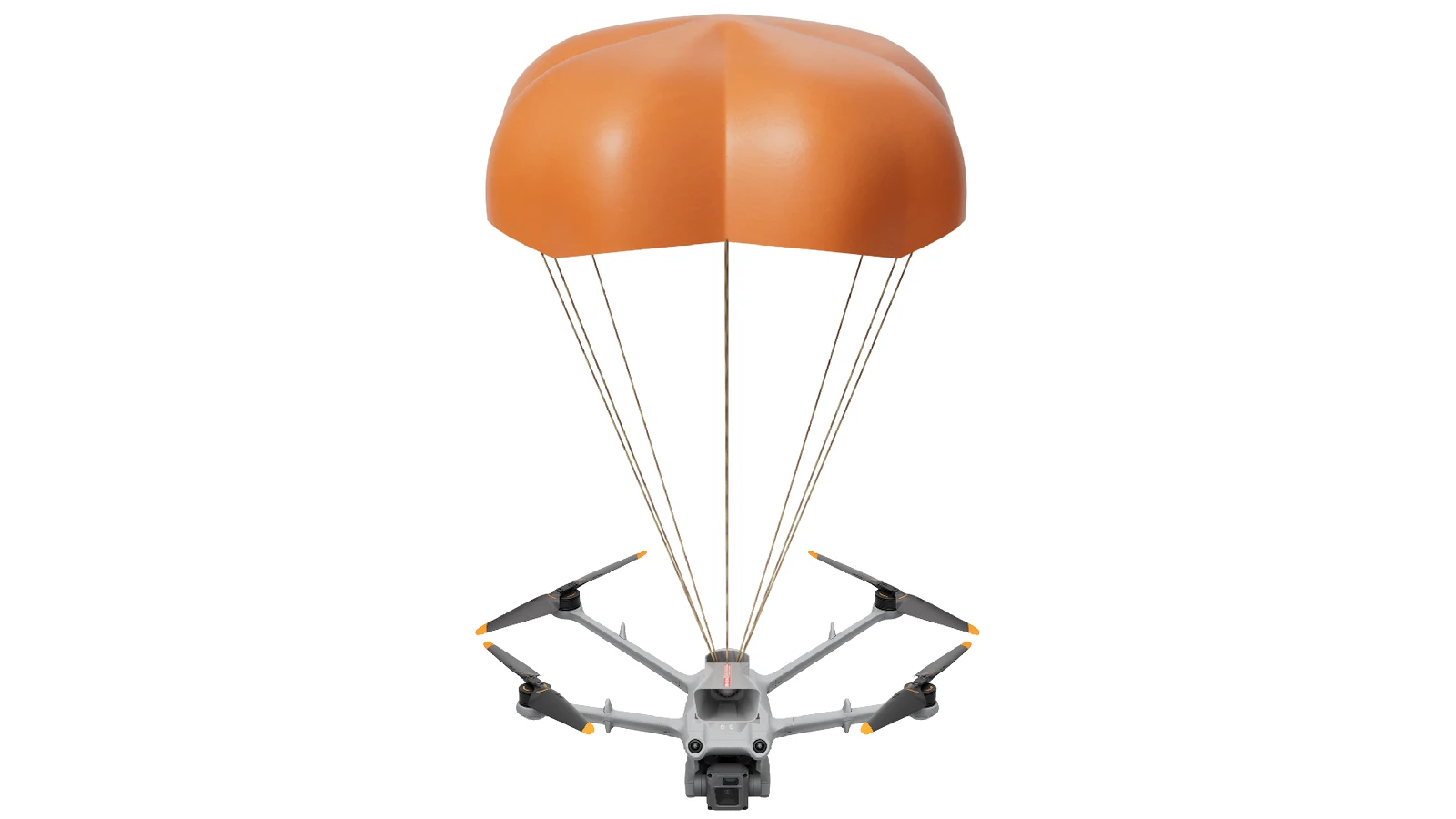
Before the airframe reaches pavement, that deployed drag surface must stabilize the descent and decelerate impact kinetic energy within human survivability thresholds. Mastering this millisecond-scale recovery chain inside tight vertical envelopes separates certified urban flight architectures from unmitigated ground risk.
What Is a Drone Parachute System?
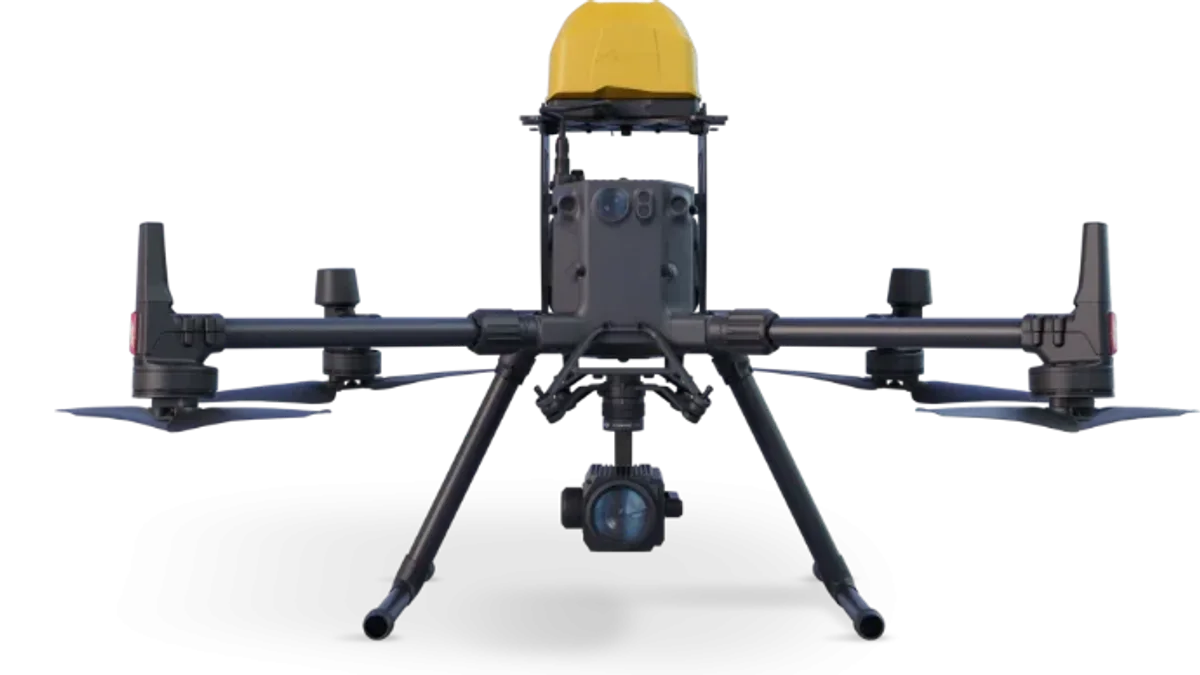
A drone parachute system—formally a parachute recovery system (PRS)—is an emergency deceleration assembly engineered to arrest uncommanded descent after catastrophic inflight failure. When a multirotor or vertical takeoff and landing (VTOL) aircraft suffers propulsion loss, power-bus failure, rotor fracture, or flight-controller lockup, the system rapidly deploys a high-drag canopy. Converting a ballistic fall into a stabilized vertical descent slashes ground impact kinetic energy, curbing injury risk and hardware damage.
In airworthiness taxonomy, emergency ballistic parachutes differ from routine fixed-wing recovery gear. Runway-independent fixed-wing aircraft often use belly landings, arrestor nets, or planned mission-end parachute landings on every sortie. An emergency PRS remains dormant during normal flights, activating strictly during unrecoverable anomalies on rotary-wing, hybrid VTOL, and heavy-lift platforms incapable of safe gliding or autorotation.
How an Emergency Drone Parachute Works in Milliseconds
Commercial drones routinely fly tens of meters above ground, leaving negligible altitude margins compared to crewed aviation. Once thrust fails, an unpowered airframe accelerates downward while tumbling unpredictably, compressing the viable recovery window into hundreds of milliseconds. Reliable mitigation therefore demands a deterministic four-stage chain—autonomous failure detection, instantaneous motor termination, energetic canopy ejection, and full aerodynamic inflation—executing faster than human reflexes allow.
Independent Failure Detection and Autonomous / Manual Triggering
In reliability engineering, a safety layer must never share single-point failure modes with the flight-control system it protects. If a flight battery disconnects, a power bus shorts, or a controller freezes, any aircraft-powered trigger fails simultaneously. High-assurance systems pair an isolated secondary battery with an independent onboard inertial measurement unit (IMU) and barometric processor. Acting as a black-box monitor, this module tracks angular rates, pitch or roll exceedances, and sustained free-fall acceleration, triggering autonomously within fractions of a second. An encrypted manual radio trigger complements autonomous logic, letting pilots command deployment when structural hazards appear visually before automatic limits trip.
Instant Motor Cut-Off and Flight Termination Interlock
Before canopy extraction begins, rotor rotation must cease. Spinning carbon-fiber blades act as rotary shears capable of slicing Kevlar or Dyneema shroud lines instantly or entangling risers around motor hubs. Airworthy systems wire a hardware flight termination interlock into the propulsion path—via inline pulse-width modulation (PWM) interrupters ahead of electronic speed controllers (ESCs), solid-state power cut-off relays, or certified kill inputs tied to an independent flight termination module. Triggering cut-off tens of milliseconds before ejection allows aerodynamic drag to scrub rotor energy before lines cross the rotor disk.
Rapid Canopy Ejection Mechanisms
Passive gravity deployment fails on tumbling multirotors because inverted attitudes and turbulent rotor wash trap slow-moving packs against the airframe. Effective recovery requires energetic ballistic extraction that propels the folded canopy and bridle clear of the rotor tips and disturbed wake within milliseconds. As riser and suspension lines snap taut, the deployment bag strips away, exposing canopy fabric directly to clean airflow. The propulsion medium supplying this impulse dictates weight efficiency, reaction speed, field reset, and air-transport legality.
Canopy Inflation, Descent Rate, and Ground Impact Energy Reduction
Once clear, freestream air inflates the canopy into high-drag equilibrium. Ground impact kinetic energy scales linearly with mass and with the square of descent velocity (Ek = 1/2 mv²); halving terminal speed cuts impact energy to one quarter, turning a lethal strike into a survivable touchdown. Most multirotor kits use unguided round or cruciform drag canopies for rapid symmetric opening and low pendulum swing, whereas select heavy-lift and defense platforms deploy steerable ram-air parafoils with servo-actuated lines to avoid water or rooftops. Industrial kits also occasionally add underside airbags and automatic wind-drag disconnects that release one riser at touchdown to prevent surface gusts from dragging the airframe.
Ejection Technologies Compared: Pyrotechnic vs. Compressed Gas vs. Spring-Loaded
Selecting an ejection mechanism balances aircraft maximum takeoff weight (MTOW), impulse speed, field turnaround, and logistics. Because energetic charges and pressurized cylinders trigger dangerous goods restrictions on commercial flights, traveling inspection teams face different constraints than fixed-base heavy-lift operators.
| Ejection Type | Propulsion Medium | MTOW & Impulse | Air-Travel Status | Field Reset | Maintenance |
|---|---|---|---|---|---|
| Pyrotechnic | Solid energetic charge | Highest impulse; heavy-lift | Hazmat; barred from passenger air | Replace single-use cartridge | Shelf-life and hazmat storage |
| Compressed Gas | Pressurized CO2 or nitrogen | High force; mid-to-heavy | Restricted hazmat; vessel rules | Fast cylinder swap and repack | Seal checks; cold derating |
| Mechanical Spring | Stored spring or band tension | Moderate impulse; light-to-medium | Non-hazmat; travel-safe | Tool-free manual field repack | Tension and canopy checks |
Pyrotechnic and Ballistic Launchers
Pyrotechnic launchers fire an electrically initiated energetic charge—similar to automotive airbag inflators—to pressurize a launch tube instantaneously. This chemistry delivers the highest thrust-to-weight ratio and fastest line-stretch velocity, suiting heavy-lift industrial, agricultural, and cargo drones whose massive canopies require high extraction momentum. The trade-off is logistical friction: International Air Transport Association (IATA) dangerous goods rules classify initiators as explosives, barring passenger air travel and complicating cross-border freight, while each firing expends a single-use cartridge requiring licensed hazmat stock.
Compressed-Gas Cartridge Systems
Pneumatic launchers substitute pyrotechnics with sealed high-pressure cylinders of liquefied carbon dioxide or compressed nitrogen. Upon triggering, an electromechanical pin punctures the seal, driving a piston or venting gas to eject the canopy rapidly without combustion heat. Pneumatic systems deliver strong launch authority for mid-to-heavy airframes and fast field resets after swapping cylinders and repacking fabric. Still, pressurized vessels face aviation shipping restrictions, and sub-zero missions must manage cold-induced pressure drop that lowers launch velocity unless mitigated through nitrogen charging or thermal design.
Mechanical Spring and Elastomer Systems
Mechanical launchers store energy in compression springs or elastomeric bands held by an electromechanical latch or thermal release wire. Containing neither explosives nor compressed gas, they remain non-hazmat and travel-safe, letting mobile survey and inspection crews check them onto commercial flights without special declarations. Equally decisive is consumable-free reuse: after inadvertent activation or testing, teams inspect, fold, and repack the canopy manually on site in minutes. Their physical limit emerges at heavy takeoff weights, where scaling spring mass and housing volume eventually penalizes endurance more than pyrotechnics.
Minimum Deployment Altitude (MDA), Standards (ASTM F3322), and Weight Trade-Offs
Mounting a parachute does not guarantee protection at every height. Every unit operates above a Minimum Deployment Altitude (MDA)—the lowest altitude where the system can detect failure, kill motors, eject the pack, inflate the canopy, and reach terminal descent velocity before impact. If a rotor fractures while hovering ten meters above ground near a tower or treeline, a large canopy typically remains uninflated at touchdown. Risk engineers treat MDA as a firm operational floor shaping climb corridors and standoff distances during low-altitude proximity work.
Because regulators reject unverified drag estimates, qualification centers on third-party standards such as ASTM F3322 for small unmanned aircraft parachute recovery systems. ASTM F3322 requires independently witnessed, full-scale drop testing of the exact aircraft-and-parachute pairing across propulsion loss, forward-flight upsets, and worst-case tumbles. Testing empirically validates deployment reliability, MDA thresholds, steady-state descent rates, and impact kinetic energy alongside repacking intervals and maintenance procedures.
This certified margin carries integration trade-offs. The canister, isolated avionics, harness, and cut-off wiring add deadweight that trims payload capacity or endurance. Mounted atop the central fuselage for an unobstructed upward firing arc, canisters raise vertical center of gravity (CG) and lateral windage. Integrators must re-verify attitude tuning, validate hardpoints against opening-shock loads—briefly reaching multiples of static aircraft weight—and maintain clearance so canisters neither shadow global navigation satellite system (GNSS) antennas nor disturb magnetometers.
Common Usage Examples and Operational Drivers
Across commercial and public-sector fleets, parachute procurement rests on regulatory market access, urban risk governance, and capital-asset protection.
Regulatory Compliance for Operations Over People and Urban BVLOS
For enterprise operators, the primary driver for certified parachute integration is unlocking approvals closed to unmitigated aircraft. Under the Federal Aviation Administration (FAA) Part 107 Operations Over People rule, routine flights over uninvolved crowds without site-specific waivers require meeting strict ground impact kinetic energy ceilings through an FAA-accepted Means of Compliance, commonly fulfilled via ASTM F3322-qualified aircraft-and-parachute pairings. Under the European Union Aviation Safety Agency (EASA) and the Joint Authorities for Rulemaking on Unmanned Systems (JARUS) Specific Operations Risk Assessment (SORA) framework, an independently validated parachute qualifies as an M2 Ground Risk Mitigation, lowering an operation's Ground Risk Class (GRC) and accelerating urban beyond visual line of sight (BVLOS) authorizations. Consequently, buyers routinely procure pre-certified aircraft-and-PRS combinations specifically to compress licensing timelines.
Commercial, Public Safety, and Urban Industrial Operations
Once regulatory approval is secured, certified recovery hardware sustains daily operations across congested spaces where remote safety buffers cannot exist. Public safety agencies operating urban Drone as First Responder (DFR) programs launch directly from precinct rooftops over busy roadways, neighborhoods, and active incidents, relying on ballistic parachutes for municipal risk accountability. Similar dynamics govern urban facade inspections, bridge assessments, live event security, and campus or suburban last-mile delivery, where unpredictable pedestrian traffic beneath flight paths makes emergency deceleration a baseline prerequisite.
Protecting High-Value Payloads and Custom Airframes
Even over unpopulated corridors where human exposure is minimal, parachutes justify their cost through asset-protection economics. Enterprise drones routinely carry specialized sensors worth several times the airframe—including survey-grade LiDAR scanners, medium-format oblique photogrammetry cameras, and optical gas imaging detectors. During battery cell collapse or single-axis motor failure, an unmitigated drop onto asphalt destroys precision optics and calibrated inertial cores. Lowering touchdown velocity converts total write-offs into minor gear repairs while safeguarding mission data, and commercial drone insurance underwriters increasingly factor tested parachute installations into hull coverage and risk pricing.
Synonyms, Related Terms, and FTS Coordination
Across standards, procurement tenders, and regulatory filings, emergency deceleration hardware appears under interchangeable terms: UAV parachute recovery system, UAS parachute system, parachute recovery system (PRS), emergency drone parachute, and drone recovery system. While the first four unambiguously denote contingency safety hardware, teams should clarify the broader phrase drone recovery system, which in fixed-wing contexts often refers to routine mission-end landing parachutes, airbags, or capture nets.
Equally critical is separating a PRS from a UAV flight termination system (FTS). An FTS enforces containment: when a drone loses command links or threatens to breach geofences toward airports or crowds, the FTS immediately cuts thrust to keep the runaway aircraft inside its authorized volume without slowing descent. A PRS minimizes ground impact energy once flight ends. In high-risk urban and BVLOS operations, both subsystems couple seamlessly—FTS cut-off guarantees containment and clears spinning rotors, immediately triggering PRS ballistic deployment to protect people and property below.