
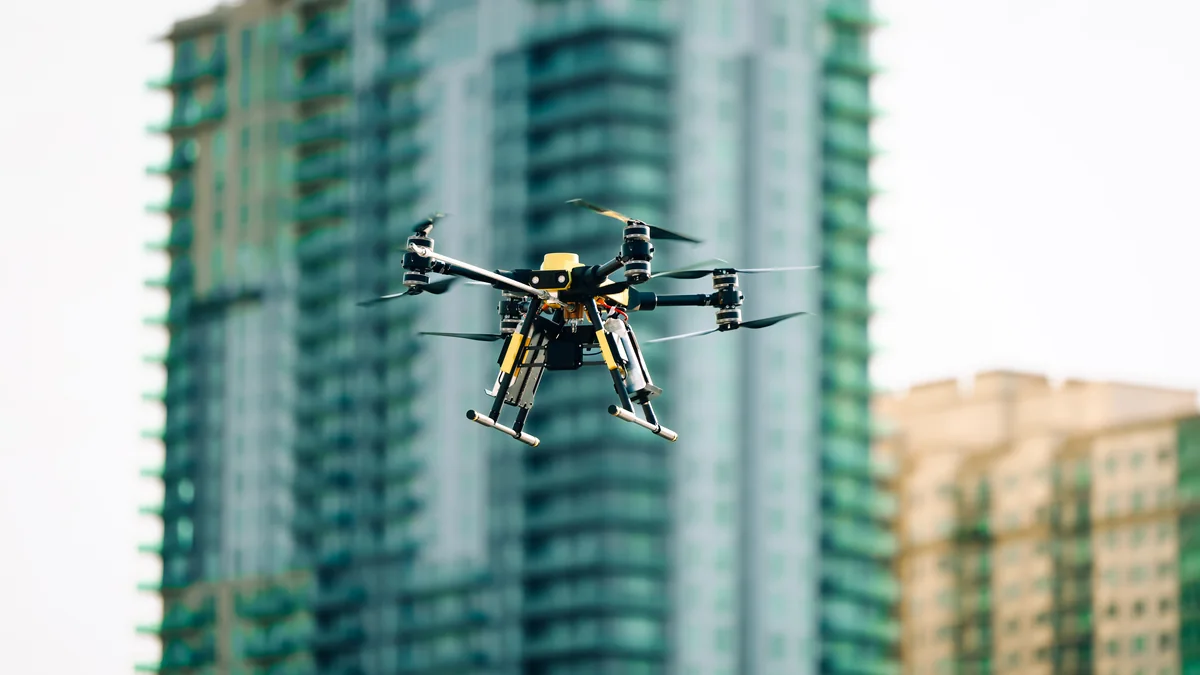
Putting a high-pressure lance several stories into the air demands far more than strapping a spray nozzle to a heavy-lift airframe. Every meter of climb adds the suspended deadweight and crosswind catenary drag of a water-filled hose, while valve actuation unleashes continuous nozzle recoil thrust and pitching moments in midair. Delivering commercial-grade exterior washing therefore requires solving flight stabilization, active recoil compensation, and ground pure-water pumping as one coupled machine.
What Is a Cleaning Drone?
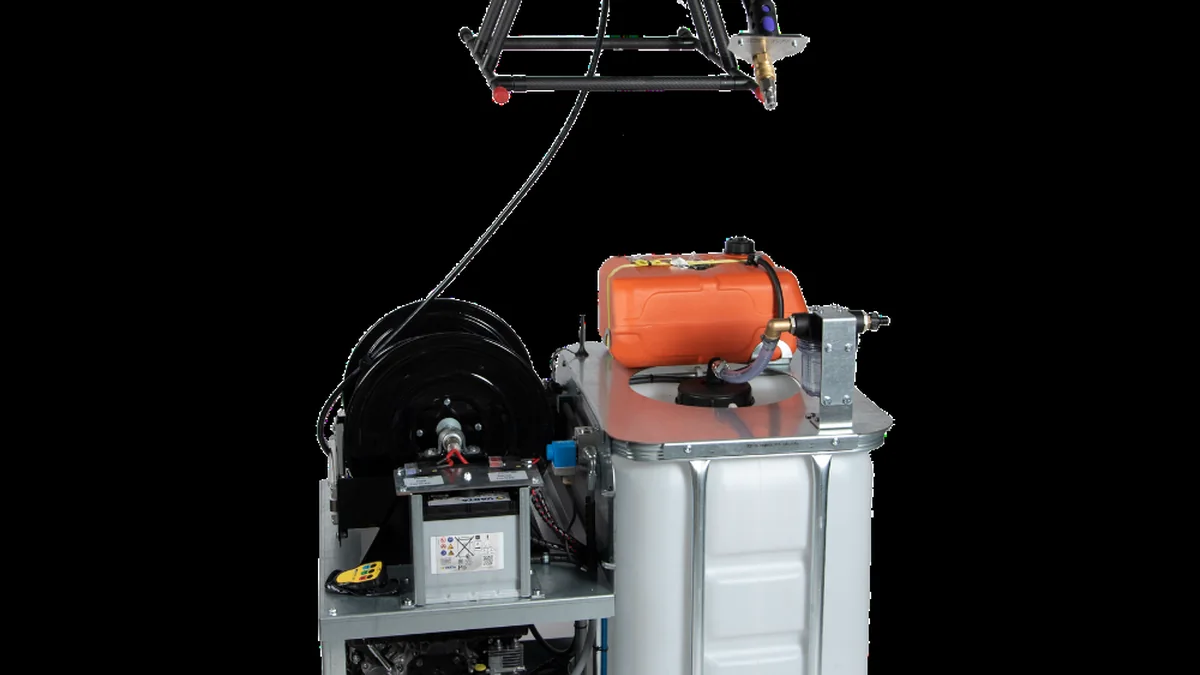
A cleaning drone is an integrated aerial washing system engineered to wash elevated architectural, commercial, and industrial surfaces without putting human technicians at height. Rather than operating as a self-contained aircraft, a commercial platform functions as a coupled air-ground fluid-mechanics system uniting a heavy-lift multirotor airframe, a pressurized delivery hose—and in some configurations a power tether—with a ground-based pump, chemical proportioning manifold, and water-treatment trailer. Because water is heavy and facade rinsing demands continuous flow, carrying wash water onboard is aerodynamically impractical for multi-story work. Ground-tethered fluid supply therefore defines this class, setting it apart from agricultural sprayers carrying finite chemical tanks over flat fields and from firefighting tethered drones engineered for extreme thermal suppression and high-flow fire-truck foam manifolds.
The primary commercial driver is eliminating the working-at-height risk and setup overhead of rope-access technicians, suspended building maintenance units (BMUs), boom lifts, and scaffolding. Conventional access on urban towers entails multi-day rigging, roof-anchor certification, street closures, and high fall-protection liability. Keeping crews safely behind a ground perimeter while flying a stabilized wash platform compresses mobilization schedules, avoids roof-anchor loads, and lowers labor exposure across recurring exterior maintenance contracts.
Cleaning Mechanisms: Soft-Washing, High-Pressure Jetting, and Contact Brushing
Effective exterior maintenance aligns fluid pressure, chemistry, and mechanical contact to substrate durability rather than applying brute hydraulic force to every surface.
Low-Pressure Chemical Soft-Washing and Deionized Pure-Water Rinsing
Soft-washing uses chemistry rather than impact energy to dissolve biological growth, soot, and atmospheric grime. The drone first coats vertical masonry, coated aluminum cladding, or roof shingles with low-pressure biodegradable surfactant or algaecide foam that clings long enough to break down biofilm and oxidized film. After dwell time elapses, the crew switches to a low-pressure rinse supplied by a ground-based reverse-osmosis and deionization (RO/DI) filtration trailer.
Deionized pure water is essential on glass curtain walls. Ordinary tap water carries dissolved calcium, magnesium, and silica that dry into chalky white spots in sunlight; stripping dissolved solids to near-zero mineral conductivity lets rinsed glass dry completely spot-free without squeegeeing. Maintaining low nozzle pressure simultaneously shields perimeter silicone sealants, window gaskets, painted composite panels, and photovoltaic anti-reflective coatings from erosion.
High-Pressure Water Jetting and Articulated Nozzle Gimbals
Heavy industrial dust, weathered concrete, marine salt crust, and compacted masonry grime resist low-pressure chemistry alone. Medium- to high-pressure water jetting applies concentrated kinetic energy through interchangeable fan or rotating nozzles powered by trailer-mounted piston pumps, allowing technicians to dial pump pressure and spray fan angles down for painted cladding or up for bare concrete and weathered steel. Because high-velocity streams generate strong mist rebound off solid walls, jetting airframes position nozzles on extended forward carbon-fiber lances equipped with pitch-articulated gimbals.
Tilting the lance across a vertical arc lets pilots reach recessed soffits, sills, and sloped roofs while maintaining safe lateral wall clearance. Positioning the tip well ahead of the rotor disk also prevents atomized backspray and detergent mist from being ingested into propellers, motor windings, and flight avionics.
Contact Rotary Brushes and Specialized De-Icing or Coating Variants
Hardened contaminants such as baked-on bird droppings, chalked paint, or tacky industrial residues often defeat touchless spraying. Contact-cleaning variants fit the forward boom with standoff guide rollers or lightweight electric rotary brushes, adding controlled mechanical scrubbing while water flushes loosened residue away. Pressing against vertical glazing introduces lateral friction and yaw-coupling loads that require compliant arms and tight attitude damping to prevent bouncing across window mullions.
This stabilized fluid-delivery architecture also supports adjacent maintenance missions. Swapping detergents for specialized liquids lets operators spray de-icing and anti-icing fluids onto frozen wind turbine blades in winter or apply hydrophobic and anti-corrosion coatings across hard-to-reach steel superstructures.
Tethered Engineering Challenges: Hose Weight, Nozzle Recoil, and Power Modes
Evaluating a cleaning drone for field deployment requires looking past unloaded flight-ceiling specifications and analyzing the coupled physics of tethered fluid mass, hydraulic recoil, and airborne power delivery.
Altitude Limits Dictated by Water-Filled Hose Weight and Wind Drag
Unloaded altitude figures bear little relation to actual working height during a wash. Every ten meters of climb forces the multirotor to hoist another ten meters of pressure-rated hose jacket plus the full pressurized water column inside its bore. Because water mass rises quadratically with inner hose diameter, even small bore increases consume payload margin rapidly and erode gust-recovery thrust, while ground pumps must simultaneously overcome rising hydrostatic head pressure and internal pipe friction to preserve upper-floor atomization.
Crosswind drag compounds this mass penalty. A long hose draped down a high-rise behaves like a vertical sail exposed to building-corner Venturi gusts and wind shear. Lateral wind bows the line into a sweeping catenary curve whose horizontal and downward tension pulls the aircraft off-axis, demanding sustained roll and pitch trim that drains battery reserves and imposes a hard physical ceiling on serviceable floors. Experienced field teams mitigate this envelope constraint by pairing thin-wall, high-tensile lightweight hoses with strict wet-weight thrust-margin calculations rather than relying on dry takeoff ratings.
Active Recoil Compensation, Standoff Distance Locking, and Waterproofing
Opening a pressurized nozzle midair produces an immediate rearward Newtonian reaction force along the lance axis. Because the spray tip is offset ahead of or below the aircraft's center of gravity, valve actuation drives both backward acceleration and an abrupt nose-up pitching moment. Purpose-built flight controllers counter recoil through feed-forward thrust compensation—pitching forward and boosting rear-rotor thrust in proportion to pump pressure or valve telemetry—paired with high-rate inertial damping that stops pitch oscillations when flow cuts off.
Uniform cleaning coverage also requires locking a steady nozzle-to-wall gap despite turbulent facade updrafts. Forward-facing ultrasonic sensors, solid-state LiDAR, or millimeter-wave radar continuously measure wall range, enabling semi-autonomous distance holding—typically between 1.5 and 3 meters—so spray fan width and impact pressure remain consistent across horizontal passes. Combining millimeter-wave radar or acoustic ranging with optical LiDAR proves especially valuable along mirrored glass curtain walls, where specular reflections and thick water mist can degrade purely optical distance returns. Operating inside dense mist and chemical aerosols further demands high-ingress waterproofing across motors, electronic speed controllers, and avionics bays alongside corrosion-resistant hardware.
Onboard Battery Swap and Water Hose vs. Dual Water-and-Power Tethered Systems
Commercial fleets divide into two power-supply architectures trading climb agility against continuous duty cycle.
| System Attribute | Water-Only Tether + Battery Swap | Dual Water-and-Power Tether |
|---|---|---|
| Airborne Tether Load | Pressurized water hose only | Water hose plus high-voltage DC power cable |
| Flight Endurance | 15–20 minutes per battery pack | Multi-hour continuous hover |
| Practical Altitude Ceiling | Higher vertical reach, lower wind drag | Lower climb ceiling from combined tether mass |
| Ground Footprint | Compact pump skid, DI tank, chargers | Larger generator, power converter, and pump trailer |
| Optimal Mission Profile | Taller facades and complex urban setbacks | Broad mid-rise walls requiring nonstop throughput |
Water-only tethered platforms minimize suspended cable mass, preserving agility around overhangs and reaching higher stories at the expense of 15- to 20-minute descents for battery swaps. Dual-tethered platforms supply high-voltage direct current alongside the hose from a ground generator, eliminating swap downtime across expansive low- and mid-rise walls where combined tether weight remains comfortably within thrust limits.
Common Commercial and Industrial Applications
Aerial washing delivers the strongest return where elevated geometry, fragile surfaces, or hazardous access drive up manual rigging costs.
High-Rise Windows and Glass Curtain Walls
Commercial office towers and hotel atriums form the flagship market for spot-free RO/DI rinsing, allowing rapid glass washes without roof davits or workers suspended outside occupied suites. Realistic scoping acknowledges touchless limits: deeply recessed mullions can shadow corners from angled spray fans, while years-old baked silicone bleed, mineral etching, and heavy mortar splatter still require periodic rope-access scraping and manual squeegeeing.
Building Facades, Cladding, Domes, and Commercial Roofs
Stadium domes, curved canopies, vaulted skylights, and fragile clay-tile or membrane roofs expose walking crews to fall and structural-breakage hazards. Soft-washing drones treat algae, lichen, and soot across sloped roofs and stone or composite cladding from above without placing footsteps on brittle glazing or aging decking, preserving roof integrity while removing collapse risk.
Utility-Scale and Rooftop Solar Panels
Accumulated dust, pollen, and sand steadily reduce photovoltaic yield, and low-pressure deionized rinsing cleans glass without abrasive dry-brushing scratches that degrade anti-reflective coatings. Within solar maintenance, drones occupy a clear niche relative to automated rail-mounted cleaning robots: whereas vast, flat, uniform ground-mounted arrays often favor fixed track-driven robotic sweepers, cleaning drones excel on elevated solar carports, steep-pitched or fragmented commercial rooftops, uneven terrain, and floating solar plants where mounting permanent mechanical rails is structurally impractical or cost-prohibitive.
Energy, Marine, and Transport Infrastructure
Tethered washing systems also serve industrial corridors where asset downtime carries steep penalties. Wind operators strip insect residue and gearbox oil from tall turbine blade leading edges and apply winter de-icing without mobilizing heavy cranes. Electric utilities perform pure-water insulator washing under strict de-energized or controlled live-line rules to clear conductive salt and dust. In maritime and transport corridors, aerial rigs rinse salt from high-freeboard cargo ship hulls in port and clean elevated bridge abutments and highway noise barriers.
Safety Setup, Ground Exclusion Zones, and Alternative Terms
Safe field execution starts on the ground before pumps pressurize. Falling overspray and dislodged facade debris create pedestrian slip hazards below the wash envelope, requiring barricaded ground exclusion zones sized for operating altitude and crosswind drift. Crews must also manage chemical runoff through storm-drain socks, containment berms, or vacuum recovery mats to meet local environmental discharge codes. Because urban building washing places aircraft near occupied facades, busy streets, and rooftop antennas, operators need near-structure flight approvals, multipath-resilient positioning or optical-flow fallbacks in urban canyons, and tight voice coordination between the pilot and ground pump operator.
Across facility tenders, aviation filings, and contractor specifications, the sector uses several interchangeable terms. Service providers routinely market the workflow as drone washing, drone cleaning, aerial washing, or UAV cleaning, while manufacturers and commercial property buyers typically classify dedicated airframes as facade cleaning drones or building cleaning drones depending on whether contracts emphasize glazed towers or broader building envelopes.