
What Is a Tethered Drone?
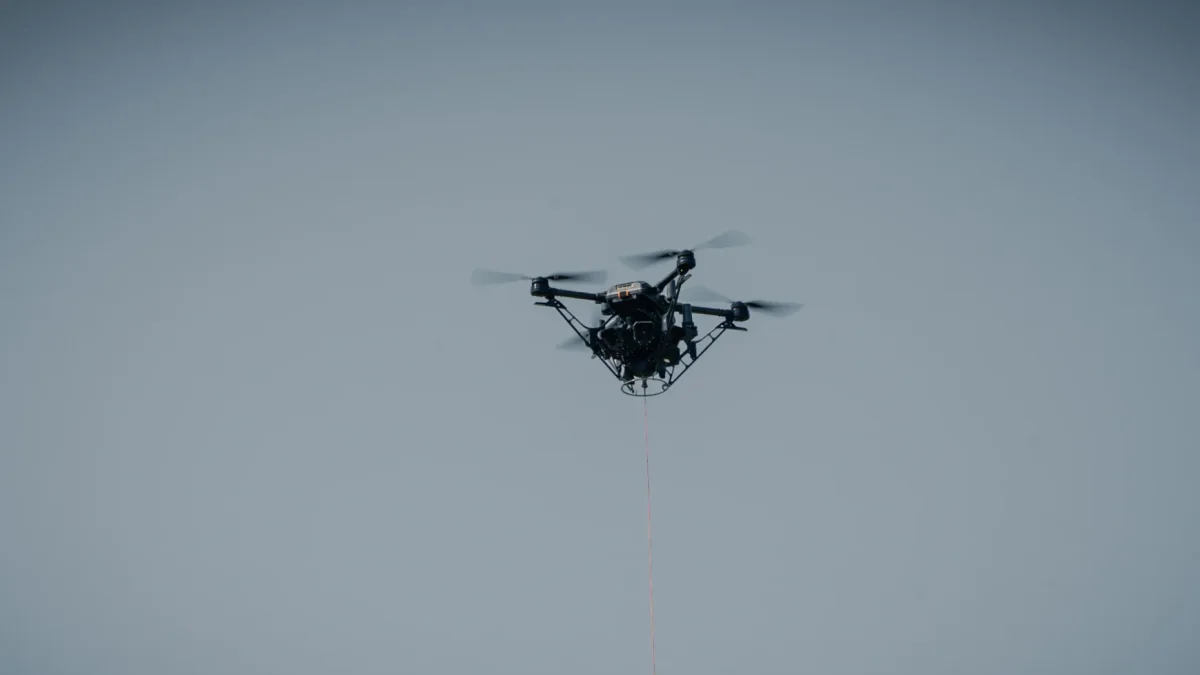
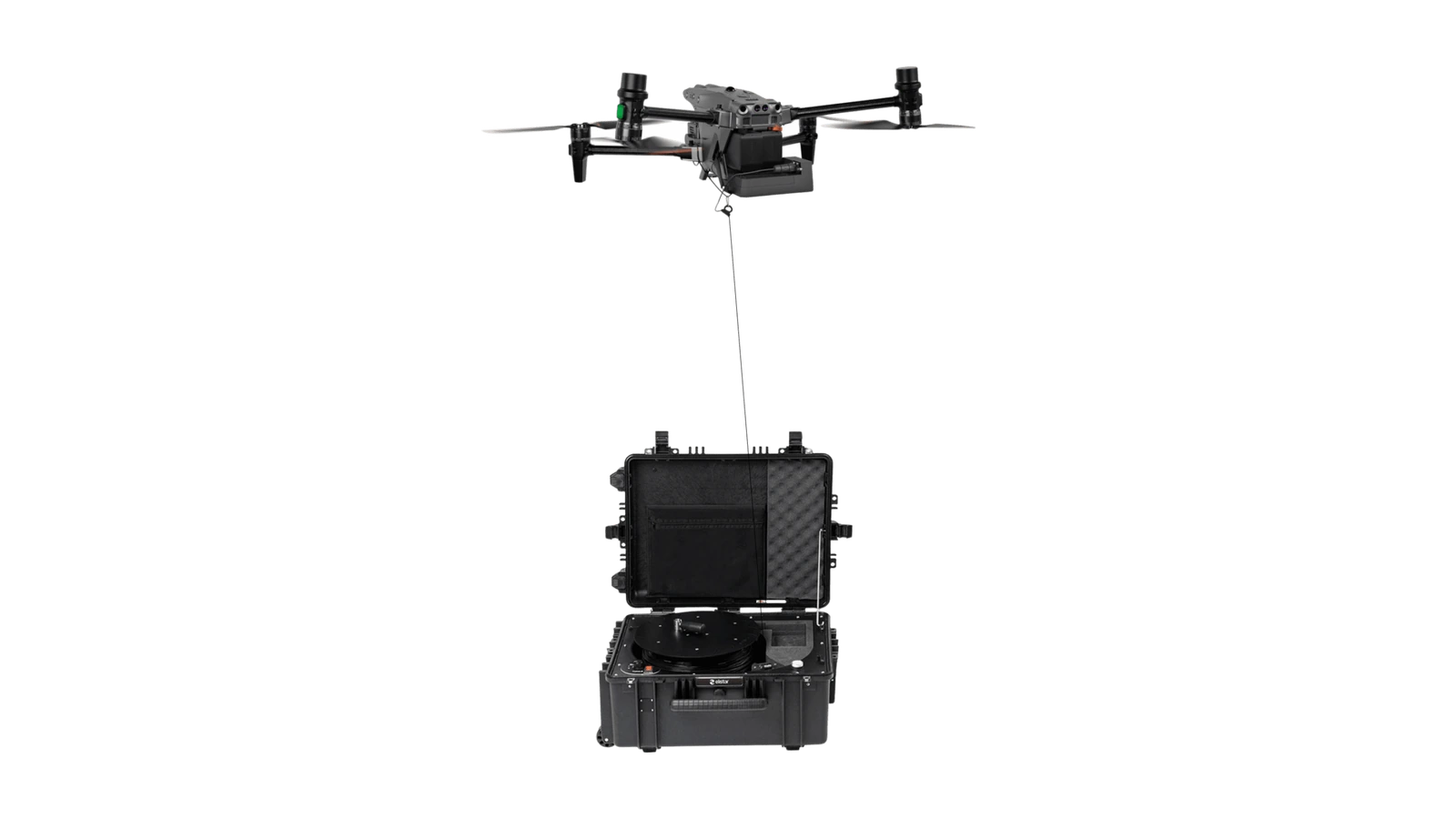
A tethered drone is an unmanned aerial vehicle (UAV) connected by a cable to a ground station or another base. The tether often supplies power from the ground and may also carry data. This allows the aircraft to stay near its base for extended observation, communications or lighting.
The complete unmanned aircraft system (UAS) includes the aircraft, tether, power supply, ground equipment and payload—the equipment carried for a task, such as a camera or light. The aircraft provides the elevated position; the rest of the system supplies the power, control and mission equipment needed to make that position useful.
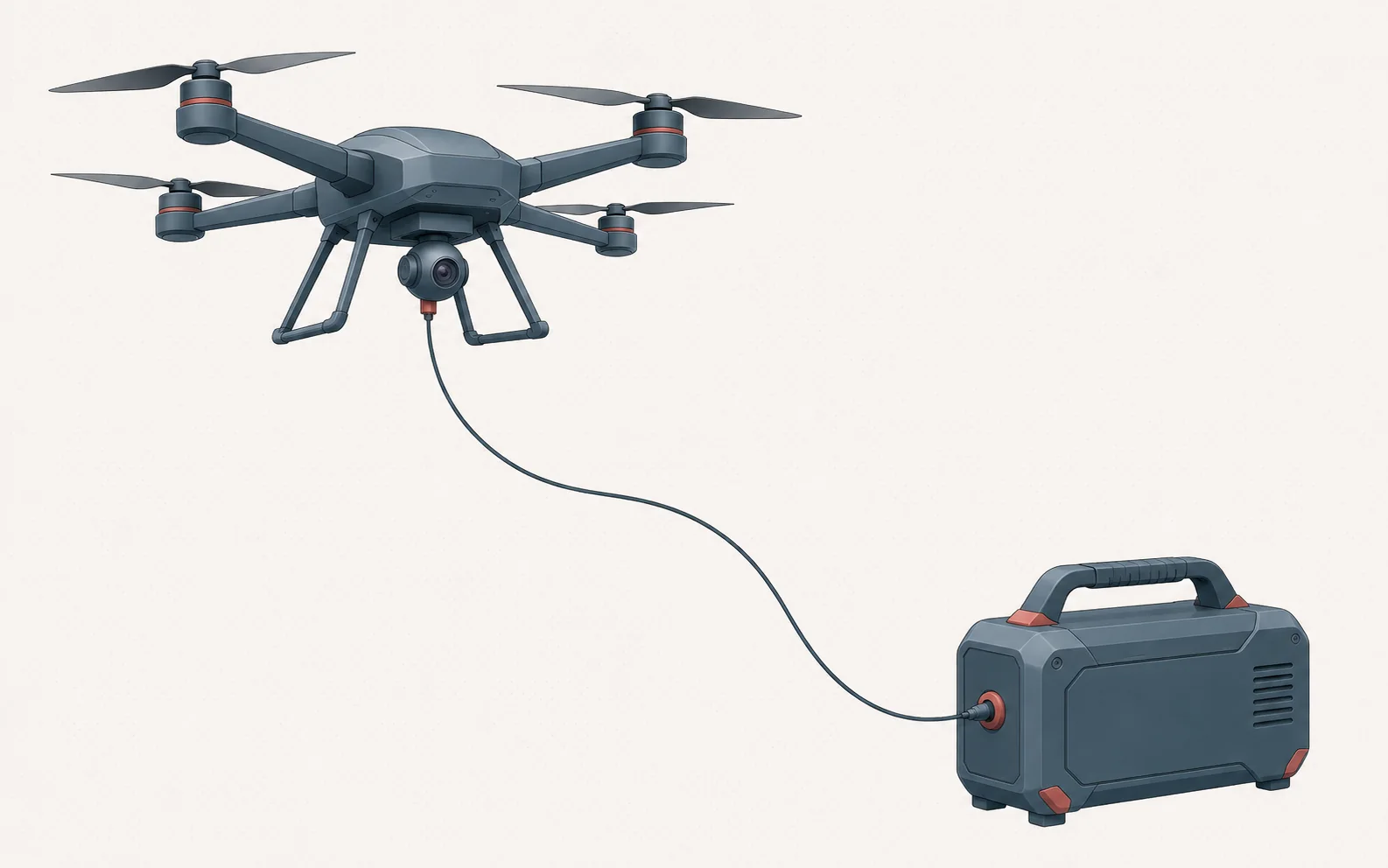
Aircraft, tether and ground station form one connected system.
The aircraft provides the elevated position and carries a mission payload such as a camera or light.
Types of Tethered Drones and System Configurations
Many tethered drones are multirotors, with several rotors keeping the aircraft aloft. How the equipment is packaged depends on the task and the organization using it:
- Complete systems bring the aircraft, tether and ground equipment together as a package.
- Compatible tethering systems can be added to certain existing aircraft, subject to the equipment and aircraft being designed to work together.
- Vehicle-integrated systems place equipment on or in a vehicle, allowing a crew to take it between sites. Portable ground stations provide another way to bring a system to a location.
Payloads can include a light, communications equipment or an electro-optical/infrared (EO/IR) camera that provides visible and thermal views. The tethering station, cable and available ground power influence how the complete system is deployed. Specifications need to be read together rather than treated as separate promises.
Read more: Cable length, operating height and power: reading tethered-drone specifications
Key Advantages of Tethered Drones
The main attraction is flight endurance: the ability to stay airborne for an extended period. With ground power, a crew can spend less time landing to replace or recharge batteries and more time watching the same area. That is useful when a situation develops slowly or a communications relay needs to remain in position.
Some tethers also carry data, providing a wired connection to equipment in the air. A steady aerial position can give a team a continuing view while people on the ground respond to changing conditions. The value is not only the time spent airborne; it is the continuity of the information, light or connectivity that the aircraft supports.
Main Limitations of Tethered Drones
The cable limits how far the aircraft can move from its base. It also has to be managed around people, vehicles, trees and other obstacles. A crew needs a suitable launch and recovery area, a dependable ground power source and a way to secure the site. Flight can still be interrupted by weather, maintenance or equipment limits.
The aircraft, cable and payload must work as a complete system. An elevated camera may be useful at a crowded incident, for example, but the crew still needs a safe position for the station and a route for the tether. Longer endurance does not remove these practical constraints.
How Do Tethered Drones Compare With Other Options?
A free-flying drone can travel away from its launch point, making it useful for a route inspection or a search across a wider area. Its flight endurance depends on its onboard energy supply. A tethered drone gives up some of that reach in exchange for a ground connection and a sustained position near one area. The two can work together: one holds an overview while the other inspects a particular location.
An automated drone dock supports repeated free-flight missions by providing a place to launch, land and recharge. The aircraft returns to the dock between flights; a powered tether supplies energy while the aircraft is in the air. A telescopic mast offers another way to raise a camera, light or antenna. It holds equipment on an extending structure rather than on an aircraft. Site access, required height and the need to move all affect which approach fits.
Read more: Tethered drone or portable mast for emergency communications?
Common Applications of Tethered Drones
Public safety teams may use an elevated camera for situational awareness: a view of how an incident is developing and where people or vehicles are moving. A light can help illuminate a work area, while a communications payload can support a temporary network. These tasks can be valuable when a team needs a continuing view or an elevated piece of equipment during a response.
Other uses include watching a construction site, an event or infrastructure. Cleaning work may use a tethered aircraft equipped for the task. The payload and site arrangements are different for each application: an observation mission needs useful imagery, whereas a communications mission depends on the network as well as the aircraft.
The Tethered Drone Industry and Its Key Participants
A tethered UAS brings together more than an aircraft manufacturer. Aircraft and tether suppliers provide the flying platform and its connection to the ground. Ground power specialists contribute the equipment that supplies electricity; camera, lighting and communications providers contribute the payloads. Software can help teams operate equipment and use the information it produces.
A system integrator connects components and helps tailor them to the customer’s task. Operators, maintenance teams and training providers turn the equipment into something that can be used at a real site. Public agencies, infrastructure owners, communications providers and service companies may buy the equipment or commission work. One organization can perform several of these roles.
The Global Tethered Drone Industry
Development and supply activity can be found in Europe, North America and Asia. Examples include civilian tethered-power development in France, a tethered-drone business in Florida, United States, and a firefighting system developed in Zhuzhou, China. The Chinese system was demonstrated during a 2025 emergency exercise in Shenzhen.
Supplier locations and places of use are different questions: equipment developed in one country may be operated somewhere else. Local projects reflect different needs. In Italy, a European Space Agency-supported team tested a connected rescue prototype. In Australia, a New South Wales demonstration tested temporary communications. In China, Hangzhou fire and rescue teams trained with tethered lighting drones for nighttime emergency support.
Commercial Adoption of Tethered Drones
Tethered drones have moved beyond demonstrations in some public-service tasks, while other uses are still being tested. A May 2025 North Carolina transportation department progress report said its tethered drones remained in operation for incident response, with additional use in work-zone traffic and flood monitoring.
A continuing task, a field demonstration and a prototype each tell a different story. An operator using equipment as part of its work has different needs from a team testing whether a new combination will function. For customers and suppliers alike, turning a trial into a repeatable service requires attention to training, maintenance, staffing, permissions and the cost of keeping equipment ready.
Read more: What a North Carolina road agency learned from a tethered-drone pilot
Tethered Drone Prices and Operating Costs
There is no single useful price for a tethered drone because the aircraft is only part of the purchase. To estimate the total cost of ownership, think of the budget in three groups:
- Equipment: the aircraft, tether station, power supply, payload and any necessary controls.
- Deployment: integration, site preparation, initial training and other work needed to put the system into use.
- Ongoing operation: staff, maintenance, connectivity, software, insurance, support and replacement parts, as applicable.
The costs depend on the configuration, location, support arrangements and amount of use. Comparing offers is easier when the equipment, service period and assumptions about operation are aligned. A lower aircraft price alone does not show what it will cost to perform the intended task.
Buying and Using Tethered Drones
An organization can buy a complete system, add compatible tethering equipment to an aircraft it already owns, or work with an integrator to bring the pieces together. It can also commission a specialist operator for the job. Buyers can ask whether rental or a trial is available for a particular project.
The practical choice depends on how often the system will be used and who will be responsible for operation, maintenance, training and permissions. An organization with recurring work may plan around its own equipment and staff; one with an occasional requirement may consider an external operator. Both approaches need a clear understanding of the site and the intended result.
Tethered Drone Laws and Regulations by Region
A tether does not automatically remove a drone from aviation rules. Requirements depend on the aircraft, the operator, the location and the mission. These examples show how approaches differ:
| Jurisdiction | General position |
|---|---|
| United States | Federal law provides a specific pathway for qualifying public-safety use of actively tethered systems, with conditions covering altitude, airspace and visual line of sight. It is not a general exemption for commercial flights. |
| European Union | EASA says EU drone rules generally apply to powered tethered aircraft heavier than 1 kg. Aircraft outside that framework still require a check of applicable national rules. |
| United Kingdom | Powered tethered aircraft over 1 kg follow the wider drone framework; those at or below 1 kg have separate national provisions. A tether may be considered a risk mitigation when applying for a specific-category authorization. |
| Mainland China | The national drone framework distinguishes aircraft categories, airspace and operations when setting requirements. Check with the relevant authorities how the rules apply to the planned system and mission. |
Privacy, radio spectrum and access to the site may also need attention. Operators should check the current requirements for their own location and planned flight.
The History and Future of Tethered Drones
The idea of supplying an aircraft from the ground addresses a familiar problem: an aircraft powered only by onboard energy must eventually land or refuel. Tethered systems brought that approach to aerial observation and communications. In 2015, an EU-funded project in France focused on a tethered power supply; in 2017, U.S. aviation authorities authorized a tethered aircraft to provide temporary communications in Puerto Rico after the hurricanes. That operation required an exemption. By 2025, the North Carolina report described continuing use for transport incidents. These are individual examples of the field’s development.
One direction to watch is how easily a tethered system can be set up and operated by a team already handling another job. Vehicle integration may make equipment easier to bring to a scene; better connections with cameras, communications networks and other aircraft may make the aerial view more useful. Progress will depend on the whole operation: the site, reliable power, trained people, applicable rules and whether the result is worth the ongoing cost.