
Closing that regional deficit demands dedicated uncrewed freighters built as core enterprise transport infrastructure rather than experimental aircraft. Modern aerial cargo platforms bridge these fragmented feeder corridors using weather-sealed, palletized fuselage bays, automated weight-and-balance locks that enforce strict center-of-gravity envelopes at warehouse depots, and certified Instrument Flight Rules and beyond visual line of sight (IFR/BVLOS) air-carrier links engineered for scheduled, all-weather dispatch.
What Is a Cargo Drone?
A cargo drone is an uncrewed aircraft engineered specifically for commercial, industrial, and humanitarian freight transport, defined by a dedicated payload bay, elevated gross takeoff weight, and extended range. Unlike aerial photography, mapping, or inspection platforms that carry lightweight sensors on external gimbals, freight unmanned aerial vehicles (UAVs) are structured around volumetric cargo capacity, rapid turnaround, and predictable ton-kilometer economics. Every subsystem—from fuselage cross-section to landing gear and flight-control redundancy—is sized to move physical goods reliably along scheduled routes.
Within the aerial logistics value chain, cargo drones occupy the middle-mile, hub-to-spoke, and regional feeder layer rather than doorstep consumer fulfillment. Dedicated freight UAVs connect regional sortation depots, coastal ports, offshore installations, island airstrips, and rural medical hubs with payloads spanning tens of kilograms to over a metric ton. By contrast, small last-mile parcel delivery drones target lightweight retail or food drop-offs into residential yards via winches or parachutes over short urban radii. Cargo aircraft also differ from multi-role heavy-lift utility drones, which prioritize raw vertical lifting thrust and underslung rigging for construction, forestry, or agriculture over enclosed, weather-protected, point-to-point transport.
Main Airframe Architectures for Aerial Freight
Selecting an uncrewed freighter requires balancing aerodynamic cruise efficiency against ground infrastructure constraints at origin and destination depots. Airframe architecture determines whether operations need runways or compact pads, while governing cruise speed, payload mass fraction, and energy cost per ton-kilometer.
Heavy Multirotor and Rotorcraft Cargo UAVs
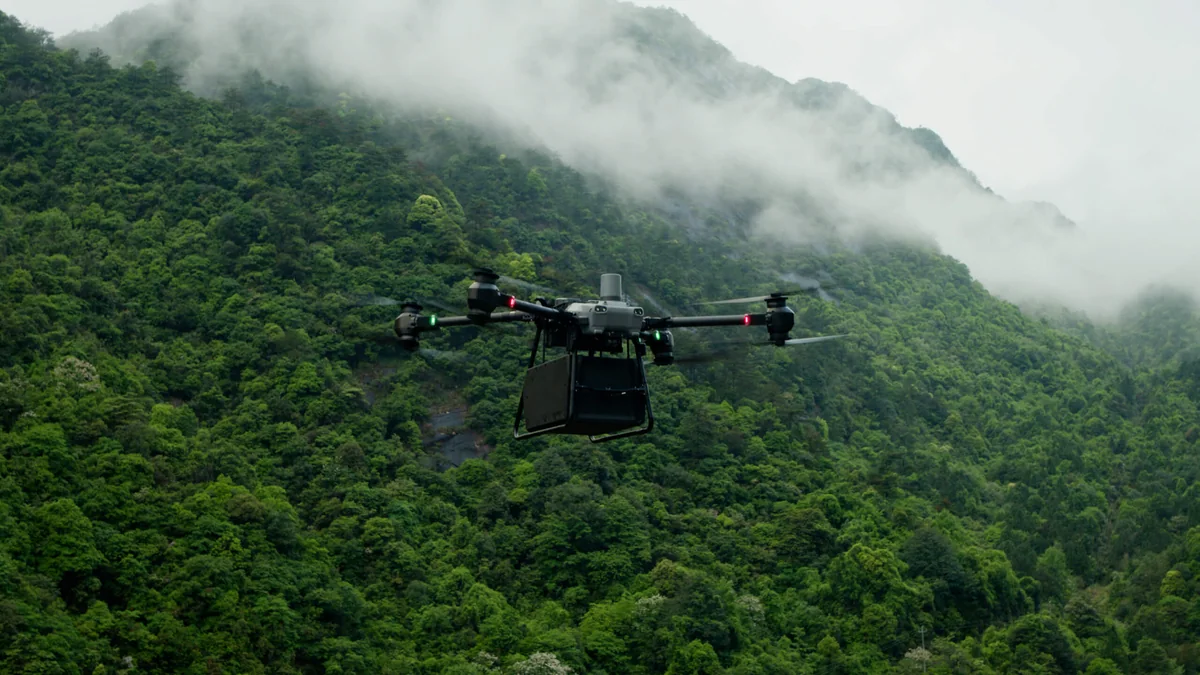
Heavy multirotor freighters and unmanned variable-pitch helicopters deliver runway-independent vertical takeoff and landing (VTOL) onto confined ship decks, offshore turbine platforms, mountain pads, and depot rooftops. Multirotors use distributed electric propulsion with minimal mechanical linkage for simplified field maintenance, whereas turbine- or piston-powered unmanned helicopters employ collective-pitch main rotors that yield higher hover efficiency, greater payload fractions, and longer endurance. Both classes excel on short-haul, high-frequency shuttles where zero runway access exists, though high hover power draw and parasitic drag limit multirotor range and raise per-kilometer operating costs on longer corridors.
Conventional Fixed-Wing Freighters (CTOL and STOL)
Conventional takeoff and landing (CTOL) and short takeoff and landing (STOL) fixed-wing freighters rely on wing-borne lift to achieve the lowest energy burn per ton-kilometer and largest payload-range envelopes in uncrewed aviation. Purpose-built STOL cargo UAVs use high-lift flaps and rugged landing gear to operate from short dirt strips or rural airfields, hauling hundreds of kilograms across hundreds of kilometers.
At the upper feeder tier, a prominent engineering pathway converts certified single-engine regional utility turboprops and twin-piston commuter airframes into optionally piloted or uncrewed freighters using autonomous flight-control actuators and redundant avionics. Compared with purpose-built heavy VTOL freighters, CTOL regional conversions inherit proven airframe structures, engine overhaul networks, and existing civil type-certification baselines. Their primary limitation is strict reliance on prepared airstrips or regional airports, confining them to airport-to-airport middle-mile legs rather than facility-yard landings.
Hybrid VTOL Cargo Aircraft
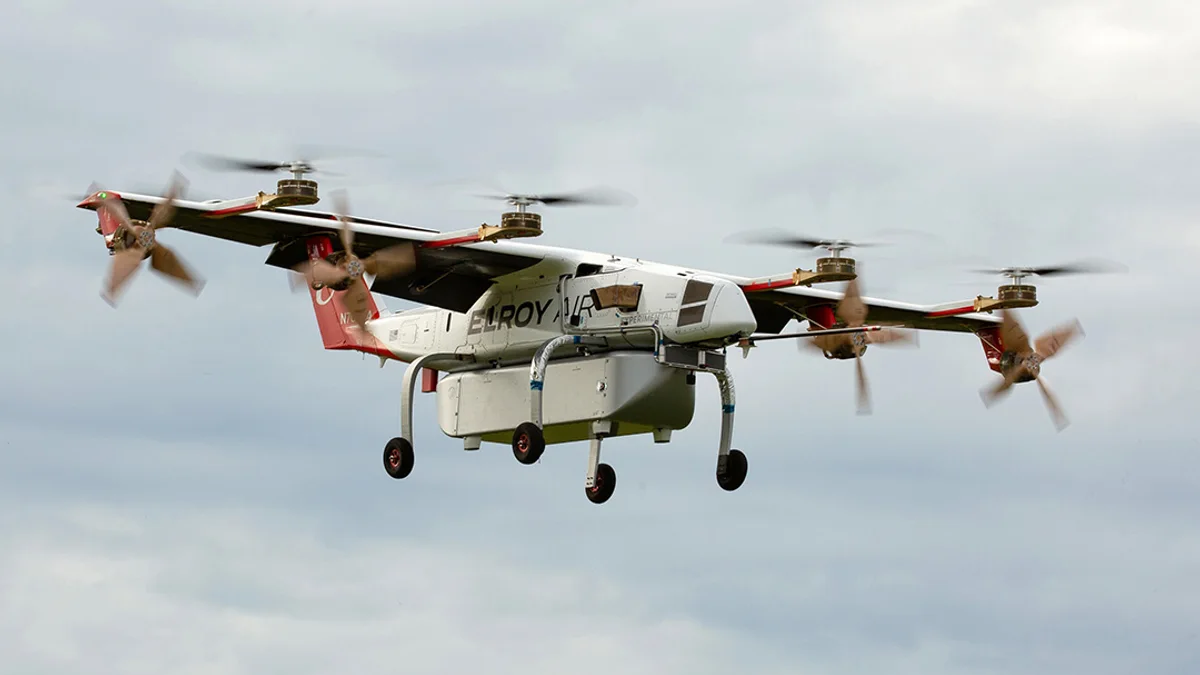
Hybrid VTOL cargo aircraft pair vertical lift rotors for pad-based launch and recovery with fixed wings and pusher or tilt-rotor propulsion for efficient horizontal cruise. This configuration lets operators bypass regional airports—launching from warehouse rooftops, fenced rural yards, or coastal piers—while crossing mountains, straits, and intercity corridors at fixed-wing speeds. Although dead-weight hover hardware or tilt mechanisms impose structural mass and drag penalties relative to pure CTOL designs, hybrid VTOL aircraft remain the most active commercial frontier for medium-weight regional freight.
| Airframe Class | Ground Infrastructure | Payload Band | Range Profile | Cargo Loading Method |
|---|---|---|---|---|
| Heavy Multirotor / Rotorcraft | Helipad, ship deck, cleared pad | Tens to low hundreds of kg | Short-haul regional | Belly pod, winch, external rack |
| Hybrid VTOL Freighter | Warehouse pad, fenced yard | Tens to several hundred kg | Medium regional / inter-island | Internal belly bay, swap-pod |
| STOL / CTOL Fixed-Wing | Dirt strip or regional airport | Hundreds of kg to 1+ metric ton | Long-range trunk / feeder | Nose clamshell, side door, pallets |
Freight-Specific Engineering: Cargo Bays, Weight and Balance, and Turnaround
Dedicated freight engineering distinguishes purpose-built aerial cargo platforms from repurposed industrial drones. Commercial viability depends on high aircraft utilization, requiring cargo interfaces that are aerodynamic, weather-sealed, rapid to cycle, and resistant to loading errors at non-aviation depots.
Internal Nose and Belly Cargo Bays, Drop Pods, and Standardized Containers
Enclosing freight inside streamlined internal fuselage bays—accessed through hinged nose clamshells, rear ramps, or wide belly hatches—significantly reduces parasitic drag compared with slung loads while shielding pharmaceuticals, electronics, and perishables from rain, salt spray, and sub-zero cruise air. Larger fixed-wing conversions and clean-sheet feeder freighters integrate floor roller tracks and tie-down grids compatible with standardized pallet bases or miniature unit load devices (ULDs) from ground sortation conveyors.
To compress ground turnaround to minutes, many medium VTOL and fixed-wing freighters employ quick-swap cargo pods. Warehouse staff pack, weigh, and seal composite containers indoors before aircraft arrival; handlers then unlatch the inbound pod, slide the pre-loaded outbound pod onto locking fuselage rails, and run automated pre-flight checks. External underslung racks remain practical only for oversized industrial hardware or rapid emergency drops where aerodynamic efficiency is secondary.
Center-of-Gravity Envelopes, Load Securing, and Dangerous Goods Containment
Weight-and-balance discipline is vital for fixed-wing and hybrid VTOL aircraft. Whereas multirotors can partially compensate for modest imbalance via differential motor thrust, an aerodynamic freighter loaded outside its certified center-of-gravity (CG) envelope risks longitudinal instability, insufficient rotation authority, or an unrecoverable post-takeoff stall. Because warehouse staff are not licensed aviation loadmasters, modern cargo drones embed foolproof safeguards: compartmentalized pre-balanced pods, landing-gear strain-gauge load cells that compute takeoff CG automatically, and flight-control lockouts that block launch whenever calculated moments breach safe limits.
Inside the bay, restraint nets, rigid bulkheads, and latching floor locks prevent load shifts during climbs, turbulence, or firm crosswind landings. Carrying regulated dangerous goods—including lithium-ion batteries, clinical specimens, or cryogenic reagents—further demands fire-resistant bay liners, thermal venting, continuous temperature telemetry, and compliant hazardous-materials containment.
Common Logistics and Freight Use Cases
Commercial cargo drone routes gain traction wherever surface infrastructure is fragmented, maritime crossings are slow, or supply-chain delays inflict severe hourly financial or human costs.
Middle-Mile Feeder Networks, Island Hopping, and Offshore Industrial Freight
Middle-mile shuttles thrive across archipelagos, fjords, and mountainous corridors where ferries and coastal roads stretch short straight-line distances into multi-hour journeys. Uncrewed freighters sustain daily scheduled exchanges of postal mail, cold-chain perishables, and light industrial components between mainland distribution hubs and island depots.
Equally compelling is the high-margin offshore and remote industrial spares market. When a critical valve, controller, or turbine component fails on an offshore wind installation, drilling rig, cargo vessel, or remote mine, unplanned downtime can cost tens of thousands of dollars per hour. In these downtime-critical and aircraft-on-ground scenarios, uncrewed freighters dispatch urgent parts directly from shore bases or support ships at a fraction of crewed helicopter charter costs and scheduling delays, generating commercial revenue even where standard parcel economics remain challenging.
Humanitarian Relief, Medical Trunk Supply, and Disaster Airlift
When earthquakes, typhoons, or floods sever bridges and roads, cargo drones establish rapid aerial lifelines into isolated communities. Large STOL and hybrid VTOL aircraft haul bulk potable water, trauma supplies, satellite terminals, and power equipment without exposing aircrews to unstable terrain or unverified landing sites. In routine healthcare networks, freight UAVs fly scheduled medical trunk routes moving blood products, pathology samples, vaccines, and specialty drugs between regional hospitals and rural district clinics.
Urban Hub-to-Hub Consolidation vs. Last-Mile Handoff
Inside metropolitan networks, cargo drones operate primarily as hub-to-hub consolidators rather than retail couriers. Medium-capacity freighters ferry consolidated totes from peri-urban sortation centers over congested ring roads to urban rooftop micro-hubs. From those staging nodes, electric cargo bikes, vans, or dedicated small last-mile parcel delivery drones complete individual residential handoffs—keeping heavy freighters on controlled depot-to-depot corridors with lower noise impact and higher payload utilization.
Key Operational Benefits and Commercialization Challenges
Assessing uncrewed air freight requires weighing structural logistics gains against demanding regulatory, weather, and unit-economics realities.
Core Benefits: Bypassing Terrain Bottlenecks, High-Frequency Small-Batch Economics, and Crewless Safety
Cargo drones reshape regional logistics by converting circuitous multi-modal road-and-ferry routes into direct point-to-point aerial corridors, compressing multi-hour transfers into tens of minutes. Right-sized payload capacities also enable high-frequency, small-batch dispatch: shippers no longer wait to consolidate full loads for crewed regional freighters or heavy trucks before moving urgent stock. Removing onboard pilots eliminates crew duty-time bottlenecks, lowers the cost of stationing flight crews at remote feeder stations, and prevents cockpit exposure during hazardous mountain approaches, maritime fog, or disaster airlifts.
Key Challenges: Type Certification, All-Weather Dispatch Reliability, BVLOS Airspace, and Per-Kilogram Economics
Scaling beyond trials requires overcoming four persistent hurdles. First, civil aviation regulators require medium and large freight UAVs operating over populated regions or shared airspace to secure formal Type Certificates alongside certified air-carrier operating approvals. Proving structural fatigue life, redundant flight-control computers, and deterministic failure handling takes years and heavy capital—explaining why several developers retrofit already-certificated regional turboprop airframes.
Second, logistics clients judge networks on all-weather dispatch reliability rather than fair-weather range. Unlike survey drones that wait for clear skies, a medical trunk line or industrial spares shuttle grounded three days weekly by crosswinds, rain, or airframe icing quickly loses contracts back to ferries and trucks. Adding certified de-icing, high-crosswind gear, and environmental sealing increases empty weight and cost.
Third, routine beyond visual line of sight (BVLOS) integration into Instrument Flight Rules (IFR) controlled airspace demands certified Communications, Navigation, and Surveillance (CNS) stacks. Resilient designs pair protected aviation C-band command-and-control (C2) links with satellite communications (SATCOM) and cellular redundancy, complemented by detect-and-avoid radars and transponders for traffic separation. Finally, across flat, well-paved highway networks, cargo drones cannot undercut the low per-kilogram rates of line-haul trucking; viable margins stay concentrated in time-critical, terrain-constrained, and high-value lanes.
Synonyms, Related Terms, and Supply-Chain Distinctions
Industry publications frequently refer to cargo drones as freight drones, unmanned cargo aircraft, uncrewed aerial freighters, or logistics UAVs. While these labels are largely interchangeable for middle-mile transport platforms, clear terminology helps separate adjacent segments of aerial logistics.
The term delivery drone—or delivery UAV—is often conflated with cargo aircraft in general coverage, yet operationally it designates the smaller downstream category engineered for last-mile parcel drop-offs rather than containerized middle-mile freight. Equally, cargo drones denote dedicated transport hardware procured or leased by aviation operators, setting them apart both from general-purpose heavy-lift utility drones built for slung industrial work and from turnkey drone delivery services, where third-party operators supply aircraft, regulatory certificates, and flight operations on a per-shipment or per-sortie contract basis.